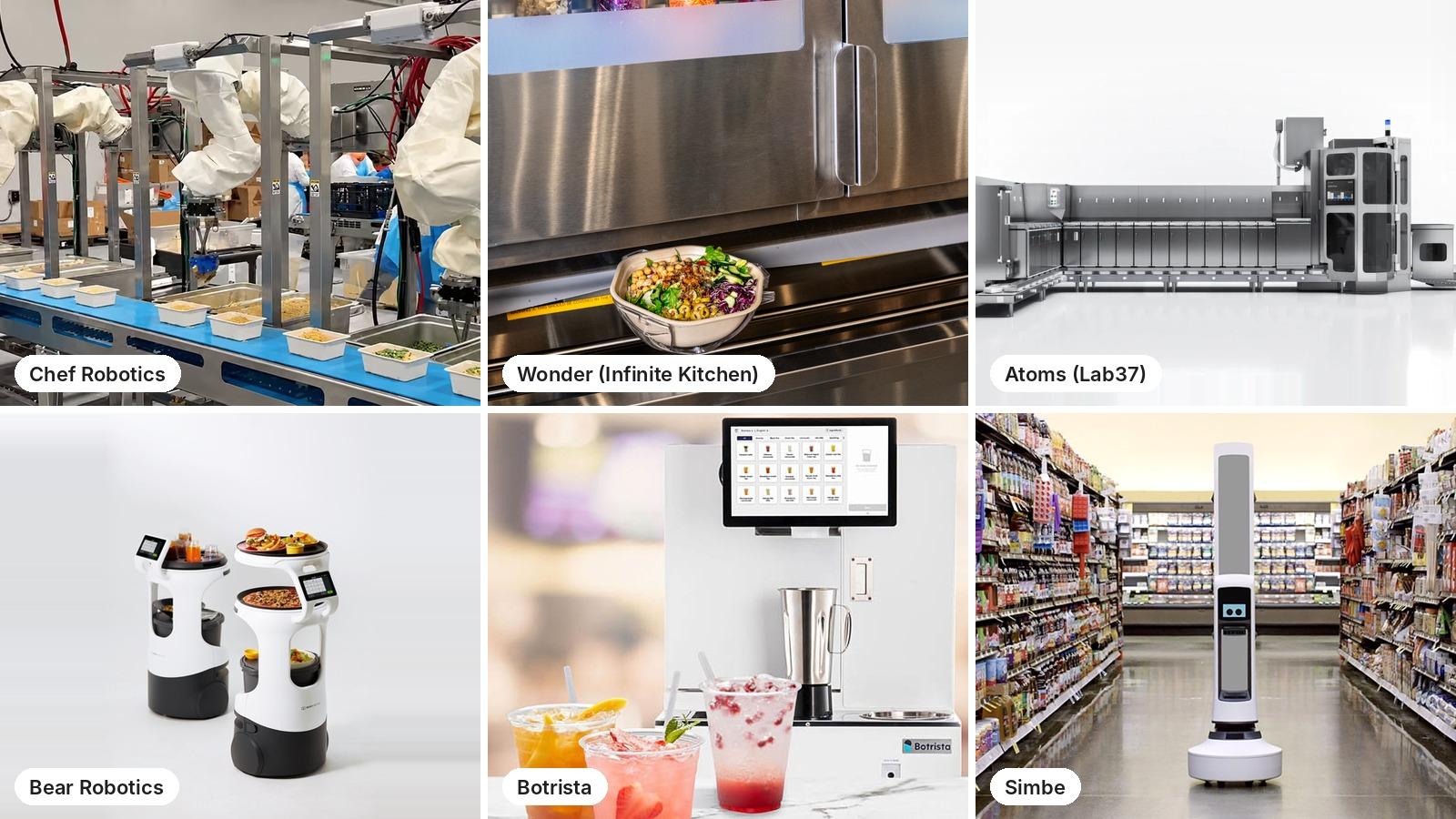
There are a range of robots working in the food and retail industries today. | Source: Chef Robotics
A few years ago, a robot making lunch was enough to make headlines. We quickly learned a robot can definitely make lunch. But the question remained: could it make a business work?
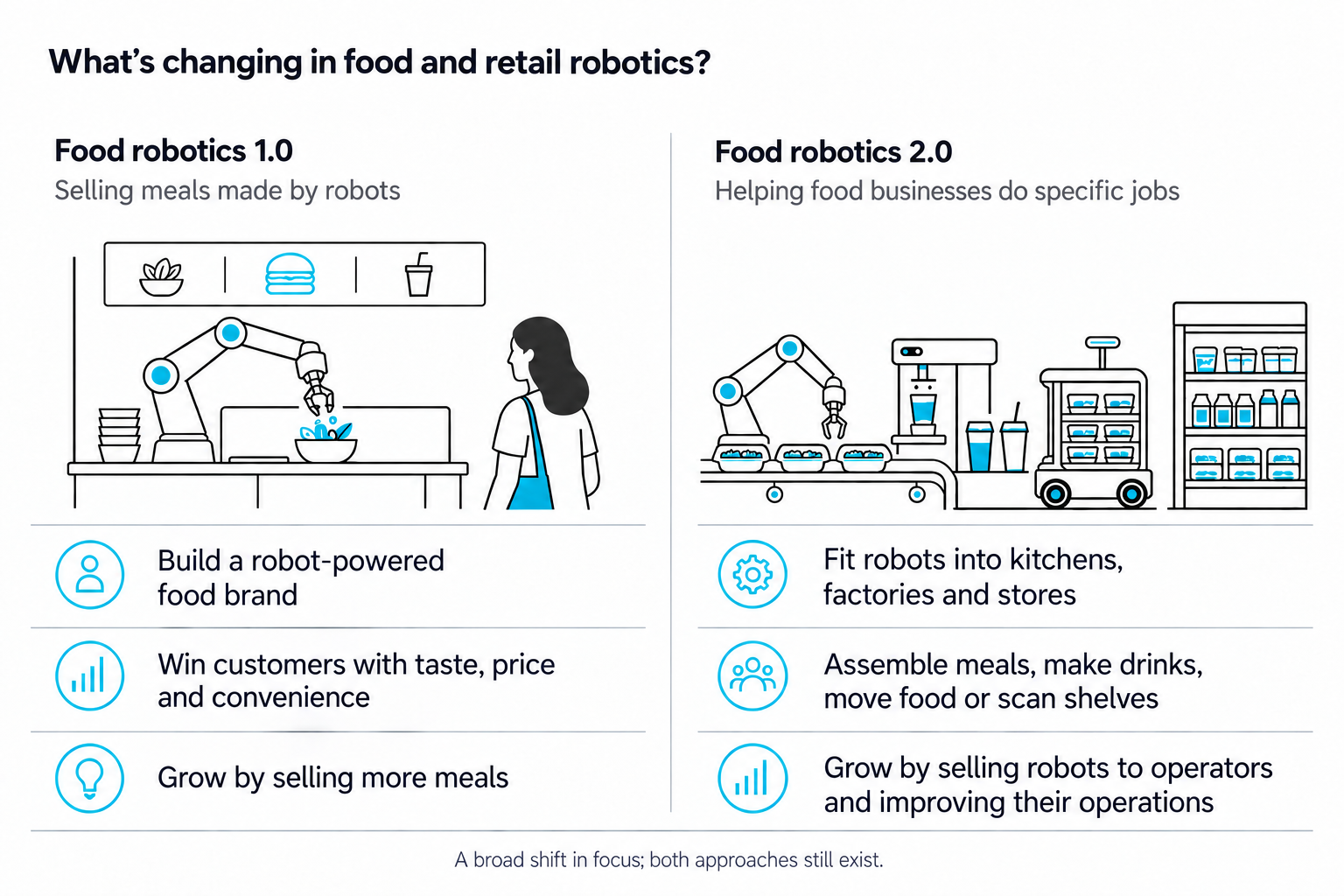
That question followed the first wave of food robotics. In food robotics 1.0, several companies set out to sell meals made by robots directly to customers. This meant they were directly in the food business, selling burgers, sandwiches, and pizzas. They had to develop the technology while giving people a reason to keep ordering: good food, the right price, and convenience. Many struggled to make those pieces work together. It was a tall order to run a restaurant business (with all the difficulties of brand and culinary) and run a robotics business. These early setbacks left the industry with a question hanging over it: could food robotics ever live up to its promise?
The existing challenges in the food industry that required automation never went away. Manufacturers still had meals to assemble, and restaurant teams still had orders to fill with hard-to-staff shifts.
That’s where Food Robotics 2.0 is taking shape around those everyday needs. It’s driving new generations of robots that are helping teams prepare meals, make drinks, move food through dining rooms, and monitor grocery shelves, while improving productivity, reducing operating costs, and delivering a measurable return on investment. The focus is on B2B (selling robots to food companies that are already great at brand and culinary) vs. B2C (selling food directly to consumers). The value comes from doing that work consistently and at a cost that makes sense. This is what makes the food robotics renaissance tangible.
Companies like Chef Robotics, Wonder, ATOMS, Botrista, Bear Robotics, and Simbe are shaping this new wave across manufacturing lines, restaurant kitchens, beverage counters, dining rooms, and grocery stores.
The food and retail robotics industry is having a Renaissance. The once-eschewed category now sees some high-profile founders focusing on it:
- ATOMS, led by Uber co-founder Travis Kalanick, raised $1.7 billion, led by Andreessen Horowitz (a16z)
- Wonder, founded by Marc Lore, has raised $3 billion. Lore previously co-founded Jet.com (sold to Walmart for $3.3 billion) and Quidsi (sold to Amazon for $545 million).
This piece looks at where these robots are deployed today, the work they’re doing, and what it takes to scale from individual installations to large-scale deployments.
Source: Chef Robotics
The companies bringing food robots into daily operations
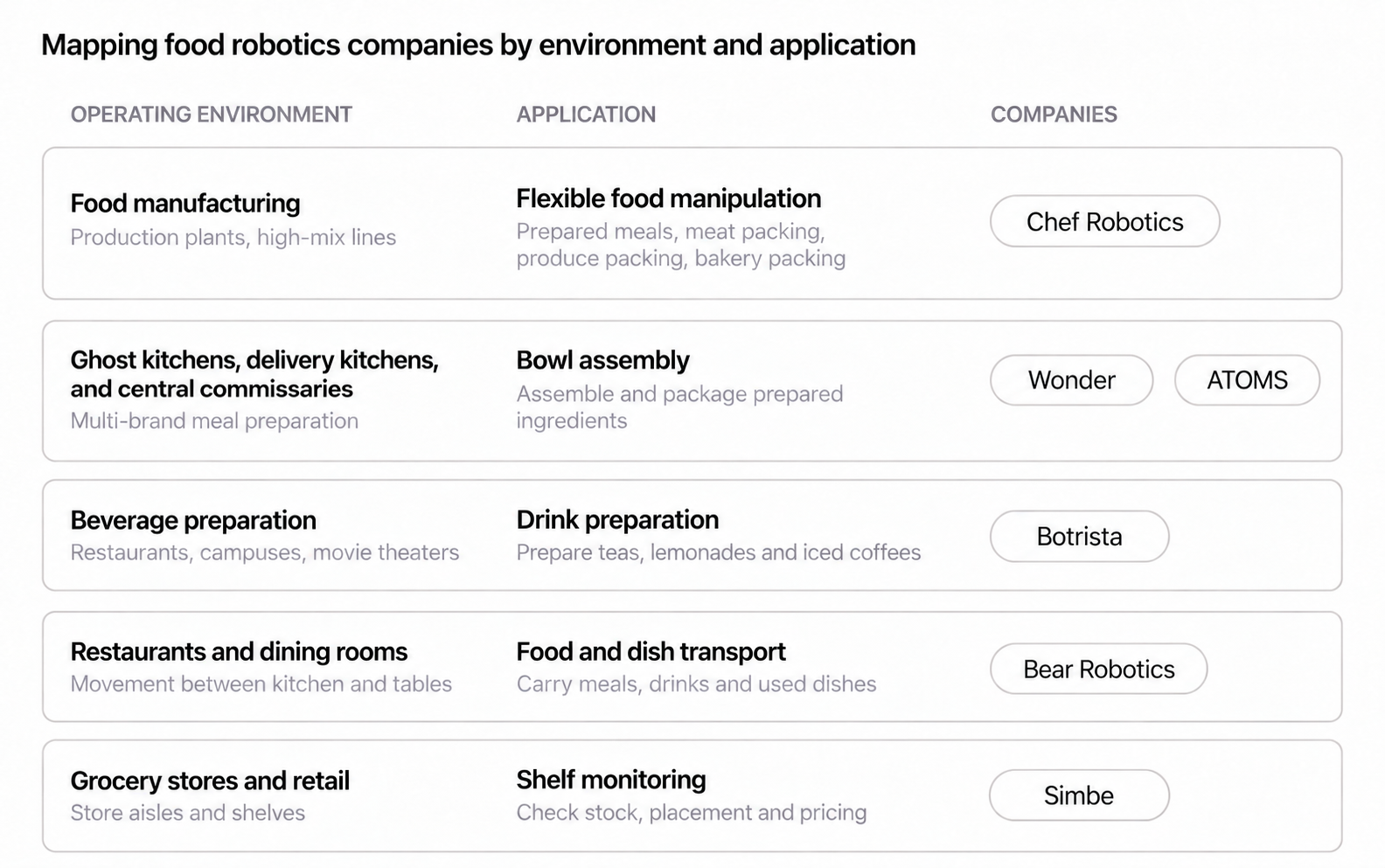
To understand the food robotics market, it’s useful to look at where different food robotics companies operate and what problems they solve. Each environment requires different levels of speed, footprint, and flexibility.
Let’s take a look at what’s unique about each operating environment:
Source: Chef Robotics
Meal assembly in food manufacturing
Rice clumps, sauces drip, and no two pieces of chicken look quite the same. Now imagine in a food manufacturing unit, portioning those ingredients into thousands of trays, with recipes, trays, and portions changing throughout the day.
That is everyday work on a high-mix meal assembly line. Workers repeatedly scoop, pick, and place ingredients, and staffing this work is a persistent challenge, with annual labor turnover regularly exceeding 150%. Fixed automation, such as depositors, works well for consistent ingredients at high volumes. Handling thousands of SKUs and frequent changeovers between production runs calls for more flexibility.
Chef Robotics builds robots that handle this variability on existing assembly lines. The focus is domain generality within food manipulation: adapting across ingredients and meal configurations while maintaining throughput, quality, and reliability. Chef robots are deployed at scale across North America and Europe and have completed more than 145 million servings in production.
Ghost kitchens, delivery kitchens, and central commissaries
Bowl assembly connects several steps: dispensing ingredients, accommodating modifications, and preparing orders for handoff. Wonder and Atoms are incorporating this workflow into broader food businesses.
Wonder operates food halls that bring multiple restaurant brands together for delivery, pickup, and dine-in. In December 2025, Wonder acquired Spyce, the Sweetgreen business unit responsible for developing the Infinite Kitchen technology.
Atoms brings together kitchen infrastructure for CloudKitchens, Otter’s restaurant software, and Lab37’s robotics. Lab37’s bowl builder dispenses, assembles, and packages bowls after employees prepare and load ingredients. Atoms has tested it with its own restaurant brands, such as The Hungry Cowgirl.
Beverage preparation
Adding iced coffees, flavored teas, and lemonades to a restaurant’s drinks menu gives customers more choice. It also gives staff more recipes to prepare while food orders are coming in.
Botrista built BotristaPro, a compact system that prepares drinks such as teas, lemonades, and iced coffees at the press of a button. Its compact footprint lets restaurants, movie theaters, and colleges add a premium drink menu without staff having to prepare each recipe manually. Botrista supplies the ingredients, trains employees to operate the system, and provides technical support and help updating drink menus. Botrista serves operators across 42 states in the US.
Jollibee uses the technology for its signature sips menu, while Texas A&M University has introduced automated beverage stations across campus dining locations. Botrista reports more than 6,000 locations signed across 42 U.S. states.
Restaurants and dining rooms
Once a meal is ready, it still needs to reach the table. During a busy shift, those trips between the kitchen and the dining room take up a considerable amount of servers’ time.
Bear Robotics built Servi, a robot that carries food and drinks through dining rooms and transports used dishes back to the washing area, navigating around people and obstacles. The staff loads and unloads the robot while it handles the repeated trips. Bear Robotics has deployed Servi at Denny’s locations and other restaurants. Across its broader portfolio, the company’s robots now operate at more than 5,000 sites in 20-plus countries.
The company has also attracted major industry backing. SoftBank led its $32 million funding round in 2020, and LG acquired a 51% stake in 2025 at a valuation of approximately $600 million. SoftBank Robotics also co-developed the newer Servi Q, launched in Japan in September 2026.
Grocery stores and retail
Keeping grocery shelves stocked requires knowing what’s missing, misplaced, or incorrectly priced. Finding those gaps across thousands of products takes regular attention from store teams.
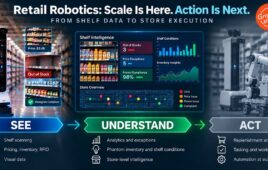
To solve that, Simbe built Tally, a robot that moves through store aisles and scans shelves for missing products, misplaced items, and pricing errors. It alerts employees so they can restock or correct the issue. Grocery operators, including SpartanNash, have deployed Simbe robots across their stores, helping teams identify what needs attention without checking every shelf manually.
Simbe has raised more than $100 million, including $50 million Series C led by Growth Equity at Goldman Sachs.
What changes when one robot becomes a fleet
Source: Chef Robotics
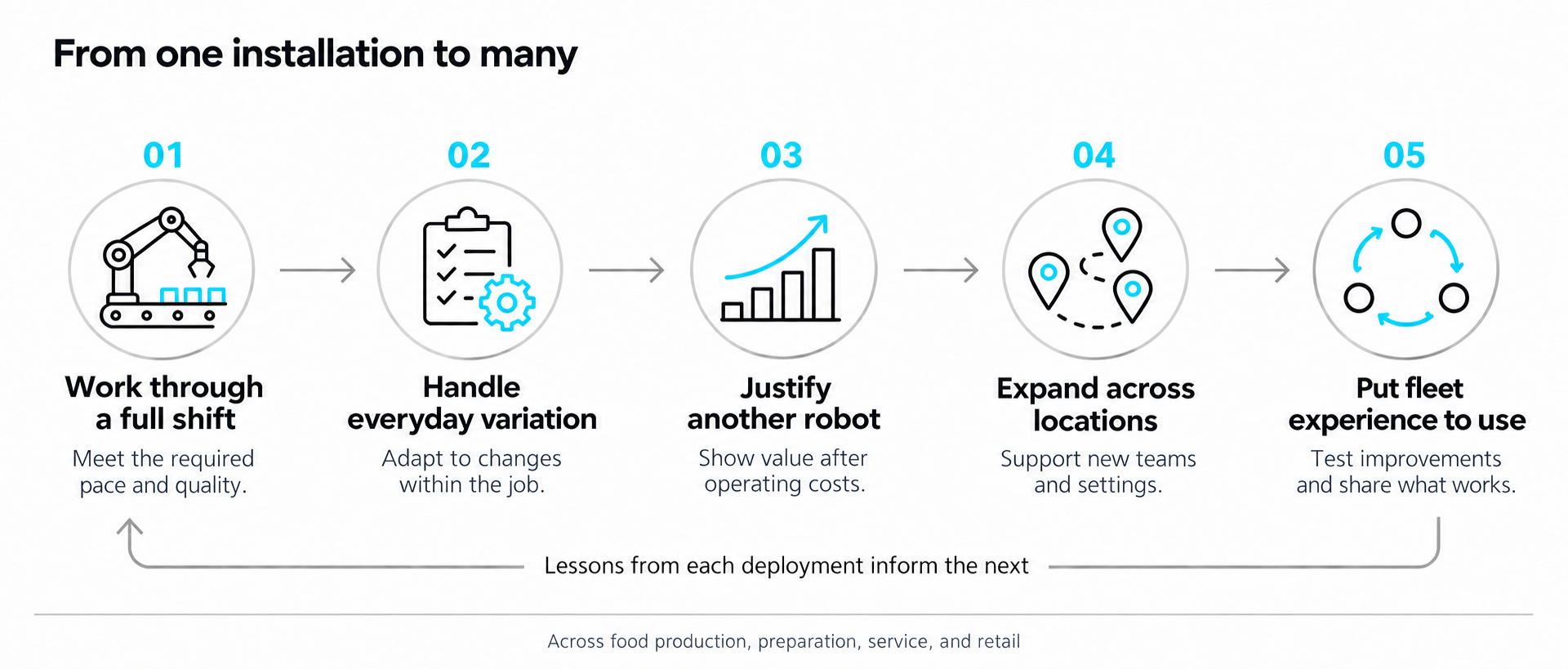
First, make the robot fleet work through a full shift. A pilot shows what a robot can do. Running it every day shows whether it can keep up when orders pile up, or a production line runs at full speed. It doesn’t have to be faster than a person to be worth the investment: matching their pace while improving portion consistency, reducing waste, or requiring less labor can still make the numbers work. What matters is the total cost of delivering the output and quality the operation needs.
Then, handle the changes that come with the job. Flexibility comes in two forms. A kitchen robot that moves between cooking, assembling meals, and washing dishes requires task generality. On the other hand, on a high-mix meal assembly line, the robot’s job remains assembly, but the work still varies: different SKUs require the same robot to handle different ingredients, portions, trays, and placement. Handling that variation within a domain requires domain generality. In either setting, operators need flexibility with the speed, quality, and reliability the operation requires.
Next, make another robot worth the investment. Once the first robot is working, the operator must decide whether adding another makes financial sense, given installation, training, cleaning, maintenance, and support costs. For example, Botrista began with a per-cup model, and Chef deploys robots through a robotics-as-a-service (RaaS) model. Recurring service models in robotics can reduce upfront investment and bundle maintenance and support. But whatever the pricing model, each additional robot needs to deliver enough value to justify its cost.
Then, carry those results into another location. The next restaurant, factory, or store will have a different layout and team. Staff need to operate and clean the equipment without an engineer beside them, and know where to turn when something goes wrong. Remote monitoring, responsive support, and clear procedures help make that possible across a growing fleet.
As the fleet grows, put its experience to use. One restaurant location might reveal an ingredient that behaves differently; another store might expose a navigation problem in a crowded aisle. Running more robots gives engineering teams more examples to learn from, but improvement takes work: reviewing what happened, making changes, and testing them. When those changes are shared across the fleet, the next installation benefits from what earlier ones taught the team.
 Submit your innovation now!
Where the food robotics market is headed
When early food robotics businesses struggled, investors lost money. Those setbacks in food robotics 1.0 created skepticism about the category as a whole.
But let’s step back and ask: where do people spend their money? Housing, transportation, food, and healthcare are recurring needs that households build their budgets around. People buy groceries, order lunch, and pick up dinner every day. In the U.S. alone, food spending reached $2.51 trillion in 2025, according to the USDA. Behind those purchases are manufacturers assembling meals, restaurants preparing orders, and stores keeping shelves stocked.
The setback during food robotics 1.0 didn’t change the size of the market or make staffing those operations any easier. For a business repeating a task thousands of times a day, improving even one step can make a meaningful difference to costs and output.
That is why Travis Kalanick and Marc Lore committing capital and experience to food robotics matters. These are founders who have built businesses around how people travel and shop. Through ATOMS and Wonder, they are now pursuing another enormous, recurring need: how people get their food. Their investment signals confidence that there is a substantial business to build here.
Food robotics 2.0 is taking shape around that opportunity. Robots that make daily operations more productive and economical give businesses a reason to adopt them and keep expanding their use. That is the case for a food robotics renaissance, and why the category is getting another serious look.
About the Author
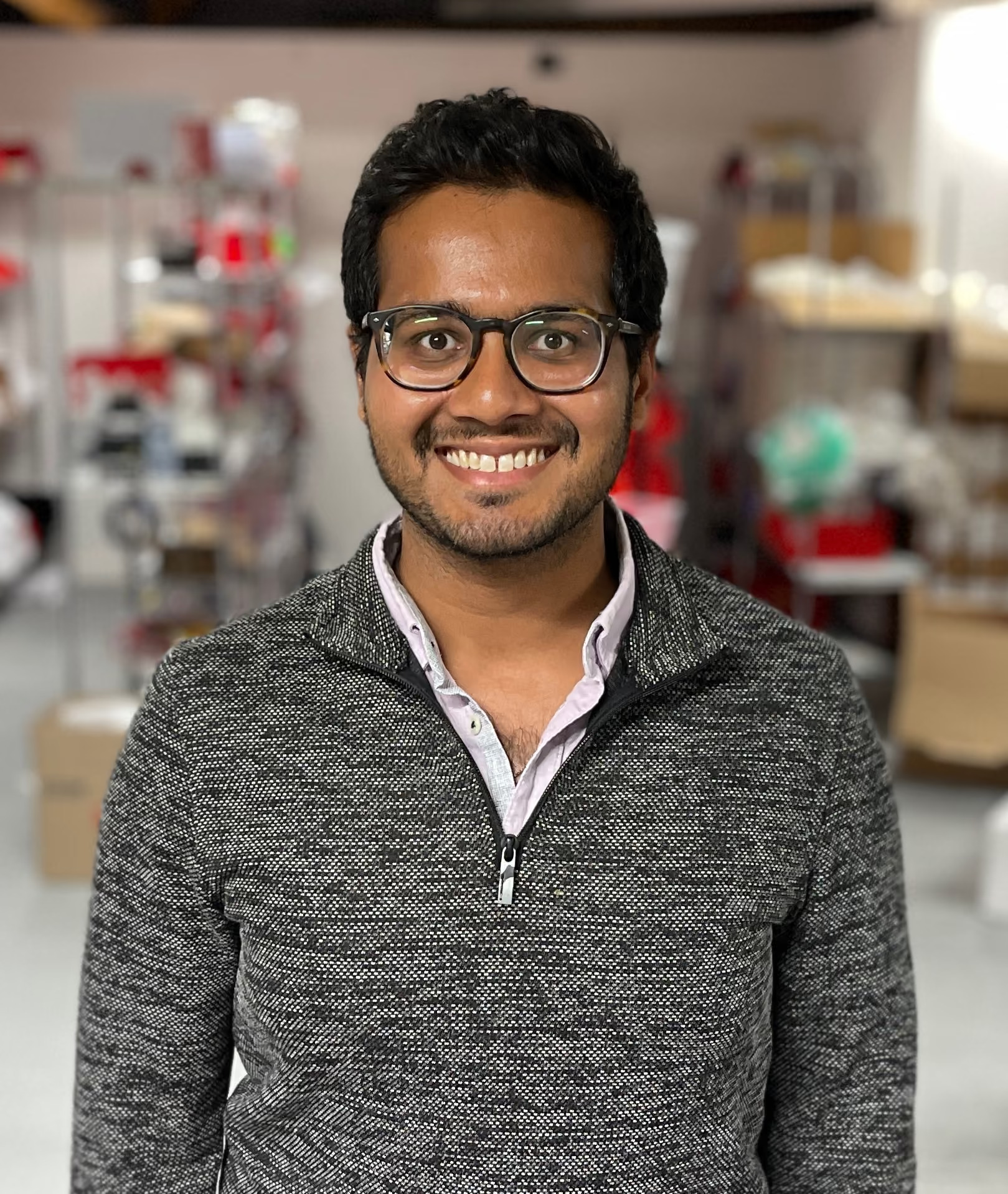 Rajat Bhageria is the founder and CEO of Chef Robotics. Prior to Chef, Rajat was founder and managing partner at Prototype Capital, a pre-seed venture capital fund investing in founders who apply new technology to old industries. Before that, Rajat was the founder and CEO of ThirdEye, where he led a team to build a product that empowers the visually impaired by recognizing what’s in front of them; ThirdEye was ultimately sold. Rajat has written a book about education reform, published a scientific paper in electrical engineering, and written for Forbes about entrepreneurship. He has a Master’s degree in Robotics and Machine Learning from the University of Pennsylvania and a Bachelor’s in Economics from The Wharton School at the University of Pennsylvania.
Tell Us What You Think!