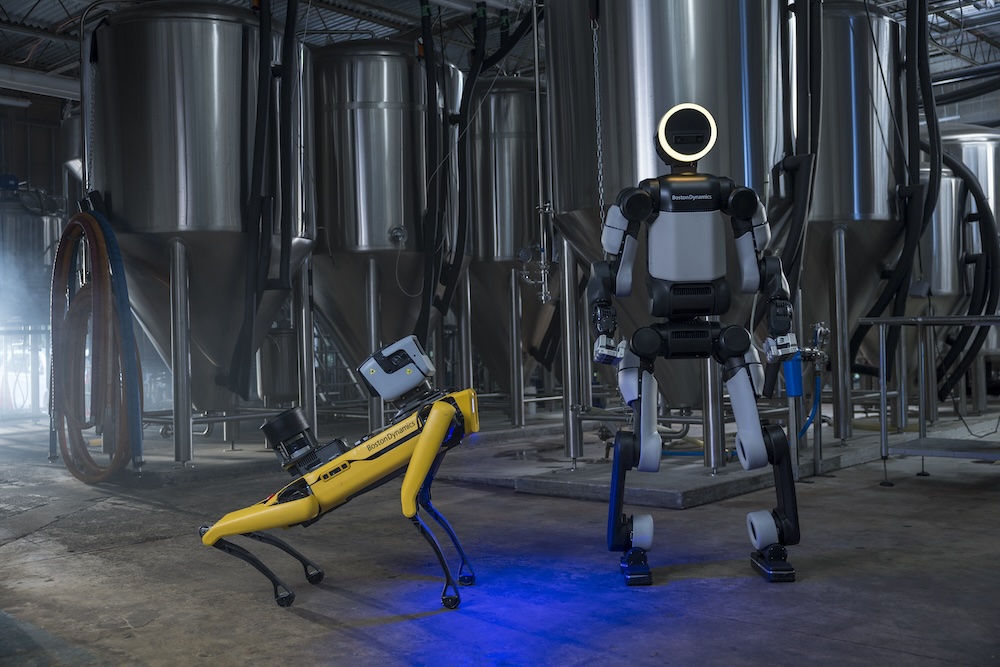
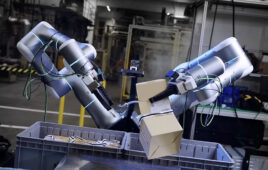
GlobalFoundries will test Boston Dynamics’ Atlas humanoid (right) in semiconductor manufacturing tasks in 2027. | Credit: Boston Dynamics
GlobalFoundries, a leading semiconductor manufacturer, will become the first customer outside of the automotive industry to test Boston Dynamics’ Atlas humanoid. Atlas testing will begin in early 2027, marking a key step in Boston Dynamics’ efforts to commercialize its humanoid.
GlobalFoundries is already a customer of Boston Dynamics, having deployed its Spot quadruped for industrial inspections for several years. The companies are expanding that relationship to include additional Spot deployments across GlobalFoundries’ global manufacturing network. Since April 2026, two Spot robots at its Singapore facility have collectively traveled nearly 900 km (559 mi.) and completed more than 90,000 inspections in sub-fab areas, achieving a 99% mission success rate, according to the companies.
Boston Dynamics and GlobalFoundries will identify potential humanoid applications in semiconductor manufacturing, assess integration requirements and customer readiness, and begin training Atlas to perform specific tasks. The companies did not disclose how many Atlas robots will be involved, which facilities will host the humanoids, or what initial tasks they will perform.
The Robot Report has reached out to Boston Dynamics for additional information. This story will be updated if we learn new information.
The agreement gives Boston Dynamics an opportunity to validate Atlas in a manufacturing environment outside of that of its parent company, Hyundai Motor Group. While automotive manufacturing has emerged as an early proving ground for humanoids, semiconductor manufacturing could present a different set of technical and operational requirements.
“Spot has helped us shift from reactive to predictive maintenance, collecting data across thousands of inspection points to prevent downtime and keep our fabs running more efficiently,” said Pradip Singh, chief manufacturing officer at GlobalFoundries. “Scaling Spot and testing Atlas are the next steps in our journey to AI-enabled manufacturing, putting physical AI to work across our operations worldwide.”
Boston Dynamics expands Atlas beyond Hyundai
When Boston Dynamics unveiled the product version of its electric Atlas humanoid at CES 2026, it said its initial production run for the year was fully committed. The humanoids were earmarked for Hyundai and Google DeepMind, the latter of which is working with Boston Dynamics to integrate its Gemini Robotics foundation models into Atlas.
Boston Dynamics said at the time it planned to begin working with additional customers in early 2027. GlobalFoundries represents the first publicly announced manufacturing customer outside of Hyundai Motor Group.
In September, Boston Dynamics opened its Robotics Metaplant Application Center (RMAC) at Hyundai Motor Group Metaplant America near Savannah, Ga. The facility serves as a training and testing ground for Atlas ahead of its integration into Hyundai’s automotive manufacturing operations.
Atlas is initially being trained to perform parts sequencing and material handling tasks, with Hyundai targeting component assembly applications by 2030. Boston Dynamics plans to move the RMAC into a facility approximately 10 times its current size in 2027.
Hyundai has outlined plans to deploy 25,000 Atlas humanoids across Hyundai Motor and Kia manufacturing facilities over the next several years. It also plans to establish a U.S. factory capable of producing 30,000 robots annually.
Boston Dynamics has ambitions for Atlas well beyond automotive manufacturing. In September, the company said it was in discussions with existing Spot and Stretch customers across several industries, including aerospace, semiconductors, logistics, food and beverage, and life sciences.
Boston Dynamics’ installed base of mobile robots could provide it with an advantage over humanoid developers that are still establishing relationships with industrial customers. Those existing relationships give Boston Dynamics access to facilities, operational data, and customers that already have experience integrating autonomous robots into their workflows.
Atlas continues to evolve
Despite entering early production, Atlas continues to undergo hardware and software development. Boston Dynamics unveiled in October a redesigned hand for Atlas featuring four fingers and 13 degrees of freedom (DoF), up from seven DoF in its previous three-fingered design.
Boston Dynamics designed the new hand with directly actuated joints and with simulation-based reinforcement learning in mind. The redesign is intended to improve the robot’s dexterity while balancing the reliability and manufacturability requirements of an industrial robot.
Boston Dynamics also demonstrated an experimental version of Atlas equipped with wheels in place of its feet. Rather than signaling the development of a new commercial product, the experiment served as a testbed for whole-body control and demonstrated the ability of reinforcement learning-based control policies to adapt to changes in the robot’s hardware.
The GlobalFoundries announcement comes just over a month after Boston Dynamics appointed former Amazon executive Rohit Prasad as CEO. Prasad previously served as senior vice president and head scientist for Alexa and artificial general intelligence at Amazon, where he helped build Alexa and led the development of the Amazon Nova family of foundation models. His appointment comes as Boston Dynamics looks to accelerate the integration of AI into its robots.

Tell Us What You Think!