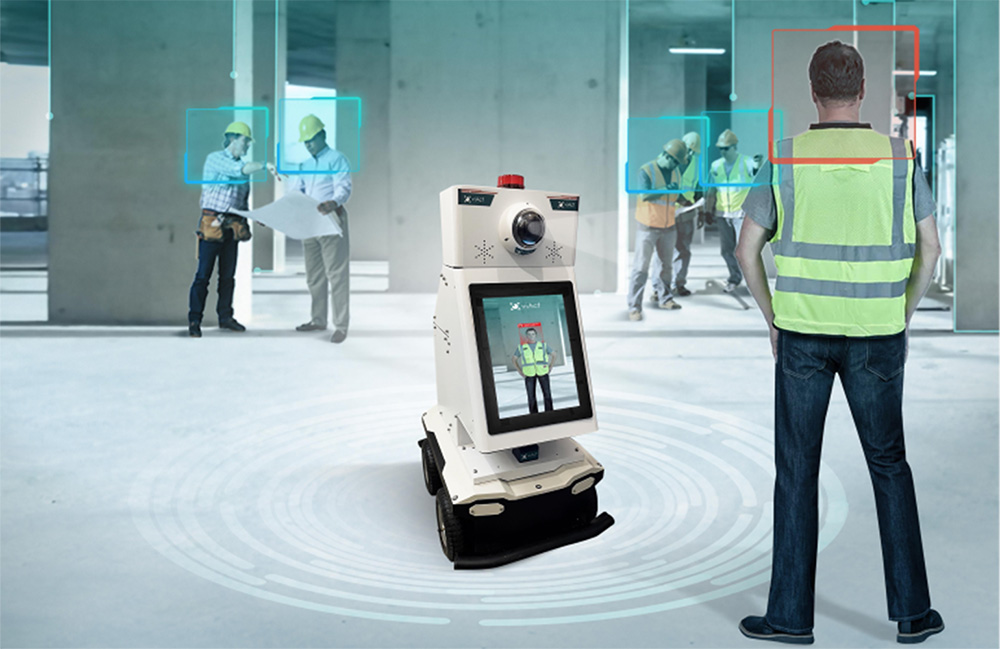
ViAct offers viBOT, an autonomous robotic monitor for construction. | Source: viAct
Construction is entering a new era of automation. Autonomous earthmoving equipment is beginning to reshape excavation. Robotic layout systems are improving precision. Drones are inspecting hard-to-reach structures. Across the board, vision AI-powered machines are steadily moving from controlled pilots to active job sites.
The global construction robotics market is estimated to reach $3.66 billion by 2030, according to Grand View Research.
Yet the success of construction robots won’t ultimately be determined by how capable the machines become. It will depend on something far less visible: how safely frontline workers and autonomous systems can work together.
Let’s picture a mid-rise construction project. An autonomous compactor is completing its programmed route across the site while an inspection drone carries out its routine progress survey overhead. Everything is functioning exactly as designed.
Then a worker steps into the compactor’s operating zone to retrieve a dropped tool. Nothing has malfunctioned. The machine continues following its assigned task exactly as it was programmed to do.
The challenge is that the job site has changed in a matter of seconds, and safe operations now depend on recognising that change before it becomes an incident.
That layer of safety is brought by vision AI, and it’s the quiet prerequisite the industry is currently excited about.
The transition zone, not full automation, is where construction risk concentrates
OSHA’s “Fatal Four,” falls, struck-by, electrocution, and caught-in/between hazards, account for roughly 58% to 59% of U.S. construction deaths in recent years. Struck-by incidents alone kill over 100 workers annually, with large majority of these incidents involving vehicles or moving equipment.
An autonomous rover doesn’t get tired or impatient the way a skid steer operator might late in a shift. But it also has no intuition for the fact that a worker just stepped behind a stack of rebar, or that a subcontractor’s crew wandered into a zone its path planner assumed was clear five minutes ago.
This is what robotics teams need to sit with before deployment, not after. The hard case is where excavation crews, electricians, and an autonomous compactor share the same 20 acres on a site that was never built with structured sensing in mind.
This growing challenge is reflected in evolving safety standards like the ANSI/RIA R15.08. This was developed to address autonomous mobile robots operating in dynamic environments, moving beyond earlier AGV standards that assumed fixed guide paths.
Every robot sees locally. Vision AI sees the whole job site
Every autonomous machine already relies on perception. Cameras, lidar, radar, ultrasonic sensors, GPS, and onboard AI help it navigate, detect obstacles, and safely complete the task it has been assigned. These systems are exceptionally good at understanding what is happening immediately around the machine.
Construction, however, demands a much broader perspective. Workers move between trades, temporary access routes are opened, materials are relocated, and heavy equipment is redirected throughout the day. No single robot, regardless of how advanced its onboard sensors are, can understand everything happening across an entire job site.
That is where vision AI fits into the robotics ecosystem. Rather than being embedded inside one machine, vision AI acts as a site-wide perception layer. It continuously analyses live video streams from existing CCTV cameras, temporary site cameras, inspection drones, body-worn cameras, and increasingly lidar and other sensor feeds. This helps it understand how workers, vehicles, equipment, and autonomous machines are interacting in real time.
This is also starting to show up as its own category of ground-based hardware. A small but growing class of autonomous mobile patrol units like viBOT are emerging specifically to carry this perception layer physically through the site. It moves continuously through zones that fixed cameras don’t reach, and drones can’t sustain a ground-level presence in. This includes basements, tunnels, and areas that shift week to week as the work program advances.
The robot’s value isn’t the mobility itself. It’s because they extend the same vision AI layer into the blind spots between fixed infrastructure, rather than adding another isolated sensor with its own narrow field of view.
Instead of every robot operating from its own isolated field of view, vision AI creates a common operational picture of the entire site.
From seeing to understanding: The next safety layer
Vision AI is evolving beyond simply detecting hard hats or identifying exclusion zone breaches. The next generation of systems combines computer vision with agentic AI that can interpret context, reason across multiple data sources, and recommend or trigger appropriate actions in real time.
On an automated job site, this means moving from isolated alerts to coordinated decision-making. Instead of one camera flagging a worker entering a restricted zone, AI can correlate live video, equipment location, drone imagery, and site activities to understand the broader operational context.
Just as important is where this intelligence runs. Processing AI at the edge, close to the cameras and sensors, allows hazards to be identified within seconds, without relying on continuous cloud connectivity. That low-latency response is essential for active job sites where safety decisions cannot wait for data to travel to a remote server and back.
At the same time, a centralized operations dashboard provides supervisors with a single, live view of the entire site. Rather than monitoring dozens of camera feeds independently, they can understand interactions between workers, robots, vehicles, and equipment as they unfold, helping them make faster and more informed decisions.
 Register now and save on your pass to RoboBusiness 2026
The future of robotics starts with better awareness
Construction robotics will continue to advance rapidly over the coming decade. Machines will become more autonomous, more intelligent, and more capable of performing hazardous or repetitive work with minimal human intervention.
But automation alone will not create safer job sites. As long as humans and machines continue sharing the same workspace — and they will for many years to come — the industry needs a common understanding of what is happening across that environment in real time.
That is the role of vision AI. Not to replace robots. Not to replace human judgement. But to provide the continuous perception that allows both to operate safely together.
 About the author

Gary Ng, co-founder and CEO of viAct, comes with a background of building engineering who turned into AIpreneur with inception of viAct in 2016. He has more than 10 years of experience in implementing technological innovations in construction industry.
Before viAct, Ng was the managing director of 3D fashiontech EFI Optitex. He was also recognized as the best regional senior executive in NASDAQ-listed technology enterprise Stratasys.
With his ultimate strength of analytical thinking & strategic decision making, Ng was an advisory board member for SXSV early in his career. He believes in the concept of transferring knowledge from experienced to youngsters and is a renowned academic professional. Currently a visiting faculty professional at The Hong Kong Polytechnic University. Gary is also an active public speaker and preacher of AI driven sustainability in workplaces.

Tell Us What You Think!