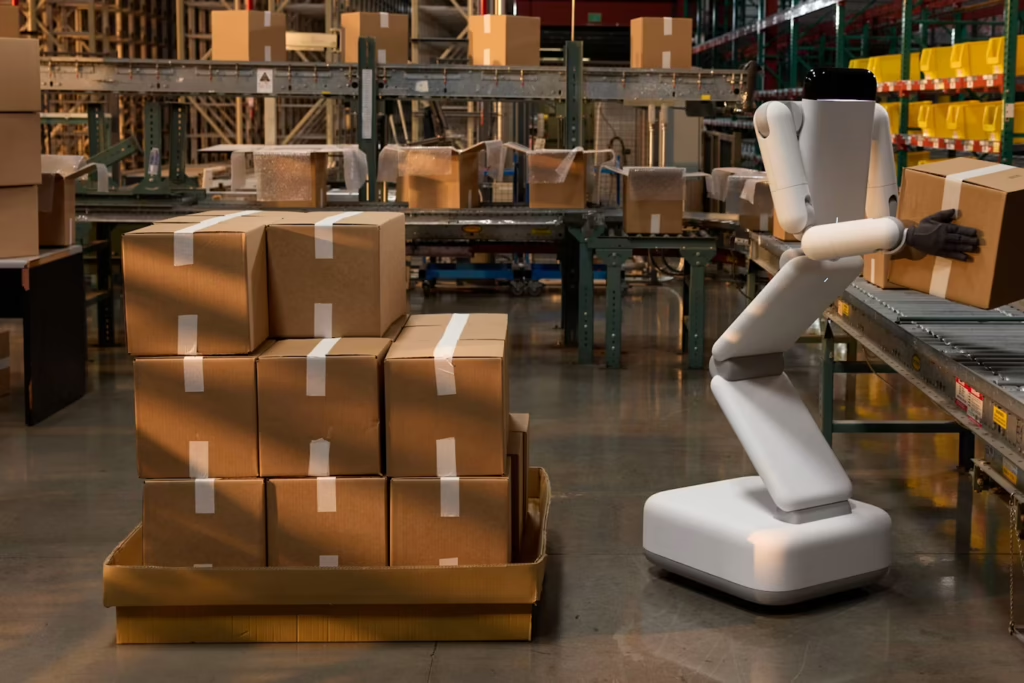
Genesis AI recently unveiled the Eno robot to bring physical AI into commercial environments. Source: Genesis AI
The fastest-growing market categories have humble beginnings. Physical AI, the combination of robotics and advanced artificial intelligence, is just the latest example.
ChatGPT began as a pitch deck at an accelerator before it became a household name in 2023. Before cloud computing became a boardroom imperative, founders were building it, server rack by server rack, cluster by cluster. And, of course, before fintech rewired retail banking, it appeared as a funding surge in deal flow data that most banks weren’t reading.
You see the pattern, and I’ve watched it repeat itself across several years of evaluating startups. The startup ecosystem is the world’s most underutilized business intelligence system.
Incumbents may amass wealth and power, but it’s the founders who choose to build. Which sectors attract a sudden surge of founding activity is a three-to-five-year leading indicator of where enterprise disruption is headed.
While AI agents garner the lion’s share of media attention and VC funding, deal flow suggests the next market for hypergrowth will be of the metallic persuasion. That is physical AI, which includes autonomous machines and smart manufacturing, among other sensor-laden systems.
Robotics and physical AI startups raised a record $27.6 billion across 1,009 deals in 2025, or more than double the prior year, according to PitchBook. Genesis AI, which emerged from stealth with a $105 million seed round, recently demonstrated a wheeled robot that can bring physical AI into commercially relevant environments without needing to replicate the human body.
Physical AI: Intelligence inside
Physical AI systems can perceive environments, understand spatial context, make operational decisions, and act autonomously in real time across industrial and other settings. Physical AI systems move beyond static automation toward adaptive operations that continuously improve through interaction with the real world.
As with most tech trends, physical AI is driven by a coalescence of several technologies that have matured simultaneously. These include: multimodal sensing, edge computing, simulation environments, robotics foundation models, and world modeling systems. These technologies allow machines to collect information from the physical environment, interpret it in context, simulate outcomes before acting, and continuously refine performance through operational feedback loops.
In addition, the costs of several components that make physical AI possible have declined, with lidar, actuators, depth cameras, and sensors becoming more affordable.
For example, Waymo said its sixth-generation Driver system significantly reduced costs while increasing resolution, range, and compute power. The autonomous vehicle system used a suite of 13 cameras, four lidars, and six radars. Together, the technological maturation plus cost reduction cultivates the right conditions for physical AI to blossom.
Manufacturing, automotive, logistics, and healthcare sectors have emerged as major areas of capital concentration, with organizations actively piloting robotics to address labor costs and the scarcity of qualified personnel, and deploying them in harsh environments even as productivity needs grow.
Figure AI, whose humanoid robots assemble automobile parts in BMW factories, reached a $39 billion valuation within three years, the fastest path to unicorn status in robotics history. Investors are banking on general-purpose robot models doing for hardware what large-language models did for software. Why wouldn’t they? The deal flow is there.
Three stages of a disruption wave
Throughout the past few years of reading deal flow, I’ve identified a consistent three-stage pattern that plays out across every major technology disruption.
Stage 1: The founder surge
A new capability emerges, attracting a disproportionate number of high-quality founding teams. Capital concentrates. Failure rates soar even as the survivors are defining the category. As I alluded to earlier, generative AI shot to the stars in 2023. Agentic AI is now moving through this stage, while physical AI is just entering it.
Dyna Robotics, which is building foundation models that let one robot learn service tasks for hotels, restaurants, and laundromats, raised a $120 million Series A funding round within about a year of its founding.
Stage 2: The corporate adoption wall
Enterprises begin piloting the technology but struggle to move from experiment to production. The startups that survive stage one hit procurement cycles, integration complexity, and organizational resistance. We’re seeing this right now with organizations implementing GenAI and agentic AI tools without adapting their operating models, according to Deloitte.
Some organizations break through this wall. After recognizing that generative AI would fundamentally reshape customer service, Intercom canceled non-AI projects, reorganized product teams and committed $100 million to replatform the business around AI. That transformation produced its Fin agent which now resolves millions of customer service queries.
Another company, Maven Robotics, mixed palletizing in warehouses, and is crossing the wall one customer at a time.
Stage 3: Industrialization
A subset of companies cracks the deployment code. The technology becomes operational infrastructure. The window for competitive entry is closing. Cloud computing reached this stage around 2015. GenAI and agentic AI will land there within 18 to 24 months, as organizations redesign their processes and double down on their change management practices.
Kiva Systems‘ warehouse robots, bought by Amazon in 2012, grew into a fleet of more than 1 million. What was once a startup capability is now sophisticated infrastructure that new entrants can’t easily match.
The practical implication is straightforward: by the time a technology reaches Stage 3, the structural advantages of early deployers are largely locked in. The companies that used AWS in 2010 to save money eventually built strong engineering cultures, data architectures, and product velocity in the ensuing years.
 Submit your innovation now!
Physical AI today, something else tomorrow
The same dynamic is playing out in AI today and the deal flow is telling us exactly which categories are where on that curve. For physical AI, the competitive advantage lies in the ability to build continuous operational learning loops where physical interaction generates data, data improves simulation and models, and improved models enhance real-world performance.
As the deployment of these intelligent systems scales, they compound advantages through infrastructure integration, operational feedback and real-world learning. More data, operationalized appropriately, yields better outcomes.
Most corporate leaders treat startup deal flow as noise. They may discount it as too early-stage, too speculative, or too distant from their operating reality.
But rather than watch startup deal flow to find your next vendor, watch it to understand where the next generation of your competitive environment is being built. Then calibrate your own development and strategic roadmap accordingly. The signals are there; you just need to know how to read them.
 About the author
Janis Skriveris is a principal and Plug and Play Ventures and director of its Deeptech Platform. He sources, diligences, and leads investments in deeptech and AI companies shaping the next generation of industrial and urban systems.
Skriveris focuses on applied AI, robotics and autonomy, next-gen mobility, industrial technologies, and the built environment — real estate, construction, and infrastructure. He helps companies validate commercial traction, refine their go-to market strategies, and access Plug and Play’s global corporate network. Since 2017, Skriveris has led 37 investments, including unicorn Einride.
Prior to Plug and Play, Skriveris worked at EY’s Assurance and Consulting Department, where he developed a deep understanding of various industries and honed his skills in strategic planning, risk management, and business transformation. He holds a bachelor’s degree in economics and entrepreneurship, graduating with distinction from the University of Latvia. Janis completed a master’s degree in finance and financial management services at the Faculty of Business, Management and Economics of the same university.




Tell Us What You Think!