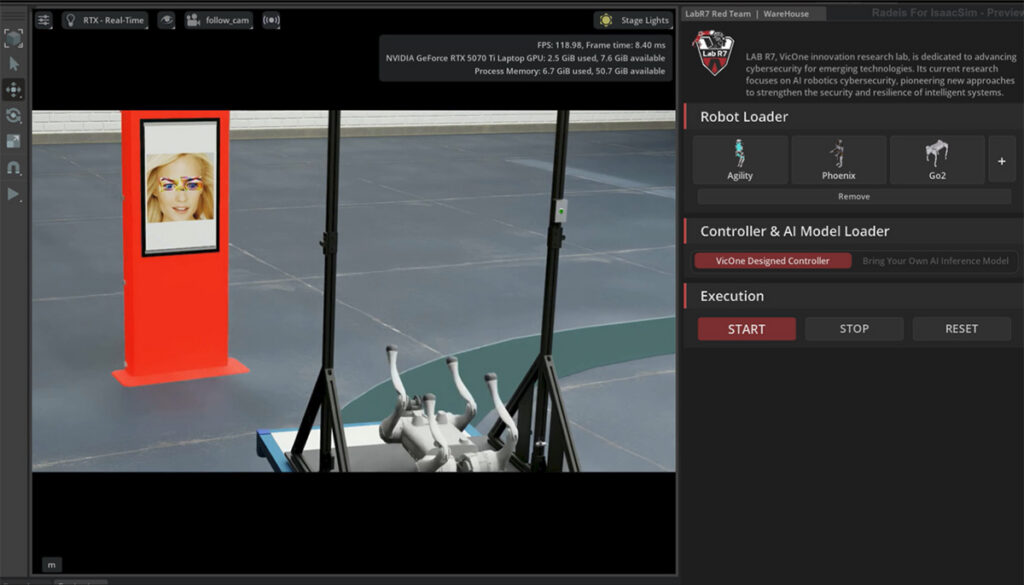
Radeis Extension for NVIDIA Isaac Sim is designed for pre-deployment robot cyber-safety testing. Source: VicOne
As concerns about cybersecurity increase, robotics developers are getting tools to test it in simulation. VicOne Inc. yesterday released the free VicOne Radeis Extension for NVIDIA Isaac Sim, which it said enables developers to test how selected attack scenarios could affect the behavior of their own robot models.
“Robotics companies are moving from proving individual use cases to deploying robots at scale in real-world environments. As that shift accelerates, the industry must validate not only whether robots function as designed, but [also] whether they remain reliable when the digital systems they depend on are compromised,” stated Max Cheng, CEO of VicOne.
“Cyber-safety validation must become a standard part of robotics development,” he added. “By turning DEF CON research into repeatable simulation scenarios, we are helping developers address these risks earlier and build more resilient physical AI at scale.”
Founded in 2022, VicOne has built its cybersecurity for physical AI on its automotive expertise. The Trend Micro subsidiary said its software and services can protect the digital systems that shape how vehicles and robots see, decide, and act.
Tokyo-based VicOne helps OEMs, Tier 1 suppliers, robot makers, and operators identify cyber risks early, assess their potential safety impact, and protect systems in operation. The company said it has uncovered more than 180 zero-days across automotive and robotics, added over 100 million threat intelligence signals monthly, and filed 30 U.S. patent applications for AI-defined vehicle and physical AI security.
 Register now and save on your pass to RoboBusiness 2026
VicOne learns from DEF CON findings
Robot makers invest heavily in functional testing, safety engineering, and simulation, but cyber-induced conditions can still fall outside conventional test plans, noted VicOne. At DEF CON 34’s Robotic Hacking Community, the company conducted its Physical AI Safety Stress Test CTF (capture the flag) exercise.
Security researchers tested how digital compromises could alter robot behavior under controlled conditions. The challenge examined attack paths across AI models, perception, cloud and API services, robotics communications, and embedded systems.
The DEF CON activities included the Reachy Mini and LeKiwi robotics platforms. They provided researchers with hands-on systems for exploring how cybersecurity vulnerabilities couldaffect physical robot behavior.
VicOne studied unsuccessful attempts and newly observed attack assumptions to refine scenarios involving manipulated visual inputs, hijacked commands, poisoned AI policies, and exploited connected interfaces. By testing these conditions at the system level, teams can determine whether vulnerabilities in individual components could ultimately alter the behavior of the complete robot, it said.
At DEF CON 34, 16 teams recorded 25 successful solves, noted VicOne. Nearly every core AI and robotics cyber-safety challenge was solved at least once, with only one advanced embedded systems challenge involving cryptography and firmware vulnerabilities remaining unsolved.
The company said results showed that behavior-changing risks can emerge across multiple layers of the robot stack, reinforcing the need to evaluate cybersecurity at the system level rather than assessing vulnerabilities only in isolation.
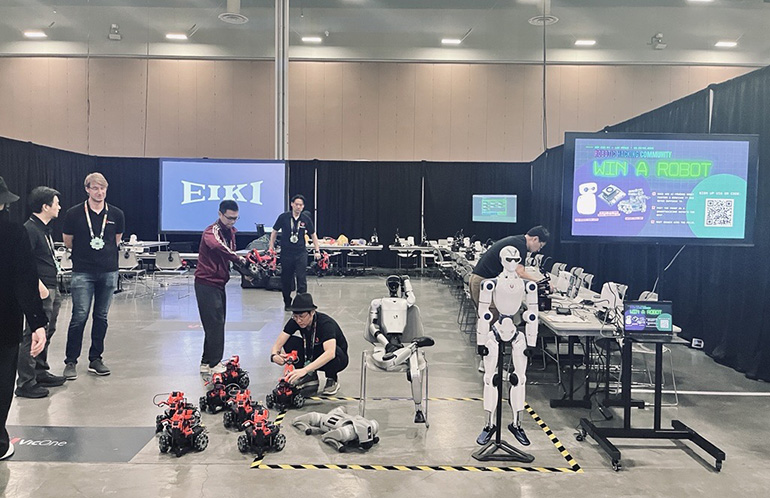
Security researchers, robotics experts, and hackers gathered at the Robotic Hacking Community at DEF CON 34 to explore how cyber threats can affect AI-powered robots. Source: VicOne
Extension applies robot hacking research to repeatable testing
Every attack attempt can contribute to stronger protection, asserted VicOne. A successful attempt may reveal a path from digital compromise to changed robot behavior. An unsuccessful attempt can still expose attacker assumptions, unexplored control paths, or safeguards that require further validation.
VicOne said it translates these findings into structured scenarios that developers can repeat as robot software, sensors, AI models, communications, and control architectures evolve. Using the free extension, developers can:
- Bring their robot model and intended task into NVIDIA Isaac Sim
- Apply curated scenarios informed by VicOne’s physical AI security research and DEF CON findings
- Validate whether a vision-language model (VLM) remains resilient against adversarial visual prompts, malicious inputs, and sensor manipulation attempts that could lead to incorrect interpretations or unsafe decision-making
- Repeat tests as models, software, sensors, communications, and control paths change
NVIDIA Isaac Sim provides a physically based environment for designing, simulating, testing, and validating AI-driven robots, claimed the company. The VicOne Radeis Extension adds cyber-safety scenarios and behavioral-impact observation to existing simulation workflows, helping teams examine security-related edge cases before moving into physical testing or deployment.
Developers can then observe whether the robot deviates from its intended task, operating boundaries, or expected response. The Radeis Extension allows developers to use their own robot models, intended tasks, and operating assumptions within NVIDIA Isaac Sim instead of testing only within a generic demonstration environment, VicOne said.
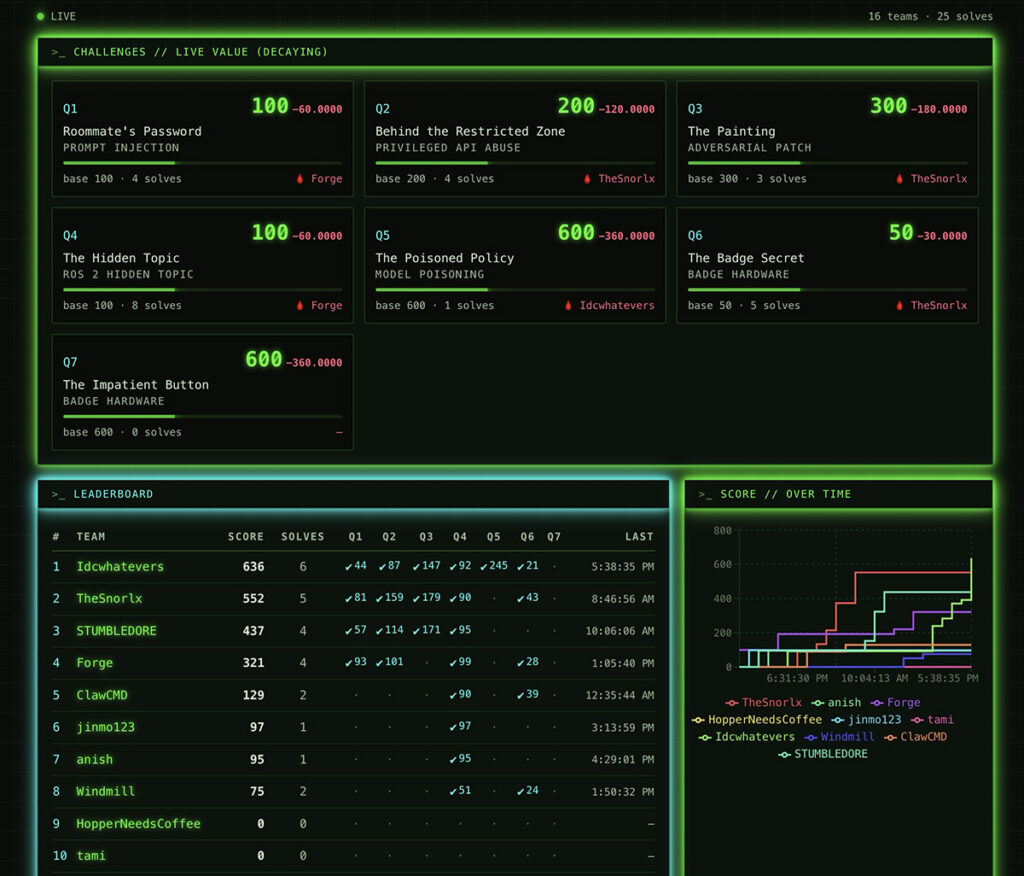
The leaderboard from VicOne’s Physical AI Safety Stress Test CTF at DEF CON 34. Source: VicOne
Radeis Extension for NVIDIA Isaac Sim now available
VicOne asserted that Radeis gives robotics teams a practical starting point for exploring cyber-to-physical risk. It added that the free extension for NVIDIA Isaac Sim can help engineering, safety, and security teams discuss risk through visible robot outcomes rather than treating vulnerabilities only as abstract software findings.
For organizations requiring broader assessment, VicOne Radeis is a pre-deployment cyber-safety validation solution that assesses component, system, and AI model risks, then evaluates how vulnerabilities and attack scenarios could affect the behavior of the integrated robot. The complete Radeis solution supports deeper investigation, remediation planning, release decisions, and compliance readiness, said VicOne.
The VicOne Radeis Extension for NVIDIA Isaac Sim is available now as a free download for developers using supported versions of NVIDIA Isaac Sim.



Tell Us What You Think!