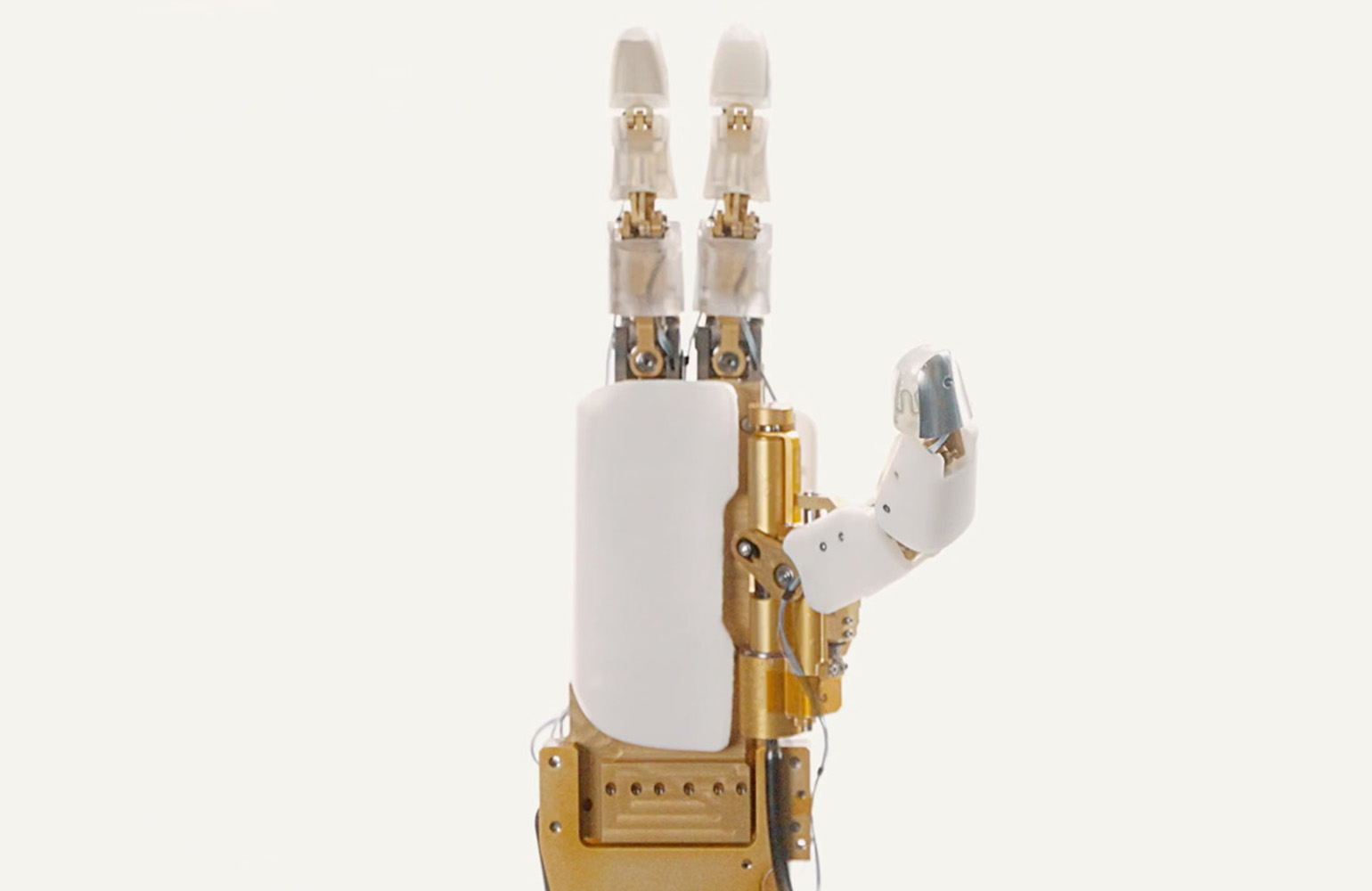
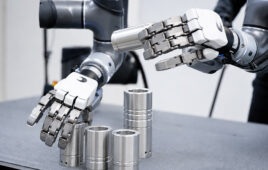
Tacta’s robotic hand comes in three- and five-finger configurations. | Source: Tacta Systems
Tacta Systems last week launched the TactaBot, which includes the company’s Tacta Hand, Skill Capture system, and a Dexterous Intelligence AI model. These three components work together to create capable, scalable, and adaptable robotic hands for high-value work.
“We have vison-only robots and a variety of different robots that do really good work today, which is moving objects and so on, but the holy grail is to be able to augment, complement, and expand the potential to use robots to do high value work,” Vikram Pavate, co-founder and CEO of Tacta Systems, told The Robot Report.
Pavate said some of the biggest workforce shortages in the world have to do with skilled labor, particularly in manufacturing environments.
“Humans have amazing brains, but AI is catching up,” he noted. “We have decent eyes, and that’s an area where computer vision, arguably, has caught up. The parts that have been missing are the hands.”
Tacta identified this problem three years ago when the company started. “For high-value work, we need our robotic hands to be able to touch and feel the real world,” Pavate said. “They need to be able to feel normal force, shear force, contact, deformation, slip, temperature, texture, surfaces.”
Tacta develops proprietary technology for its robotic hand
Tacta offers a dexterous, human-sized gripper with five fingers, and 15 degrees of freedom (DoF), three per finger. Each finger can lift up to 25 newtons of force, which is about 2.5 kg (5.5 lb.) in each fingertip, Pavate said.
The hand use Tacta’s proprietary Fluidic Tendon actuation technology. Pavate said the system features cables with fluids moving through them to push pistons to move the fingers.
“That allows us to make the fingers very, very thin,” Pavate said. “There’s no heat generated anywhere close to the hand. This allows us to maintain incredible stability and precision that we would not be able to achieve with motor-driven hands.”
He added that the robotic hand is more reliable than cable-driven hands. These can be precise and fast, but if one cable goes out, the whole hand breaks down. The Tacta hand can last up to 30 million cycles. claimed Pavate.
Proprietary sensors are the core of Tacta’s system
Tacta’s robotic hand and its glove capture system both use its tactile sensor. Smaller than a grain of sand, each sensor recognizes the full dynamic range of human touch from 250 pascals to 700,000 pascals. The sensors can also measure temperature with a precision of 0.1 degrees centigrade
“These are not MEMS-based sensors, and each of these sensors has its own analog-to-digital conversion, and the scale, the pitch, is 1 mm,” explained Pavate.
While the company’s hands offer high cycle times, its fingertip sensors are replaceable. “The cycle count is for the mechanical side,” Pavate acknowledged. “The fingertips and the sensors here … will wear out at some point. We have designed them to be consumables at this point.”
Data capture glove can help close the physical AI data gap
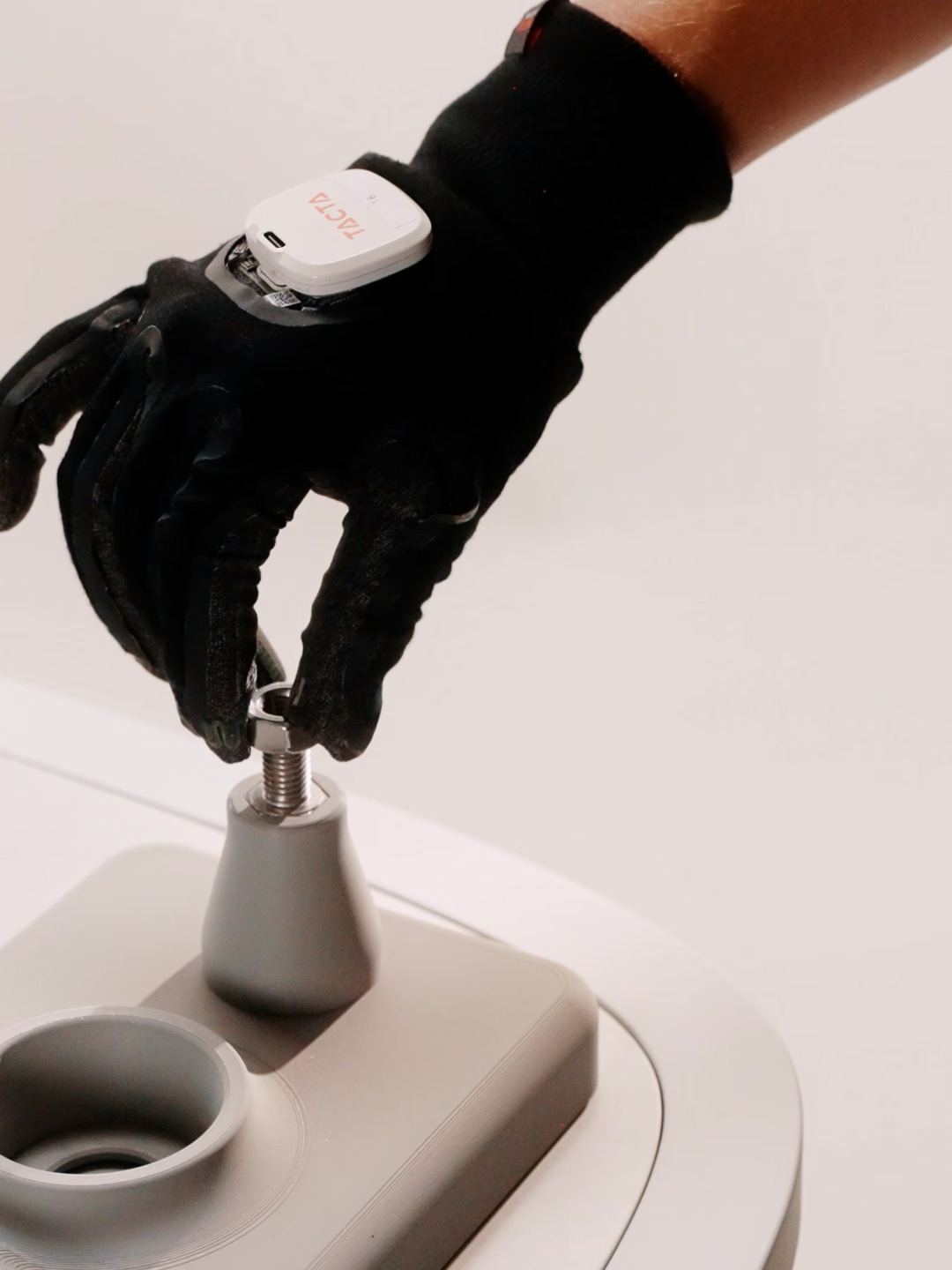
The Tacta Glove allows the company to build datasets for dexterous tasks to teach robots new skills. | Source: Tacta Systems
In contrast to language-based AI models, today’s AI models for robotics are severely limited by a lack of relevant real-world data. “There’s no Shakespeare and the web and Reddit and The New York Times to train these models in the physical world, especially for high value work,” said Pavate.
Tacta is offering to speed up this process with its data-capture system. The Tacta Glove features 256 of the company’s tactile sensors on each fingertip.
“We’re starting out with the fingertips because most of our work is on the fingertips today. [The system] can easily be scaled to the entire hand,” Pavate said. “We use these tactile sensors on the front. We use motion capture in the back.”
All the data the glove captures is streamed wirelessly to a local host device. The glove can be deployed immediately, without training, and workers can wear it naturally as they complete complex tasks.
The Tacta Glove and Skill Capture system record force, motion, video, and temperature data directly from workers on the factory floor. The company said that every hour of work performed with the Tacta Glove further compounds its robot training dataset.
Tacta transfers this gathered data to its robot
Tacta also offers its Dexterous Intelligence AI engine and sensory system, which is powered by its Tacta Glove and Skill Capture system. The company uses an off-the-shelf, pre-trained AI model, and then trains it with its tactile and motion-capture data for a variety of different tasks.
“Then, we go to the customer site and we fine-tune that using our gloves on their operations,” said Pavate. This approach significantly reduces the training time required to learn new skills, Tacta asserted.
In the long term, Pavate said he could see this technology used in a range of environments, such as nursing homes, hospitals, or food preparation. Imagine a world-renowned sushi chef wearing the gloves while preparing precisely crafted dishes, or a pianist using them while playing a song, he said.
For now, however, the company is focusing on manufacturing. “It’s an environment that we, as founders of the company, understand,” said Pavate. “We spent many, many decades in that space. We come from the electronics side of the industry.”
With reshoring top of mind for U.S. industry and robotics suppliers right now, Tacta said it also sees a strong opportunity in electronics manufacturing. The company expects to ship its first TactaBots in early 2027.
 Register now and save on your pass to RoboBusiness 2026

Tell Us What You Think!