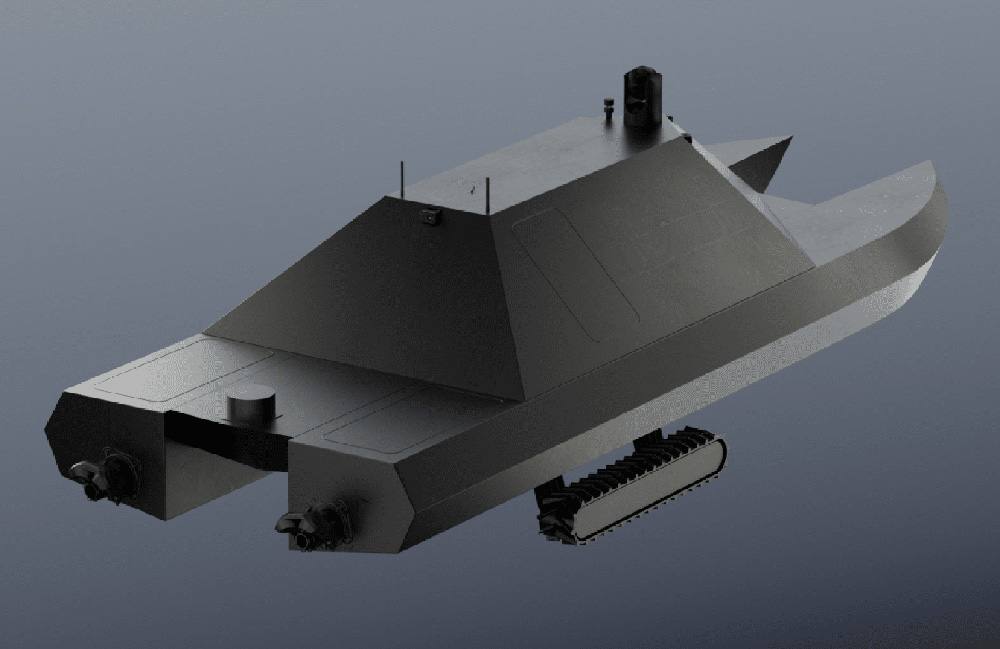
Alligator can be deployed in infrastructure-free environments, manned or unmanned. | Source: Skana Robotics
Defense technology startup Skana Robotics recently unveiled its latest autonomous vessel, the Alligator. The amphibious vessel combines infrastructure-free deployment, crewed or uncrewed operation, and the ability to carry and launch other autonomous systems.
The Alligator is designed to deliver logistics, sensors, and personnel between water and land. It features a 1,500 kg (3,306.9 lb.) payload capacity, a 300 nautical mile (555.6 km) range, and a top speed of 40 knots (74 kph).
“From the seaside, Alligator approaches the shoreline with its tracks retracted, behaving like a standard surface vessel,” Idan Levy, co-founder and CEO of Skana Robotics, told The Robot Report. “The reverse is similar: From land, Alligator drives down a natural or semi-prepared shoreline, enters the water on its tracks, stabilizes, then retracts the tracks and transitions into full maritime propulsion. The key point is that there’s no need for ramps, jetties, or cranes.”
Levy said the Alligator is best suited for places where land, shallow water, and subsea missions overlap, especially in areas where coastal infrastructure doesn’t exist or is damaged. He highlighted autonomous underwater vehicle (AUV) tendering, subsea inspection, critical infrastructure protection, search and rescue, natural disaster response, and more potential use cases.
Skana Robotics is a Tel Aviv, Israel-based developer of unmanned maritime platforms that combine real-world operational insight with advanced engineering. Founded in 2023, the company specializes in scalable, software-defined systems designed for autonomy, resilience, and integration into hybrid fleets.
 Register now and help us celebrate 20 years of RoboBusiness!
Alligator combines speed and agility
Alligator combines the range and speed of a naval craft with the agility to operate without the need for docks. The vessel serves as a mobile launch and recovery node for underwater assets, including multiple Stingray AUVs, enabling operations far from existing ships or infrastructure. This extends naval reach across dispersed maritime environments.
“The main challenge [designing the Alligator] was that nothing about land mobility could compromise performance at sea and vice versa,” Levy said. “For most amphibious systems, you end up choosing a ‘primary’ domain. With Alligator, the requirement was genuine duality: stable, shallow-draft operation in the water and reliable traction, stability, and payload-carrying capability on land.”
“On top of that, Alligator had to remain uncrewed, software-defined, and mass-producible, not a one-off demonstrator,” he continued. “That forced strict constraints on weight, modularity, and the use of COTS [commercial off-the-shelf] components, while still protecting the hull form, the retractable track system, and the autonomy stack from the harshest parts of the littoral environment.”
Designed as part of Skana’s connected fleet, the Alligator communicates in real time with surface and subsurface vessels through the company’s SeaSphere resource-allocation and mission-planning system, enabling coordinated, cross-domain missions.
Skana builds on the progress it made with Bullshark and Stingray
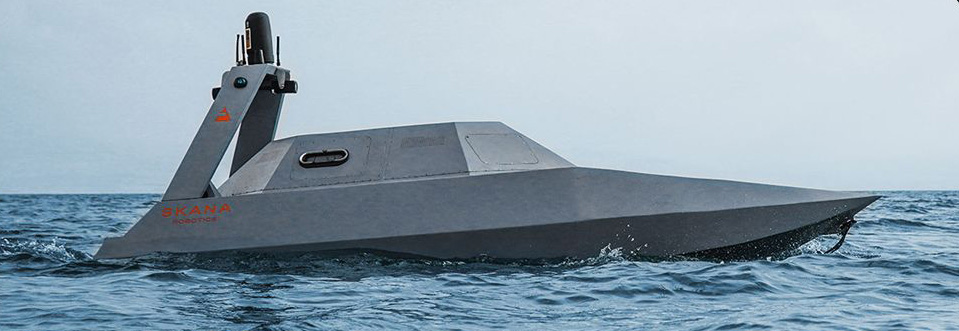
Skana Robotics’ Bull Shark autonomous surface vessel is launchable from docks, beaches, or larger vessels. | Source: Skana Robotics
The Alligator joins Skana’s fleet of autonomous maritime vessels that have already progressed from the prototype stage to deployable and adaptable naval assets designed for mass production. They include the Bullshark autonomous surface vessel and Stingray AUV. Skana’s third and largest vessel, the Alligator, will join the company’s product line by Q1 2026.
Levy noted that the Skana team drew on its previous experience building underwater vehicles when creating Alligathor.
“The first full operational demonstration of the Alligator is planned for Q2 2026, so we’re not yet in the phase of public or at-sea demonstrations of the complete platform,” he acknowledged. “However, the Alligator is not being built from a blank sheet of paper.”
“The core team behind Skana has spent the past two decades designing, building, and operating autonomous maritime and robotic systems across a wide range of operational environments and mission types,” said Levy. “That accumulated field experience—what fails in surf zones, how autonomy behaves in GPS-denied areas, what breaks first under saltwater exposure, what operators actually trust—has been directly embedded into the Alligator’s mechanical design, autonomy architecture, and CONOPS [concept of operations] from Day 1.”
“So instead of ‘learning after the fact’ through early demos, the Alligator reflects lessons learned across years of real-world autonomous operations, translated into a platform that is designed to avoid the known pitfalls from the start,” he continued.
Skana looks ahead to 2026
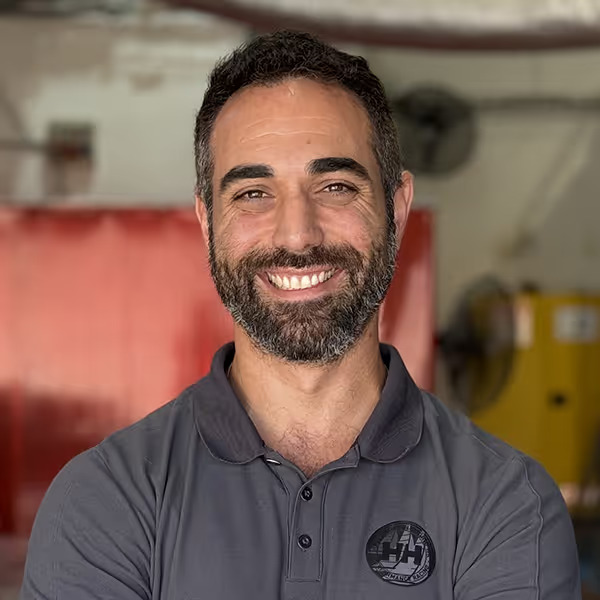
Idan Levy, the co-founder and CEO of Skana Robotics. | Source: Skana Robotics
Levy said he expects to see transitions that have been at work in the industry for a few years now bubble ot the surface.
“First, we see hybrid fleets continuing to mature,” Levy said. “Manned–unmanned teaming will keep moving from pilots and demonstrations toward early operational concepts. It’s still a learning process for most navies, but hybrid operations are increasingly being treated as a practical capability rather than a future concept.”
“Second, there is a gradual move toward software-defined maritime platforms,” he continued. “More systems are being designed so that new behaviors, mission logic, and coordination methods can be updated through software, even if most fleets are still early in adopting that mindset at scale.”
“Third, we expect to see growing interest in distributed and attritable systems, not as replacements for capital ships, but as complementary layers that extend coverage, persistence, and resilience,” said Levy.
He predicted that 2026 would be a year of experimentation, integration, and learning, rather than a single moment of transformation.

Tell Us What You Think!