The Robot Report

  • Home
  • News
  • Technologies
    • Batteries / Power Supplies
    • Cameras / Imaging / Vision
    • Controllers
    • End Effectors
    • Microprocessors / SoCs
    • Motion Control
    • Sensors
    • Soft Robotics
    • Software / Simulation
  • Development
    • Artificial Intelligence
    • Human Robot Interaction / Haptics
    • Mobility / Navigation
    • Research
  • Robots
    • AGVs
    • AMRs
    • Consumer
    • Collaborative Robots
    • Drones
    • Humanoids
    • Industrial
    • Self-Driving Vehicles
    • Unmanned Maritime Systems
  • Business
    • Financial
      • Investments
      • Mergers & Acquisitions
      • Earnings
    • Markets
      • Agriculture
      • Healthcare
      • Logistics
      • Manufacturing
      • Mining
      • Security
    • RBR50
      • RBR50 Winners 2025
      • RBR50 Winners 2024
      • RBR50 Winners 2023
      • RBR50 Winners 2022
      • RBR50 Winners 2021
  • Resources
    • Automated Warehouse Research Reports
    • Digital Issues
    • eBooks
    • Publications
      • Automated Warehouse
      • Collaborative Robotics Trends
    • Search Robotics Database
    • Videos
    • Webinars / Digital Events
  • Events
    • RoboBusiness
    • Robotics Summit & Expo
    • DeviceTalks
    • R&D 100
    • Robotics Weeks
  • Podcast
    • Episodes
  • Advertise
  • Subscribe

Sarcos completes solar panel installation demonstration

By Brianna Wessling | March 9, 2023

Sarcos Technology and Robotics Corporation announced that it successfully completed the final validation of its Outdoor Autonomous Manipulation of Photovoltaic Panels (O-AMPP) project. 

The O-AMPP project began in 2021 with funding support from the U.S. Department of Energy Solar Energy Technologies Office (SETO). The project aims to streamline the process of solar field construction into one harmonized robotic system that can deliver, detect, lift and place photovoltaic modules in the field. 

Sarcos hopes that the project will result in lower soft costs for similar projects, the ability to engage in more projects simultaneously, improved construction timelines and quality and a safer worksite that reduces the risk of injuries, including lifting and fatigue-related injuries. 

The O-AMPP proof-of-concept consists of an Autonomous Working Vehicle (AWV) featuring the Guardian XM robotic system and an Autonomous Delivery Vehicle (ADV). The proof-of-concept was used to optimize the flow of photovoltaic modules from delivery to installation. 

“Achieving this market validation and field test milestone is a mission-critical step on our path to commercializing our robotic solar field construction solution and, ultimately, enhancing safety and productivity in the solar field construction industry,” Kiva Allgood, president and CEO of Sarcos, said. “I am grateful to the teams at Mortenson, JLG Industries, Pratt Miller, and Array Technologies for their support, expertise, and resources throughout this process, and we look forward to collaborating in the future as we prepare to make this solution readily available to the industry.”

During the field trial, Sarcos collaborated with Mortenson, JLG Industries, Array Technologies and Pratt Miller. Mortenson provided critical subject matter expertise and the validation site. JLG Industries supplied the mobile elevating platform used for the AWV and that the Guardian XM robotic system was mounted to and integrated with. 

Array Technologies supplied the tracker technology and engineering resources used in the project. Pratt Miller provided the mobile base on which the ADV prototype was built. 

“The solar construction industry is facing unprecedented labor shortages while simultaneously facing an increase in demand for solar energy,” Trent Mostaert, vice president of industrialization at Mortenson, said. “We believe the O-AMPP system can address these challenges while improving safety, productivity, and efficiency for our workers. It will also enable solar project developers to scale output and production to the levels needed to achieve the Energy Department’s 2030 and 2050 renewable energy goals. We are excited about the possibilities and potential impact of the O-AMPP system in solar construction.”


About The Author

Brianna Wessling

Brianna Wessling is an Associate Editor, Robotics, WTWH Media. She joined WTWH Media in November 2021, after graduating from the University of Kansas with degrees in Journalism and English. She covers a wide range of robotics topics, but specializes in women in robotics, robotics in healthcare, and space robotics.

She can be reached at [email protected]

Tell Us What You Think! Cancel reply

This site uses Akismet to reduce spam. Learn how your comment data is processed.

Related Articles Read More >

Neros Archer is a FPV drone built for modular payloads and resilient communications.
Neros Technologies raises $250M to deploy its defense drones by the end of 2026
The ARM Institute has issued Project Call 27-01 for defense-related manufacturing technology projects.
ARM Institute calls for defense manufacturing technology projects
SEW-EURODRIVE's PxG economy series of planetary servo gear units.
SEW-EURODRIVE adds economy series to its planetary servo gear unit portfolio
A3 has reported North American industrial robot orders for the first half of 2026.
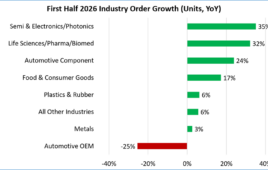
Q2 2026 robotics demand increased across industries, reports A3

RBR50 Innovation Awards

“2026”
“rr
EXPAND YOUR KNOWLEDGE AND STAY CONNECTED
Get the latest info on technologies, tools and strategies for Robotics Professionals.

Latest Episode of The Robot Report Podcast

Automated Warehouse Research Reports

Sponsored Content

  • The 370-billion-dollar race: How integrated design can help humanoid manufacturers succeed in a rapidly growing market
  • humanoid robot sorts parts. 5 Physical AI infrastructure platforms shaping robotics in 2026
  • How integrated actuators improve humanoid robot joint performance and system integration
  • Boston Dynamics will discuss human-machine interaction for humanoid robots in a webinar. Boston Dynamics to discuss the art behind human-robot interaction
  • In robotics, ruggedization is no longer optional
More Sponsored Content >
The Robot Report
  • Automated Warehouse
  • RoboBusiness
  • Robotics Summit & Expo
  • About The Robot Report
  • Subscribe
  • Contact Us

Copyright © 2026 Arrowfly LLC. All Rights Reserved. The material on this site may not be reproduced, distributed, transmitted, cached or otherwise used, except with the prior written permission of Arrowfly
Privacy Policy | Advertising | About Us

Search The Robot Report

  • Home
  • News
  • Technologies
    • Batteries / Power Supplies
    • Cameras / Imaging / Vision
    • Controllers
    • End Effectors
    • Microprocessors / SoCs
    • Motion Control
    • Sensors
    • Soft Robotics
    • Software / Simulation
  • Development
    • Artificial Intelligence
    • Human Robot Interaction / Haptics
    • Mobility / Navigation
    • Research
  • Robots
    • AGVs
    • AMRs
    • Consumer
    • Collaborative Robots
    • Drones
    • Humanoids
    • Industrial
    • Self-Driving Vehicles
    • Unmanned Maritime Systems
  • Business
    • Financial
      • Investments
      • Mergers & Acquisitions
      • Earnings
    • Markets
      • Agriculture
      • Healthcare
      • Logistics
      • Manufacturing
      • Mining
      • Security
    • RBR50
      • RBR50 Winners 2025
      • RBR50 Winners 2024
      • RBR50 Winners 2023
      • RBR50 Winners 2022
      • RBR50 Winners 2021
  • Resources
    • Automated Warehouse Research Reports
    • Digital Issues
    • eBooks
    • Publications
      • Automated Warehouse
      • Collaborative Robotics Trends
    • Search Robotics Database
    • Videos
    • Webinars / Digital Events
  • Events
    • RoboBusiness
    • Robotics Summit & Expo
    • DeviceTalks
    • R&D 100
    • Robotics Weeks
  • Podcast
    • Episodes
  • Advertise
  • Subscribe