The Robot Report

  • Home
  • News
  • Technologies
    • Batteries / Power Supplies
    • Cameras / Imaging / Vision
    • Controllers
    • End Effectors
    • Microprocessors / SoCs
    • Motion Control
    • Sensors
    • Soft Robotics
    • Software / Simulation
  • Development
    • Artificial Intelligence
    • Human Robot Interaction / Haptics
    • Mobility / Navigation
    • Research
  • Robots
    • AGVs
    • AMRs
    • Consumer
    • Collaborative Robots
    • Drones
    • Humanoids
    • Industrial
    • Self-Driving Vehicles
    • Unmanned Maritime Systems
  • Business
    • Financial
      • Investments
      • Mergers & Acquisitions
      • Earnings
    • Markets
      • Agriculture
      • Healthcare
      • Logistics
      • Manufacturing
      • Mining
      • Security
    • RBR50
      • RBR50 Winners 2025
      • RBR50 Winners 2024
      • RBR50 Winners 2023
      • RBR50 Winners 2022
      • RBR50 Winners 2021
  • Resources
    • Automated Warehouse Research Reports
    • Digital Issues
    • eBooks
    • Publications
      • Automated Warehouse
      • Collaborative Robotics Trends
    • Search Robotics Database
    • Videos
    • Webinars / Digital Events
  • Events
    • RoboBusiness
    • Robotics Summit & Expo
    • DeviceTalks
    • R&D 100
    • Robotics Weeks
  • Podcast
    • Episodes
  • Advertise
  • Subscribe

Robots don’t run themselves: The workforce powering physical AI

By Christopher Bower | August 22, 2026

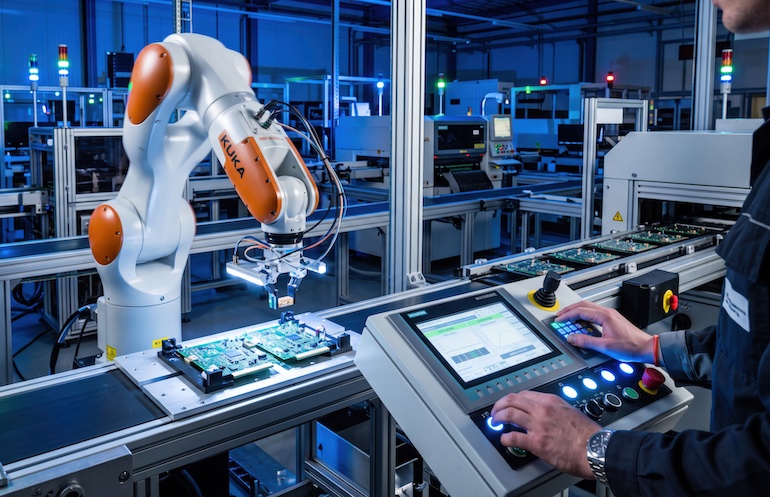
Factory robot supervised by a human.

A hybrid human-robot workforce requires new metrics, according to HireArt. Source: Lee AI, via Adobe Stock

As robotic systems move from pilots into scaled deployments, a pattern is becoming harder to ignore: The limiting factor is rarely the robot itself. It’s the workforce required to operate, maintain, and continuously adapt it in the real world.

Most robotics programs begin with a familiar model—small, tightly coordinated teams supporting early deployments. Engineers are close to the system, operators are highly trained, and issues are resolved quickly because everyone is in the loop. That structure works well when there are five or 10 robots in controlled environments.

But it starts to break down when deployments scale to dozens of sites across multiple shifts and inconsistent physical environments. At that point, robotics stops behaving like a product launch and starts behaving like a distributed operations business.

Physical AI deployments shift labor priorities

A useful parallel can be found in how AI labor has evolved over the past decade. Early computer vision systems relied heavily on simple, task-based data labeling that could be distributed broadly.

As models shifted toward large language models, the work itself became less about discrete tasks and more about judgment, nuance, and quality control. That change drove a shift away from loosely coordinated crowd work toward more structured, trained teams with clearer accountability.

Physical AI is now going through a similar transition, but with higher stakes. When intelligence is embodied in machines operating in warehouses, hospitals, factories, or public spaces, “quality” is no longer just a model metric. It becomes uptime, safety, hardware integrity, and customer experience in dynamic environments.

That shift exposes a gap in how many teams think about workforce design. Traditional gig-style or purely task-based labor models struggle in environments that require consistent shift coverage, safety training, site-specific protocols, and escalation procedures. In practice, many robotics deployments are finding that accountability and repeatability matter more than raw throughput.

This is driving a quiet move toward hybrid workforce structures. Some organizations are building a stable core of trained, hourly W-2 operators and technicians who own baseline execution, standard operating procedure (SOP) adherence, and escalation paths.

Around that core sits a more flexible layer of surge capacity for pilots, new site launches, and specialized deployments. While exact configurations vary, a common pattern is an even split between fixed and variable capacity, adjusted as systems mature and incident volume stabilizes.


SITE AD for the 2026 RoboBusiness call for speakersRegister now and save on your pass to RoboBusiness 2026

New roles present organizational challenge

Within these teams, new role types are emerging that don’t map cleanly to traditional job families. Robot operators, field technicians, teleoperators, QA validators, and data capture specialists all sit between engineering and operations. They are responsible not only for running systems, but also for interpreting edge cases, documenting failures, and translating real-world behavior into engineering feedback loops.

In this context, incentives matter as much as structure. Speed-only metrics, common in earlier forms of digital labor, can actively degrade performance in physical environments.

Instead, teams are placing more weight on adherence to procedures, quality of documentation, escalation accuracy, and safe behavior under uncertainty.

What’s becoming clear is that scaling robotics is not just a technical challenge. It is an organizational one. Success depends on whether companies can build workforce systems that are as robust and adaptive as the machines themselves.

In other words, the next phase of robotics scaling won’t be defined only by better autonomy. It will be defined by whether teams can reliably scale human judgment alongside machine intelligence, across sites, shifts, and real-world conditions that rarely behave as expected.

Christopher Bower is co-founder, chief revenue officer, and president of HireArtAbout the author

Christopher Bower is co-founder, chief revenue officer, and president of HireArt, which provides a contract-for-hire platform. The New York-based company’s stated mission is to reinvent flexible employment by connecting workers and businesses and supporting their productivity.

HireArt said its tool allows customers to build and manage a modern contract workforce with a single tool. They can handle employer of record, on-demand sourcing, vendor management, and freelancer management, all in the same self-serve user interface.

Bower has worked at HumanEdge, Tandym Group, and Access Confidential. He is also a voluntary career coach at the New York Public Library.


Tell Us What You Think! Cancel reply

This site uses Akismet to reduce spam. Learn how your comment data is processed.

Related Articles Read More >

Robotic mowing is becoming more commercilally viable because of vision and satellite guidance, AI planning, and autonomy, says Sunseeker Robotics.
The technology that could bring robot mowers to one in two American lawns
headshot Roby Lynn and the podcast logo.
How software-defined manufacturing fits into real factory operations
A person using ATDev's RAMMP system.
ATDev gives update on its journey building autonomous wheelchairs
Loomia's Smart Skin Tactile Sensing Dev Kit includes both capacitive and force-sensitive resistor sensors.
Unichem acquires Loomia to accelerate entry into the humanoid ‘skin’ market

RBR50 Innovation Awards

“2026”
“rr
EXPAND YOUR KNOWLEDGE AND STAY CONNECTED
Get the latest info on technologies, tools and strategies for Robotics Professionals.

Latest Episode of The Robot Report Podcast

Automated Warehouse Research Reports

Sponsored Content

  • The 370-billion-dollar race: How integrated design can help humanoid manufacturers succeed in a rapidly growing market
  • humanoid robot sorts parts. 5 Physical AI infrastructure platforms shaping robotics in 2026
  • How integrated actuators improve humanoid robot joint performance and system integration
  • Boston Dynamics will discuss human-machine interaction for humanoid robots in a webinar. Boston Dynamics to discuss the art behind human-robot interaction
  • In robotics, ruggedization is no longer optional
More Sponsored Content >
The Robot Report
  • Automated Warehouse
  • RoboBusiness
  • Robotics Summit & Expo
  • About The Robot Report
  • Subscribe
  • Contact Us

Copyright © 2026 Arrowfly LLC. All Rights Reserved. The material on this site may not be reproduced, distributed, transmitted, cached or otherwise used, except with the prior written permission of Arrowfly
Privacy Policy | Advertising | About Us

Search The Robot Report

  • Home
  • News
  • Technologies
    • Batteries / Power Supplies
    • Cameras / Imaging / Vision
    • Controllers
    • End Effectors
    • Microprocessors / SoCs
    • Motion Control
    • Sensors
    • Soft Robotics
    • Software / Simulation
  • Development
    • Artificial Intelligence
    • Human Robot Interaction / Haptics
    • Mobility / Navigation
    • Research
  • Robots
    • AGVs
    • AMRs
    • Consumer
    • Collaborative Robots
    • Drones
    • Humanoids
    • Industrial
    • Self-Driving Vehicles
    • Unmanned Maritime Systems
  • Business
    • Financial
      • Investments
      • Mergers & Acquisitions
      • Earnings
    • Markets
      • Agriculture
      • Healthcare
      • Logistics
      • Manufacturing
      • Mining
      • Security
    • RBR50
      • RBR50 Winners 2025
      • RBR50 Winners 2024
      • RBR50 Winners 2023
      • RBR50 Winners 2022
      • RBR50 Winners 2021
  • Resources
    • Automated Warehouse Research Reports
    • Digital Issues
    • eBooks
    • Publications
      • Automated Warehouse
      • Collaborative Robotics Trends
    • Search Robotics Database
    • Videos
    • Webinars / Digital Events
  • Events
    • RoboBusiness
    • Robotics Summit & Expo
    • DeviceTalks
    • R&D 100
    • Robotics Weeks
  • Podcast
    • Episodes
  • Advertise
  • Subscribe