
|
Listen to this article
 |
Perceptive Automata, a Boston-based developer of human behavior understanding AI for autonomous vehicles and robots, recently shut down. According to co-founder and CTO Sam Anthony, Perceptive Automata went “kablooey” after it failed to close Series B funding.
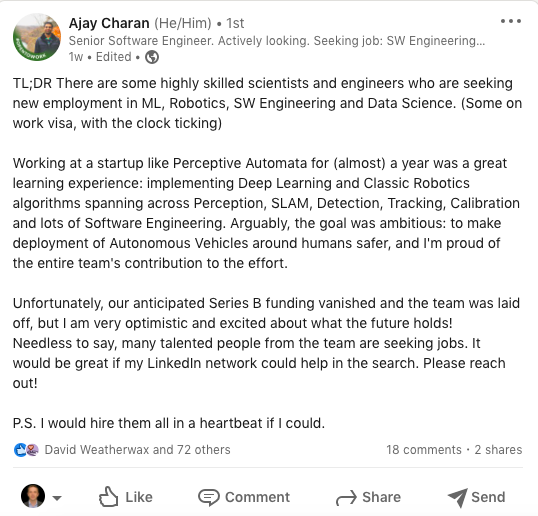
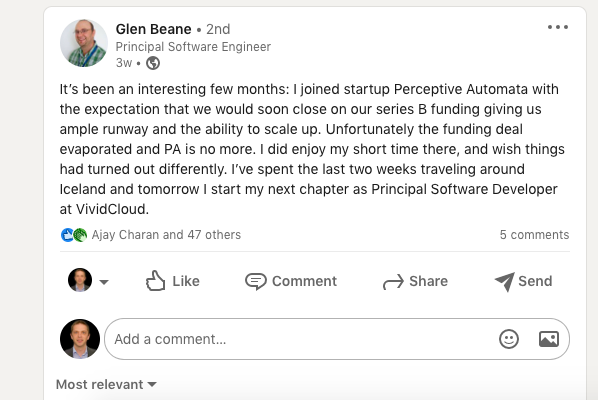
CEO Bruce Reading is now trying to sell the company’s intellectual property. Some now-former employees posted about the unexpected closure on LinkedIn. You can see screenshots of posts below, which both said the Series B funding didn’t close. Anthony also discussed shutdown on a recent episode of the Autonocast podcast.
Anthony said that the shutdown snuck up on him and the staff. “The part that was lousy was how it went down for the staff. There was a sense that we were blindsided by it falling apart,” he said. “That said, I’m not sure we should’ve been blindsided by it. Part of being a VC-funded company is that you have fairly specific marks you have to hit. If you don’t hit them, the path is cloudy at best. Combined with other factors outside of our control, we were in a tough spot.”
Anthony continued, “We didn’t meet the metrics investors use to determine Series B funding. Part of that is due to the state of [autonomous vehicles] and our focus on [autonomous vehicles].”
State of Mind AI
Founded in 2015, Perceptive Automata was trying to solve what it, and others, have described as the hardest problem in robotics today: endowing AI with human understanding. In its attempt to do that, Perceptive Automata combined behavioral science techniques and machine learning into a product called State of Mind AI (SOMAI). The core software module is wrapped in a C++ API that enables integration with autonomous driving stacks.
When working with autonomous vehicles, Perceptive Automata said SOMAI would help the systems better anticipate and react to human behavior. SOMAI ingests in real-time data from a system’s sensors of the humans around it, including eye contact, posture, physical orientation, head movement and more. SOMAI then outputs real-time estimates about two human state of mind attributes: intention and awareness. Those outputs are sent to a system’s stacks and, Perceptive Automata claims, would better enable autonomous navigation around cyclists, other drivers and pedestrians. You can watch a video explanation of SOMAI below.
On the Autonocast podcast, Anthony said “no Level 4 players have what we were offering. And I know for sure they’re going to need it at some point.” Many autonomous vehicle companies, including leaders such as Cruise and Waymo, have been using behavior prediction models for some time. Waymo just wrote a few months ago about how it uses “key points” to try to predict human behavior. It published a paper about its work on 3D human pose estimation tech. Cruise has also written about this at length in the past.
Perceptive Automata claims it takes a different, better approach than traditional AI methods by removing the so-called “black box.” On its website it says, “When a system like this looks at pedestrians, all it can do is try to guess what sort of black box — what set of numbers — is the best fit for a pedestrian. Traditional deep learning, for all of its benefits, has that limitation. But that black box doesn’t tell you what you need to know about how a pedestrian behaves: their state of mind.”
Autonomous vehicle companies not ‘feeling enough pain’
Anthony said on the Autonocast podcast that, at the end of the day, Perceptive Automata wasn’t able to show real market traction. But this is where things get muddy, as Anthony appears to partly blame autonomous vehicle companies for Perceptive Automata’s failure. He said autonomous vehicle companies weren’t yet “feeling enough pain” to want to work with Perceptive Automata.
“They all want to solve this themselves without talking to another soul about it. They have very large prediction teams that are saying, ‘just give me another couple years and I’ll solve this.’ So the prediction teams saw us as competitive, and these company’s didn’t want to outsource this.”
He continued, “their ability to hit internal metrics around revenue and deployments, notwithstanding their vehicles not working right, was greater than we anticipated. So we didn’t get that traction.”
Anthony said this is just his version of what happened. He added that somebody working at an AV company could have a different version of this story about Perceptive Automata not providing enough value. Anthony then goes on to share skepticism about the autonomous vehicle industry, including discussing a recent blog from Rodney Brooks about his experience riding around San Francisco in a Cruise robotaxi.
Perceptive Automata raised $16 million in Series A funding in late 2018. Overall, it raised $20 million since it was founded.

Tell Us What You Think!