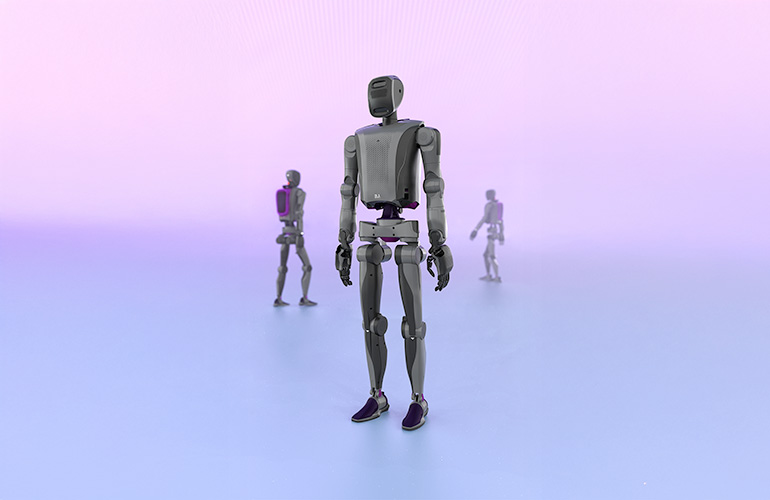
Mentee says it is developing an AI-first humanoid for real-world usefulness and adaptability. | Credit: Mentee Robotics
Mobileye Global Inc. yesterday said it will acquire Mentee Robotics Ltd., which is developing a third-generation, vertically integrated humanoid robot. This transaction would combine Mobileye’s artificial intelligence technology and global production expertise with Mentee’s humanoid platform and AI talent with the goal of creating a global leader in physical AI across two markets: autonomous driving and humanoid robotics.
Jerusalem-based Mobileye said it plans to pay $900 million, including about $612 million in cash and up to 26.2 million shares of Class A stock, subject to the vesting of any Mentee options before closing. It noted that the transaction is subject to customary closing conditions and that it expected to close it in the first quarter of 2026.
Mobileye develops computer vision and machine learning technology for the automotive industry. The company provides hardware and software for advanced driver-assistance systems (ADAS) and autonomous driving. Its product lineup includes the EyeQ family of system-on-chips (SoCs), which process visual data to support vehicle safety features.
Additional offerings include SuperVision for hands-off operation, Chauffeur for eyes-off autonomous driving, and the Drive platform for mobility services. To support these systems, the Mobileye uses Road Experience Management technology to generate maps through data collected from fleets of vehicles from global automakers.
At a CES 2026 press conference, Prof. Amnon Shashua, co-founder and CEO of Mobileye, said he was impressed with the “Real2Sim2Real” technology at the core of Mentee Robotics’ intellectual property. The acquisition shouldn’t come as too much of a surprise, since he is also a co-founder of Mentee Robotics. The Herzliya, Israel-based company emerged from stealth in 2024.
Shashua abstained from voting on matters related to the transaction, which was proposed by a strategic committee that included independent directors and Intel Corp., Mobileye’s largest shareholder.
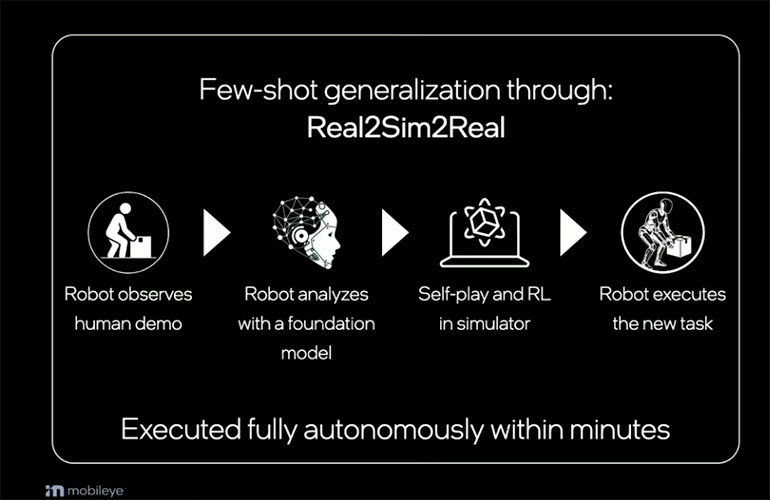
Mobileye is investing in Mentee’s Real2Sim2Real pipeline and AI training IP. | Credit: Mobileye
“Today marks a new chapter for robotics and automotive AI, and the beginning of Mobileye 3.0,” said Shashua. “By combining Mentee’s breakthroughs in humanoid robotics with Mobileye’s expertise in automotive autonomy and its proven ability to productize advanced AI, we have a unique opportunity to lead the evolution of physical AI across robotics and autonomous vehicles on a global scale.”
Prof. Lior Wolf, CEO of Mentee Robotics, said: “I am immensely proud of what Mentee’s multidisciplinary team has accomplished in just four years. We set out to build a platform that combines cutting-edge AI with deeply integrated hardware to make humanoid robots truly useful in real-world environments. Joining forces with Mobileye gives us access to unparalleled AI infrastructure and commercialization expertise, accelerating our mission to bring scalable, safe, and cost-effective humanoid solutions to market.”
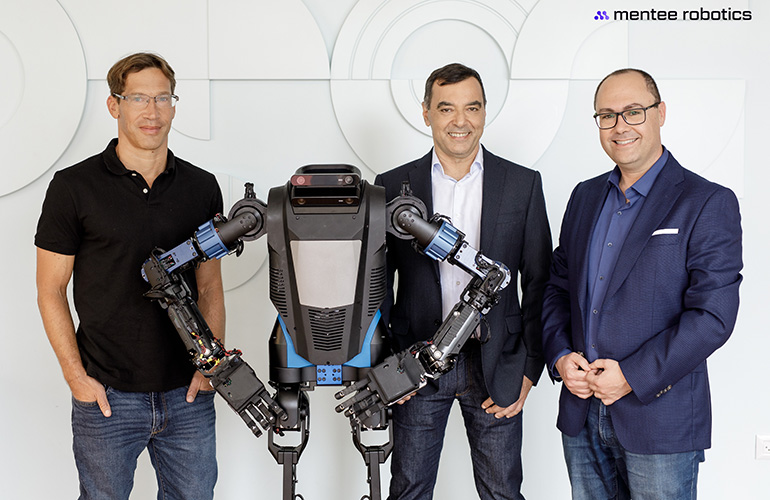
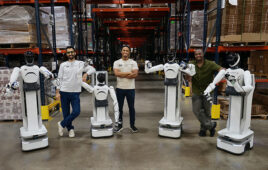
Mentee Robotics co-founders include Lior Wolf, CEO (L); Amnon Shashua, chairman (M); Shai Shalev-Shwartz, chief scientist (R). | Credit: Mentee Robotics
Mentee builds humanoid with environmental awareness
Mentee Robotics said its system integrates scene understanding and natural command execution, can autonomously process tasks without remote control, offers reliable positional movement and navigation, and can safely manipulate rigid objects.
Using simulation, the company is working on “few-shot generalization” technology to enable its robot to quickly learn and execute new skills and tasks with a small number of human demonstrations.
In addition, MenteeBot’s integrated technologies include a proprietary actuator, high-precision motor drivers, a robotic arm equipped with motor-driven tactile sensing, and a hot-swappable battery.
“Both autonomous driving and humanoid robotics face the same fundamental challenge: achieving reliable operation and demonstrating practical value in a human-dominated physical world,” said Mobileye. “Success requires meeting stringent performance requirements, achieving verifiable safety levels, operating efficiently on edge computing platforms, and enabling cost-effective, large-scale deployment.”
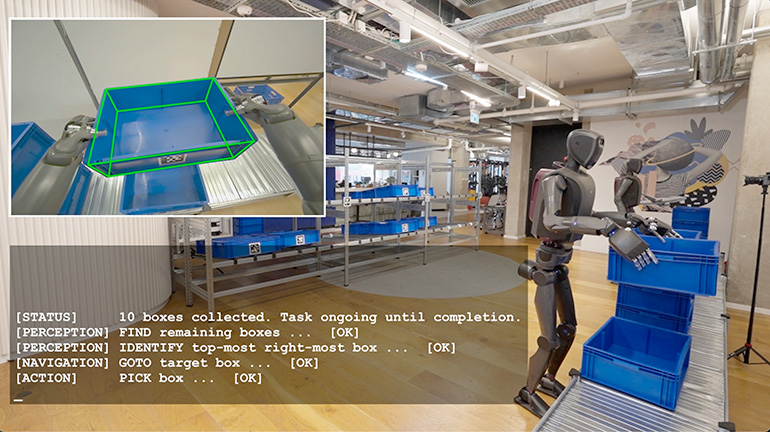
MenteeBot demonstrates autonomous task execution, encompassing scene perception, navigation and locomotion, detecting and localizing objects, grasping, and manipulating objects. | Credit: Mentee Robotics
Mobileye claims acquisition will catalyze physical AI
The companies said the acquisition will advance physical AI across robotics and autonomous vehicles. They cited the following technical synergies:
- Enhanced autonomy stack: Mentee’s advancements in vision-language-action (VLA) models and large-scale simulation with novel Sim2Real transfer techniques complement Mobileye’s autonomy stack. The companies said these capabilities will strengthen autonomous driving systems through improved generalization of long-tail scenarios, faster adaptation to new environments, and more efficient development and validation cycles.
- Safety leadership for humanoids: Humanoid robots operating near humans, other machines, and dynamic environments require a level of verifiable safety that goes beyond reactive collision avoidance, acknowledged Mobileye. Unlike fixed automation, humanoids must reason in real time about human behavior, shared spaces, movable objects, and fragile surroundings, while producing predictable and auditable outcomes. Mobileye brings a safety-first approach developed for autonomous driving, including formal models such as Responsibility-Sensitive Safety (RSS), mathematically grounded decision-making under uncertainty, and system-level redundancy architectures validated at scale. It said these technologies provide a foundation for defining, verifying, and enforcing safe behavior to build the trust, reliability, and regulatory readiness required for humanoids to become economically viable at scale.
- Accelerated commercialization: Mobileye cited its two decades of expertise in bringing advanced technologies to market with tools and infrastructure that adhere to strict safety standards. The company also has AI training infrastructure and relationships with high-volume precision manufacturers that it said will accelerate deployment of humanoids in factories, warehouses, and industrial environments globally.
MenteeBot to roll out for industry in 2028, into homes in 2030
Shashua was measured in his assessment of the go-to-market for the MenteeBot system, which is prudent given the current state of humanoid technology. He said the company plans to begin production in 2027 with partner Aumovio, with a goal of beginning household deployments in 2030.
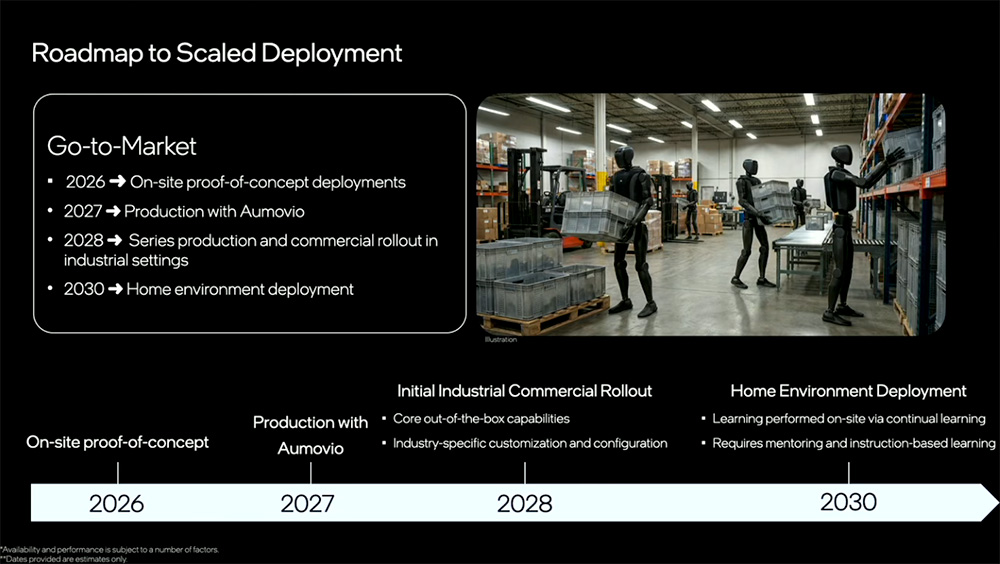
Amnon Shasua outlined MenteeBot’s go-to-market strategy at CES. | Credit: Mobileye
- 2026: Begin proof-of-concept (PoC) engagements with multiple customers to validate the robot in fulfillment centers and assembly environments, and secure production partners.
- 2027: Start manufacturing the first experimental batch of robots to prepare for scaling and production validation.
- 2028: Prepare for commercial deployment in structured environments, with productization, scaling plans, and go-to-market readiness.
- End of decade (~2030): Expand focus to home use, emphasizing continuous learning and generalization capabilities for unstructured environments.
- Ongoing: Optimize the AI training pipeline to reduce task-learning times and coordinate knowledge-sharing between the humanoid project and Mobileye for added synergies.
Shasua said these steps will establish a solid foundation for scaling production, market readiness, and long-term adoption in both industrial and consumer markets.
Watch Mobileye’s full CES 2026 press conference:

Tell Us What You Think!