The Robot Report

  • Home
  • News
  • Technologies
    • Batteries / Power Supplies
    • Cameras / Imaging / Vision
    • Controllers
    • End Effectors
    • Microprocessors / SoCs
    • Motion Control
    • Sensors
    • Soft Robotics
    • Software / Simulation
  • Development
    • Artificial Intelligence
    • Human Robot Interaction / Haptics
    • Mobility / Navigation
    • Research
  • Robots
    • AGVs
    • AMRs
    • Consumer
    • Collaborative Robots
    • Drones
    • Humanoids
    • Industrial
    • Self-Driving Vehicles
    • Unmanned Maritime Systems
  • Business
    • Financial
      • Investments
      • Mergers & Acquisitions
      • Earnings
    • Markets
      • Agriculture
      • Healthcare
      • Logistics
      • Manufacturing
      • Mining
      • Security
    • RBR50
      • RBR50 Winners 2025
      • RBR50 Winners 2024
      • RBR50 Winners 2023
      • RBR50 Winners 2022
      • RBR50 Winners 2021
  • Resources
    • Automated Warehouse Research Reports
    • Digital Issues
    • eBooks
    • Publications
      • Automated Warehouse
      • Collaborative Robotics Trends
    • Search Robotics Database
    • Videos
    • Webinars / Digital Events
  • Events
    • RoboBusiness
    • Robotics Summit & Expo
    • DeviceTalks
    • R&D 100
    • Robotics Weeks
  • Podcast
    • Episodes
  • Advertise
  • Subscribe

ISO and ASTM define standard for additive manufacturing in construction

By Eugene Demaitre | December 8, 2023

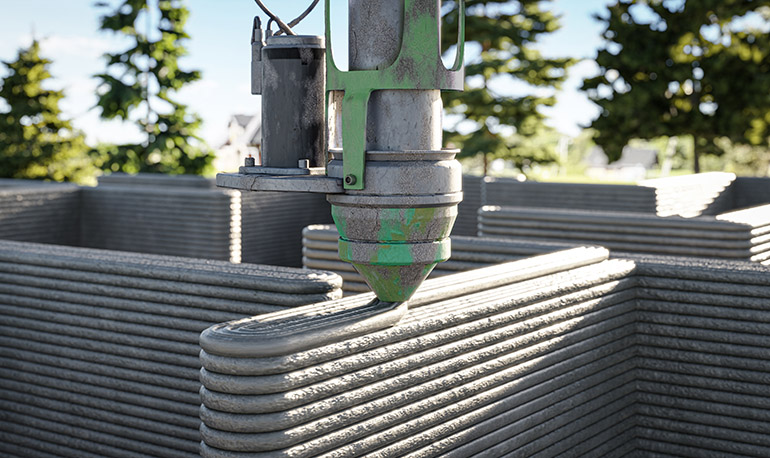
Additive manufacturing for construction gets safety standards from ISO.

ISO and ASTM have jointly defined standards for additive manufacturing in construction. Credit: Adobe Stock

Robotic arms and additive manufacturing are changing how materials are handled and how buildings are constructed. However, as robots enter new environments and take on new tasks, the need grows for developers, integrators, and end users to be aware of quality and safety requirements. The International Organization for Standardization, or ISO, has posted documents to help them meet those requirements.

Standard defines safe design for industrial end effectors

An example of relevant industrial standards, ISO/TR 20218-1:2018 provides guidance on the safe design and integration of end effectors for robots. It also adds to ISO 10218-2:2011 on how to integrate robots.

The document covers collaborative robot applications, where robots share workspace with people.

“In such collaborative applications, the end-effector design is of major importance, particularly characteristics such as shapes, surfaces and application function (e.g. clamping forces, residual material generation, temperature),” wrote ISO.

It emphasized the importance of conducting safety assessments. Even when robots are marketed as collaborative, their payloads or motion may not be.

Safety incidents are rare, but interested parties should do their due diligence when developing and deploying robots, noted Aaron Prather, director of robotics and autonomous systems at ASTM International.

ISO and ASTM publish first joint standard for AC

Announced this week, ISO/ASTM 52939:2023 specifies qualification principles for structural and infrastructure elements in additive manufacturing for construction. It provides criteria for additive construction (AC) processes, quality, and factors for system operations, as well as processes on a site.

The new standard applies to all additive manufacturing technologies in building and construction of load bearing and non-load bearing structures, as well as structural elements for residential and commercial applications. It does not cover metals, material properties, operational safety, packaging of equipment and materials, or guidelines for operating specific robots.

ISO/ASTM 52939:2023 is the first jointly published standard from ISO and ASTM International, said Prather. Standards bodies typically focus on different technologies, applications, and industries, but global cooperation can improve worker safety, product quality, and regulatory environments, he noted.

“This addresses moving from traditional construction standards and bridging over to additive,” Prather told The Robot Report. “[It could be] the first step on many to come.”

“This standard also sets the basis for the coming construction robot standards that are in the works across numerous organizations,” he added.

The standard is voluntary, and builders must follow local and regional requirements, noted ISO. In October, ASTM International announced a roadmap for digitalization of the construction industry, sponsored by the National Institute of Science and Technology (NIST).


SITE AD for the 2026 Robotics Summit save the date.

Additive manufacturing changing construction 

Several companies have demonstrated the potential of additive manufacturing for production-grade elements and 3D-printed buildings, including ABB, Branch Technology, HS2, ICON Technology, Mighty Buildings, and SQ4D.

These systems often combine concrete extruders with gantry robots or industrial robot arms. There has also been research into using drones for repair of difficult-to-reach structures, and NASA conducted a 3D-printed habitat challenge in 2019.

Possible advantages include stronger and unique architectures, less waste of materials, and even reduction in carbon emissions, according to research reports from Palgrave Macmillan and Frontiers Media. The global market for 3D printing systems in construction is modest but could increase from $13.38 million in 2023 to $22.63 million by 2030 at a compound annual growth rate (CAGR) of 7.8%, predicted Virtue Market Research.


About The Author

Eugene Demaitre

Eugene Demaitre is editorial director of the robotics group at WTWH Media. He was senior editor of The Robot Report from 2019 to 2020 and editorial director of Robotics 24/7 from 2020 to 2023. Prior to working at WTWH Media, Demaitre was an editor at BNA (now part of Bloomberg), Computerworld, TechTarget, and Robotics Business Review.

Demaitre has participated in robotics webcasts, podcasts, and conferences worldwide. He has a master's from the George Washington University and lives in the Boston area.

Tell Us What You Think! Cancel reply

This site uses Akismet to reduce spam. Learn how your comment data is processed.

Related Articles Read More >

An autonomous dozer from Caterpillar.
Caterpillar partners with NVIDIA to lay the foundation for autonomous systems
Buildroid demonstrates its BLR robot at a construction site.
Buildroid AI expands simulation-first robotics platform to U.S. sites
hero image of the bobcat rx3 prototype.
Doosan Bobcat unveils RX3 autonomous concept loader
The 1200CX can reduce work at height, cut 70% of repetitive motion, and capture 99% of dust, claims Canvas.
Oshkosh acquires core technology developed by Canvas

RBR50 Innovation Awards

“rr
EXPAND YOUR KNOWLEDGE AND STAY CONNECTED
Get the latest info on technologies, tools and strategies for Robotics Professionals.

Latest Episode of The Robot Report Podcast

Automated Warehouse Research Reports

Sponsored Content

  • Supporting the future of medical robotics with smarter motor solutions
  • YUAN Unveils Next-Gen AI Robotics Powered by NVIDIA for Land, Sea & Air
  • ASMPT chooses Renishaw for high-quality motion control
  • Revolutionizing Manufacturing with Smart Factories
  • How to Set Up a Planetary Gear Motion with SOLIDWORKS
The Robot Report
  • Automated Warehouse
  • RoboBusiness Event
  • Robotics Summit & Expo
  • About The Robot Report
  • Subscribe
  • Contact Us

Copyright © 2026 WTWH Media LLC. All Rights Reserved. The material on this site may not be reproduced, distributed, transmitted, cached or otherwise used, except with the prior written permission of WTWH Media
Privacy Policy | Advertising | About Us

Search The Robot Report

  • Home
  • News
  • Technologies
    • Batteries / Power Supplies
    • Cameras / Imaging / Vision
    • Controllers
    • End Effectors
    • Microprocessors / SoCs
    • Motion Control
    • Sensors
    • Soft Robotics
    • Software / Simulation
  • Development
    • Artificial Intelligence
    • Human Robot Interaction / Haptics
    • Mobility / Navigation
    • Research
  • Robots
    • AGVs
    • AMRs
    • Consumer
    • Collaborative Robots
    • Drones
    • Humanoids
    • Industrial
    • Self-Driving Vehicles
    • Unmanned Maritime Systems
  • Business
    • Financial
      • Investments
      • Mergers & Acquisitions
      • Earnings
    • Markets
      • Agriculture
      • Healthcare
      • Logistics
      • Manufacturing
      • Mining
      • Security
    • RBR50
      • RBR50 Winners 2025
      • RBR50 Winners 2024
      • RBR50 Winners 2023
      • RBR50 Winners 2022
      • RBR50 Winners 2021
  • Resources
    • Automated Warehouse Research Reports
    • Digital Issues
    • eBooks
    • Publications
      • Automated Warehouse
      • Collaborative Robotics Trends
    • Search Robotics Database
    • Videos
    • Webinars / Digital Events
  • Events
    • RoboBusiness
    • Robotics Summit & Expo
    • DeviceTalks
    • R&D 100
    • Robotics Weeks
  • Podcast
    • Episodes
  • Advertise
  • Subscribe