
|
Listen to this article
 |
Goodbye to the hydraulic version of Atlas and hello to the electric model designed for commercialization. That’s the message from Boston Dynamics Inc., which yesterday retired the older version of its humanoid robot after 15 years of development and today showed a preview of its successor.
“The next generation of the Atlas program builds on decades of research and furthers our commitment to delivering the most capable, useful mobile robots solving the toughest challenges in the industry today: with Spot, with Stretch, and now with Atlas,” said the company in a blog post. Spot is a quadruped used in facilities inspection and other tasks, and Stretch is designed to unload trucks.
Boston Dynamics began with humanoids by sawing one of its pneumatically powered quadrupeds in half back in 2009. By 2016, the Waltham, Mass.-based company showed that its robot could walk, open a door, and maintain its balance while being shoved by a person holding a hockey stick, all without a tether.
Roboticists continued to improve Atlas, giving it a smaller form factor and more sensors, training its artificial intelligence, and enabling it to do increasingly impressive feats. They ranged from parkour and dancing to taking tools through a mock construction site.
In fact, it was that demonstration of Atlas manipulating a plank, picking up a bag of tools, and taking it to a worker that earned Boston Dynamics an RBR50 Robotics Innovation Award. The company will be exhibiting at the RBR50 Showcase at the Robotics Summit & Expo on May 1 and 2.
 Learn from Agility Robotics, Amazon, Disney, Teradyne and many more.
Boston Dynamics evolves with the times
As capable as the YouTube darling was, the older version of Atlas still had limitations, both in range of motion and in terms of size and power usage. Boston Dynamics noted that it designed its legged robots to operate in unstructured environments, and it acknowledged that Atlas was initially a research and development project rather than a commercial product.
In the meantime, the company itself changed owners, from Google in 2013 to SoftBank in 2017 and most recently to Hyundai in 2020. Along with those changes came an increasing focus on robots such as Spot and Stretch serving industrial needs. To continue pure research, Hyundai founded the Boston Dynamics AI Institute in 2022.
“The AI Institute recently launched a new version of Spot with an API [application programming interface] designed for researchers,” said Robert Playter, CEO of Boston Dynamics. “We’re talking about how to jointly solve some big challenges — the diversity of manipulation tasks we need to do with this robot [Atlas] is huge, and AI is essential to enabling that generality.”
Playter told The Robot Report that Boston Dynamics needs results within two to three years, while the AI Institute has more of a five-year timeframe.
Robot lessons apply to fleets, new Atlas
“It takes a solid year from a clean sheet to a new robot,” said Playter. “We wanted to know that we could solve essential dexterous manipulation problems before releasing the product.”
Boston Dynamics learned numerous lessons from commercializing Spot and Stretch, he said. It has improved control policies, upgraded actuation, and minimized joint complexity. The new Atlas has three-fingered grippers.
The Orbit fleet management software, which initially applies to indoor deployments of Spot, could also help supervise Stretch and Atlas.
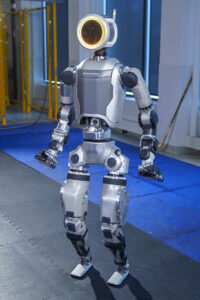
Atlas gets ready for mobile manipulation in industrial settings. Source: Boston Dynamics
“Everything we understood, from the time of launching Spot as a prototype to it being a reliable product deployed in fleets, is going into the new Atlas,” Playter said. “We’re confident AI and Orbit will help enhance behaviors. For instance, by minimizing slipping on surfaces at Anheuser-Busch, we proved that we can develop algorithms and make it reliable.”
“Now, 1,500 robots in our fleet have them running,” he added. “It’s essential for customers like Purina to monitor and manage fleets as a vehicle for collecting data. As we develop and download new capabilities, Orbit becomes a hub for an ecosystem of different robots.”
Safety and autonomy are basic building blocks
Boston Dynamics has considered safe collaboration in its development of the new Atlas. ASTM International is developing safety standards for legged robots.
“We recognized early on that Atlas is going to work in spaces that have people in them,” said Playter. “This sets the bar much higher than lidar with AMRs [autonomous mobile robots].”
“We started thinking about functionally safe 3D vision,” he recalled. “We started with Stretch inside a container, but ultimately, we want it going everywhere in a warehouse. Advanced, functionally safe, remote vision and onboard systems are essential to solving safety.”
While Spot and Atlas are often teleoperated, Playter said this is a necessary step toward greater levels of autonomy.
“Making the robots knowledgeable about different types of objects and how to grasp them, teleoperation is just a tool for providing examples and data to the robot,” he explained. “It’s not a useful way of building intuition, but it’s easier if you can operate robots at a higher and higher level. Like you don’t need to tell Spot where to plant its feet, you don’t want to tell Atlas where to grasp.”
In the new video below, the previous version of Atlas handles automotive parts and real products weighing up to 25 lb. (11.3 kg).
Atlas ready for rivals in the humanoid race
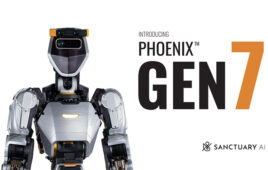
Over the past two years, the number of humanoid robots in development has rapidly grown. It now includes Agility Robotics‘ Digit, Tesla’s Optimus, and Figure AI‘s Figure 01. In the two past weeks alone, Rainbow Robotics, Sanctuary AI, and Mentee Robotics have all made announcements.
Investment has also been flowing to humanoid companies, with 1X Technologies raising $100 million in January, Figure AI raising $675 million in February, and Accenture investing in Sanctuary AI in March.
Humanoid robots have advanced in parallel with generative AI, and Playter said he welcomes the competition.
“There were three seminal events: Boston Dynamics got acquired for $1 billion, interest in Tesla’s robot validated what we’ve done for a long time, and the emergence of new AI holds the promise of generalization of tasks,” he said. “They’ve inspired lots of new players, but having new tech isn’t all you need to have a commercial product. You need to focus on a use case, build a reliable machine, and manufacture it in a way to build a business. We want to avoid a ‘humanoid winter,’ so rollouts have to be real.”
Playter added that practical design and proper implementation of AI will help differentiate robots rather than focusing on making them more human-like. The new version of Atlas demonstrated that point in how it stood up in the video at the top of this article.
“It’s not talking to a robot that moves the needle, but whether you can build a robot that eventually does 500 tasks,” he said. “Anthropomorphism blows things out of perspective. We did not want a human-shaped head for Atlas. We want people to remember it’s a machine and that it can move in ways humans can’t.”
The financial stability of the businesses involved will also be relevant for commercial success, said Playter.
“It takes sustained investment; these are expensive products to launch,” he noted. “Having products already out helps build momentum.”
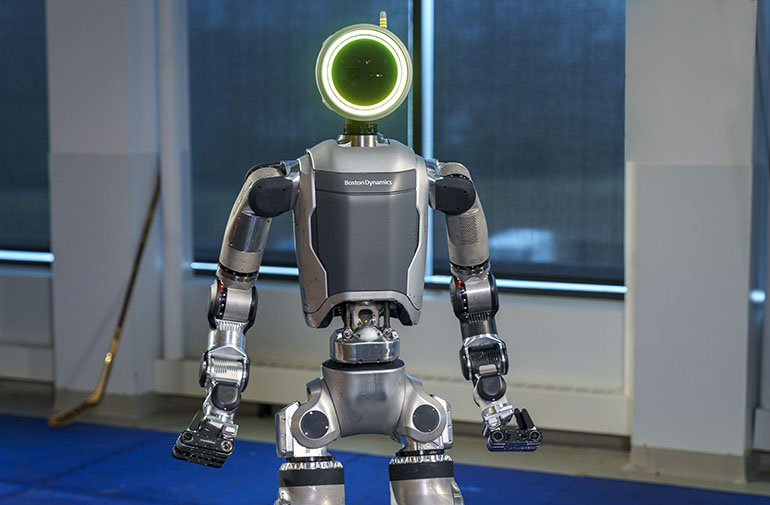
Atlas is humanoid — to a point. Source: Boston Dynamics
When will we see the new robot in the wild?
Boston Dynamics will begin testing the all-electric version of Atlas with parent company Hyundai and select partners next year, said Playter.
“We’re beginning in their factory,” he told The Robot Report. “In addition to the target application of a lot of parts movement — a special kind of logistics in automotive production — I think that will evolve as the dexterity of the robots improves over time.”
“We see robots in the workplace as an evolution, a continuum from Spot to Atlas,” asserted Playter. “Each product in the series informs the launch of the next.”
“Industries will have to figure out how to adapt and incorporate humanoids into their facilities,” he said. “We’ll actually see robots in the wild in factories beginning next year. We want a diversity of tasks.”

Tell Us What You Think!