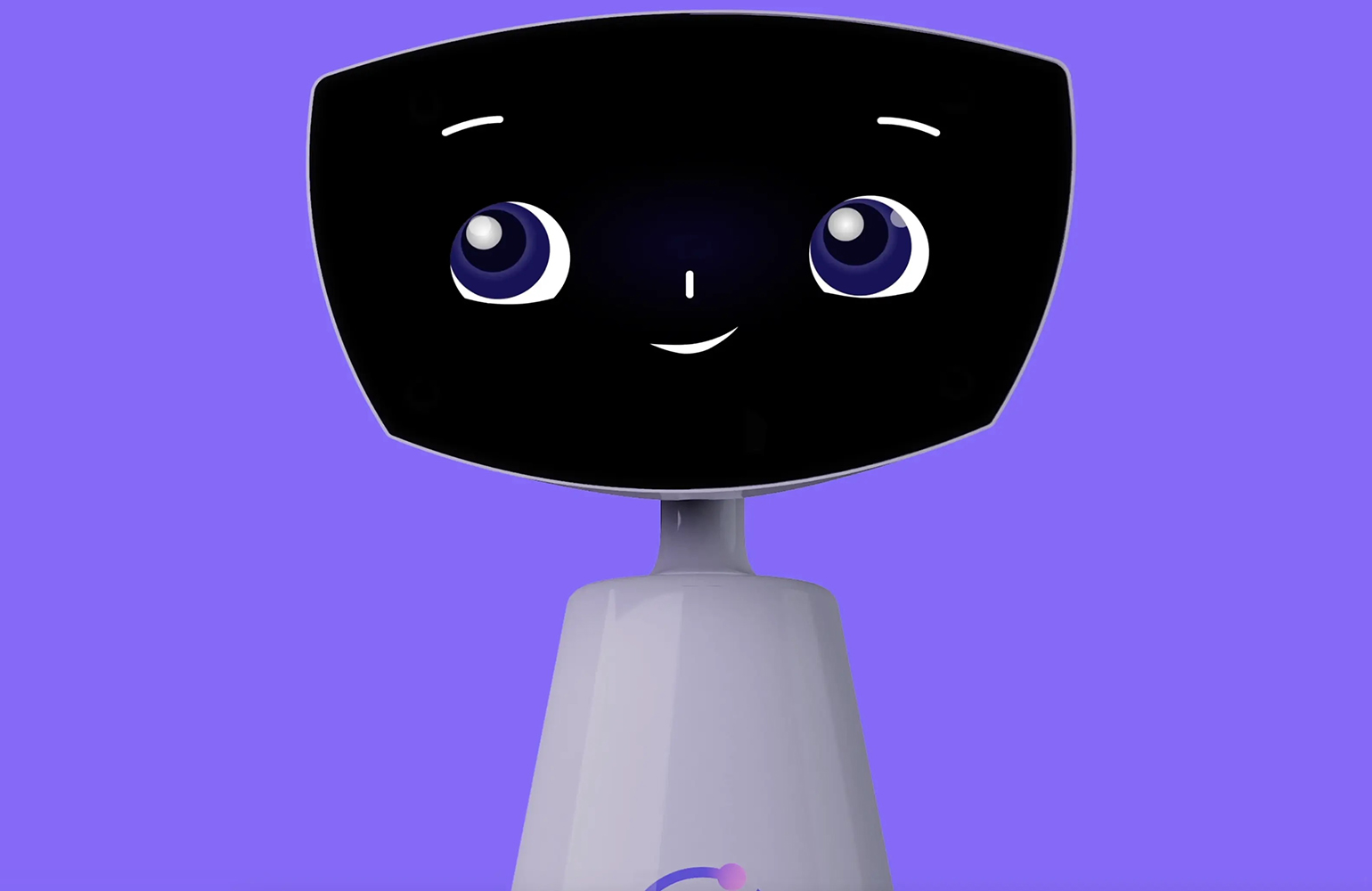
Robin is designed to support healthcare teams and patients. | Source: Expper Technologies
Every day, staffers in pediatrics hospitals and nursing home are doing everything they can to keep their patients calm and cooperative. In around 30 hospitals, dental clinics, and adult care facilities, this work is aided by Robin, a mobile robot from Expper Technologies.
Robin is a socially assistive robot that aims to enhance the emotional well-being of the people it interacts with. The robot is kid-sized, with a friendly face and a simply designed body. It moves around using a wheeled base and doesn’t have any arms or manipulators. The system does all of its interaction with the world through its speech.
Glendale, Calif.-based Expper has developed a fictional backstory and distinct personality behind Robin. Davit Martirosyan, the co-founder and head of engineering at Expper, described the robot as a kid who’s very interested in doing different things and very open to learning new things.
“Robin came from the universe to Earth, and it always wants to go back to the universe, see what it can see there, but it’s impossible for him,” Martirosyan told The Robot Report. “So, that means Robin has a dream, and he wants to know everyone, to meet everyone, become friends with everyone.”
As a founder of Expper, Martirosyan has always been intimately familiar with Robin. But now, the therapeutic system is with him in his home. This means he is experiencing the technology both as an engineer and as part of his everyday life.
Expper develops robot during the pandemic
Expper started in 2019 and sold its first robots in early 2020, right as the COVID-19 pandemic started to shut things down.
“We sold our first robot here in LA to a dental clinic, and we started to build that robot remotely. Imagine, it’s a hardware product,” Martirosyan. “We built [the robot] in one apartment. The software was in another apartment. Then in another apartment, we did tests on this robot.”
The team was able to balance this spread out work and get its first system, another robot for UCLA Children’s Hospital, out into the world. During this time, the hospital did a pilot and research on how robots help kids handle anxiety in healthcare settings.
Expper found that the pandemic was both a drawback and an opportunity. One one hand, it posed logistical challenges to building the robot.
On the other hand, children who found themselves in the hospital during COVID were often separated from their families. This meant that they could benefit more from Robin’s presence.
What does Robin do during its deployments?
Robin can be deployed across hospitals, dental clinics, and eldercare homes, so its job can vary. Dental clinics are some of the robot’s simpler deployments, according to Expper.
“When kids come [into a dental clinic], everyone knows it’s very hard and painful to do some procedure on the tooth, so Robin helps introduce them to what procedure they’re going to have,” Martirosyan said. Typically, because of the small size in dental clinics, Robin remains stationary during these deployments.
Robin acts like a peer for other children to lean on. It will tell them about its experience getting the same procedure to help them feel more comfortable.
And, importantly, the robot plays with kids to help keep them distracted and calm while they wait to see a doctor or to get a procedure. Robin doesn’t judge, and it doesn’t guide or push the kids to do things. Instead, it just listens, Martirosyan asserted.
In hospitals, Robin can also move move around to different rooms in the hospital. Martirosyan said the Expper team saw the robot’s impact early into its deployments. He recalled a case involving a child who refused to eat for two days.
“Everyone was stressed — doctors, parents — and they didn’t know what to do,” Martirosyan said. “Robin came into the room and started to play around with him. After around 15 or 20 minutes, Robin says, ‘I need to go.’ The kid said, ‘No, stay here.’ Robin answered, ‘You know, I need to charge my battery, and you also need to charge yourself. You need to eat.'”
When Expper first started, Martirosyan said Expper focused on tailoring Robin to interactions with children. However, the company quickly learned that adults were interested in interacting with Robin as well.
System is designed to safely operate in chaotic environments
Part of the reason Robin typically stays stationary in smaller dental clinics is for safety.
“They’re just standing in one place and talking with kids, because the space is not big enough,” noted Martirosyan. “Robin usually is in a waiting room, so we don’t need to move.”
In a hospital, an Expper teleoperator monitors the robot as it navigates hallways. In addition, if Robin looses connection completely, it’s programmed to stop moving.
To keep the robot running, a hospital will also assign members of its own staff to be in charge of Robin.
“They can guide Robin where to go, when to go, what to do,” Martirosyan said. “They can also share some small information about patients so Robin can work around it.”
For example, if the child has a favorite movie, they can inform the robot so it will know what to chat about.
“Also, Robin has operators behind the scenes to control everything,” Martirosyan said. “So, in most situations, AI can handle everything. If it’s something that goes out of that scope, Expper can help Robin to figure that out.”
What’s next for Robin?
Expper already has around 10 new deployments planned for Robin, Martirosyan said. “We have more than five years of life experience in hospitals and clinics, so I can say that the technology proved itself, and it works,” he said.
Looking ahead, Expper plans to continue scaling its robots and working to make Robin more sustainable. Additionally, the company wants to lead the industry in defining how humans will reliably communicate with robots.
“Everyone already expects that robots will be around us very soon, so it’s a huge change in the world,” Martirosyan said. “We need to define how machines should communicate with people. They definitely cannot be their friends; they are not human. They also can’t be just another gadget. It’s something in the middle.”
“Our mission is to make that communication, that change, be very smooth … and very acceptable for everyone, because everyone’s going to benefit from these new technologies,” he added.
 Register now and save on your pass to RoboBusiness 2026

Tell Us What You Think!