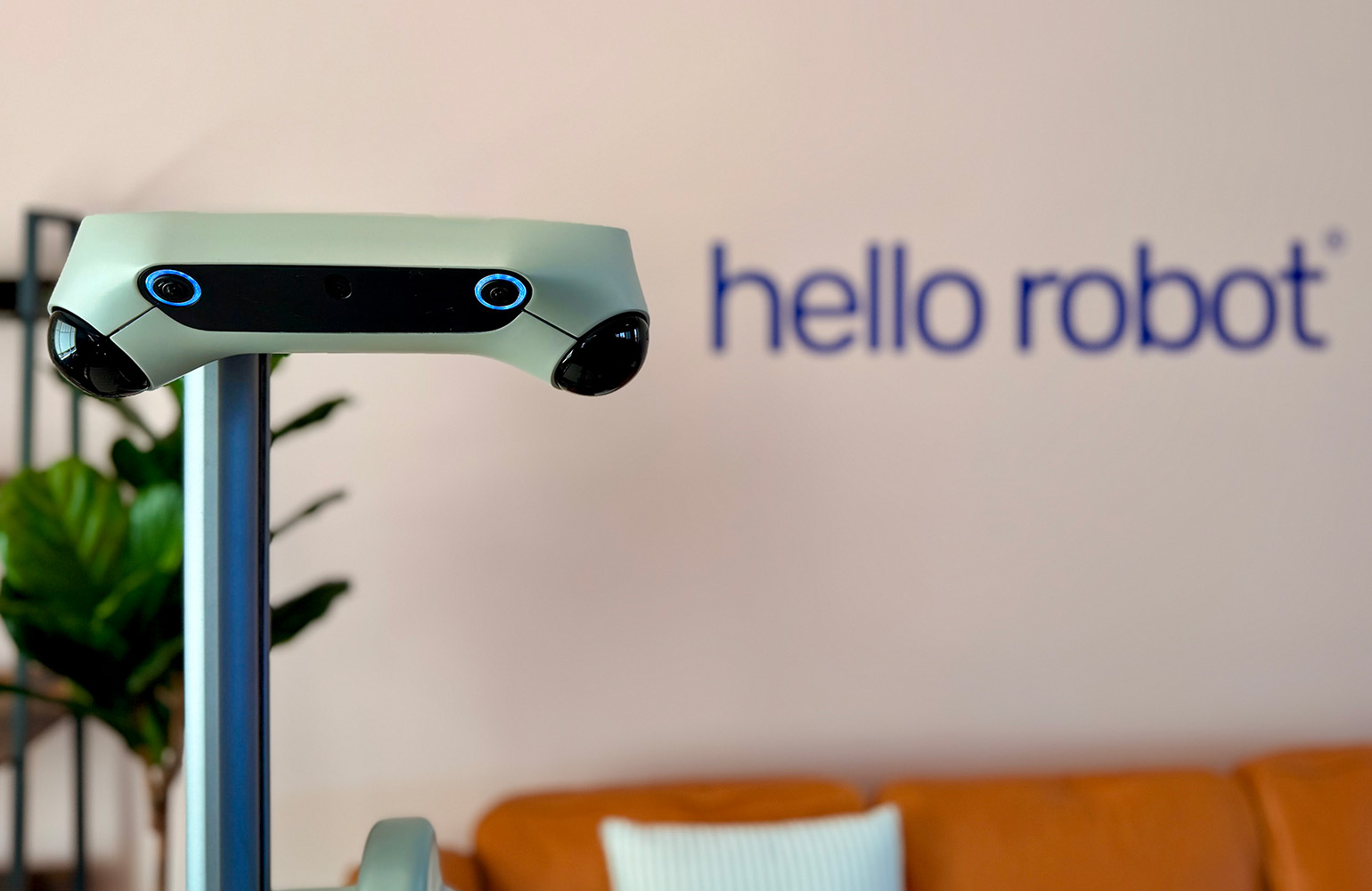
Stretch 4 has a new power system that enables up to eight hours of runtime and a docking station that supports self-charging. | Source: Hello Robot
Hello Robot, the team behind the Stretch mobile manipulation platform, today announced the release of Stretch 4. Available now for $29,950, Stretch 4 is an open-source robotics platform designed for researchers, developers, and application engineers building the next wave of physical AI applications for general-purpose robotics.
“There’s just a whole set of new features, some hidden, some very obvious, that just make this fundamentally a total redesign, top to bottom. So, we’re very excited about it. We think it’s just a fantastic robot,” Charlie Kemp, co-founder and chief technology officer of Hello Robot, told The Robot Report.
Stretch 4 features a telescoping arm, an omnidirectional base, and a sophisticated sensor array. This array includes two hemispherical 3D lidars, three high-resolution cameras, and six laser line sensors. The architecture follows the “sensor-rich” philosophy used by Waymo to achieve high-fidelity safety in self-driving, Hello Robot said.
In 2025, Hello Robot’s Stretch 3 won the RBR50 Robotics Innovation Award for Robots for Good.
Hello Robot ensures that robot can see its surroundings
Stretch 4 is equipped with a wide-angle 3D sensing head. The sensor head is fully calibrated and rigidly fixed with respect to the arm and mobile base, simplifying autonomy, said Hello Robot.
“These robots are fairly blind and dumb about people today, and often they can’t see what’s happening. If you’re in a home, and there’s a pet or a kid behind the robot, it can’t see that,” Aaron Edsinger, co-founder and CEO of Hello Robot, told The Robot Report. “So we really wanted to take seriously the notion of enabling safety through sensing.”
Stretch 4 features two hemispherical 3D lidars and global-shutter fisheye RGB cameras that observe the surroundings, dramatically reducing blind spots even when the arm is in use. Meanwhile, one central, high-resolution RGB camera observes the gripper’s workspace, supporting dexterous manipulation.
These features, Hello Robot said, will help the mobile manipulator handle chaotic environments. “What we’ve really pushed on is saying, you have to be able to sense your environment, if you’re in a dynamic setting, like a home with cords, a threshold, staircases, kids, all sorts of stuff. That’s where the sensing suite really comes into play,” Edsinger said.
Stretch 4 is faster and bigger, but safety is still built in
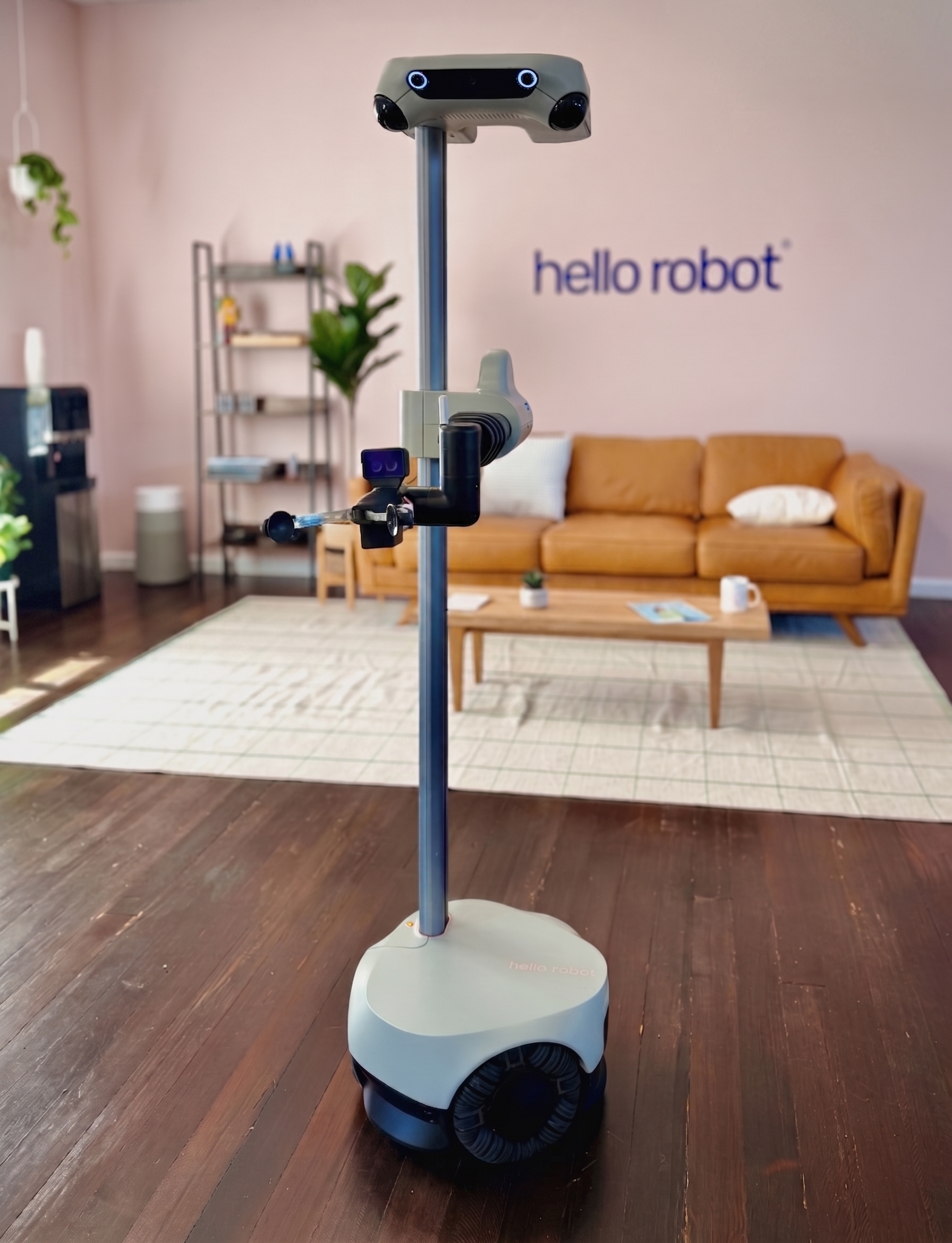
Over a thousand users from 23 countries have piloted Stretch since 2020. | Source: Hello Robot
Stretch 4’s arm, lift, and base operate at twice the speed of Stretch 3, while its total reach has been extended by 10%.
“[The robot] needs to be taller because people with severe mobility impairments are often in powered wheelchairs, and so their heads are higher off the ground,” Kemp said. “You want the robot to have dexterity around them. So, as much as we loved having a shorter, lighter-weight robot, the realities of that use case that we really care about meant that we had to make Stretch a bit bigger.”
Despite its bigger size, Stretch still has some built-in safety components. “Safety does become an even bigger consideration as you get bigger, stronger, and faster,” noted Edsinger. “I still believe the design itself is fundamentally much better than anything out there in terms of safety, because of the intrinsic physics of what we’re doing.”
Hello Robot keeps the weight of the robot low to the ground, which makes it less likely to fall over. Additionally, the team doesn’t use actuators that have to fight against gravity to lift the arm, making it more reliable.
“We’re still building out that safety layer; we wouldn’t say it’s safety-certified or anything like that,” Edsinger continued. “There’s still work to be done, but the fundamental design principles are totally remarkable for what else is out there in the industry right now.”
Assistive system is designed for portability
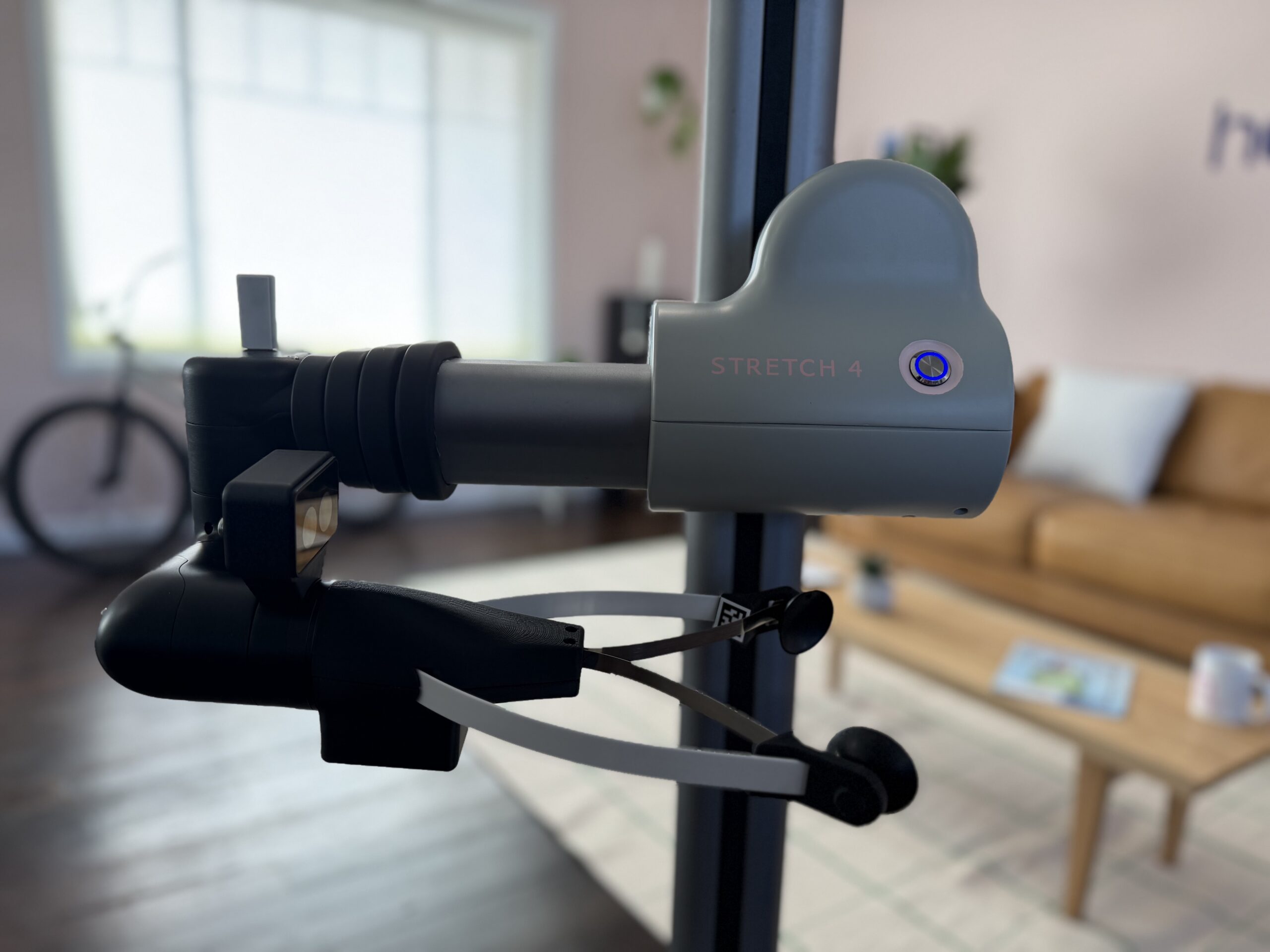
Users can control Stretch 4 using a mobile phone app. | Source: Hello Robot
With Stretch 3, Edsinger said customers enjoyed being able to take the robot and toss it into the back of their cars. “Stretch 4 is heavier, taller, stronger, faster, and it’s a really careful balance. We really struggled with that because we didn’t want to lose that magic,” he said.
“You still have to be able to pick it up and put it in the back of a car,” added Edsinger. “You should be able to take it up a staircase. It should feel like you can just hit the stop button, push it out of the way, and put it in your closet.”
To make the robot easier to transport, Hello Robot made the battery pack removable so that people could easily remove 30 lb. (13.6 kg) from the robot.
Stretch 4 also has an omnidirectional base, which is intended to remove friction in people’s lives when it comes to getting the robot into exactly the right position. The 7.8 in (20 cm) wheels let the robot traverse indoor terrain, including carpets, rugs, and thresholds.
In addition, the robot has a new quick-release mechanism that allows users to efficiently swap between a compliant gripper, a parallel jaw gripper, and a tablet interface. It features eight redundant degrees of freedom plus the gripper, including an ambidextrous wrist with an integrated depth camera that can be configured for either left- or right-handed operation.
Early testers respond to Stretch 4
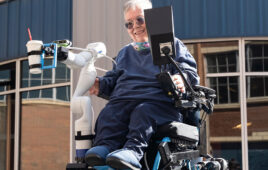
Hello Robot works with a select group of early adopters to see how Stretch fits into their lives. One of these people is Henry Evans, a non-verbal person with quadriplegia.
“I’ve had the privilege of working with the Hello Robot team for some time, and what strikes me about Stretch 4 is its versatility,” stated Evans, the co-founder of Robots for Humanity. “It has an omnidirectional base, which gives it the freedom to move effortlessly, in any direction, and it has simple, intuitive controls, which make it feel like an extension of my body. For me, that is particularly important, because Stretch 4 represents my only means of interacting with my physical environment. Stretch 4 gives me greater confidence, deeper independence, and a life with more possibility.”
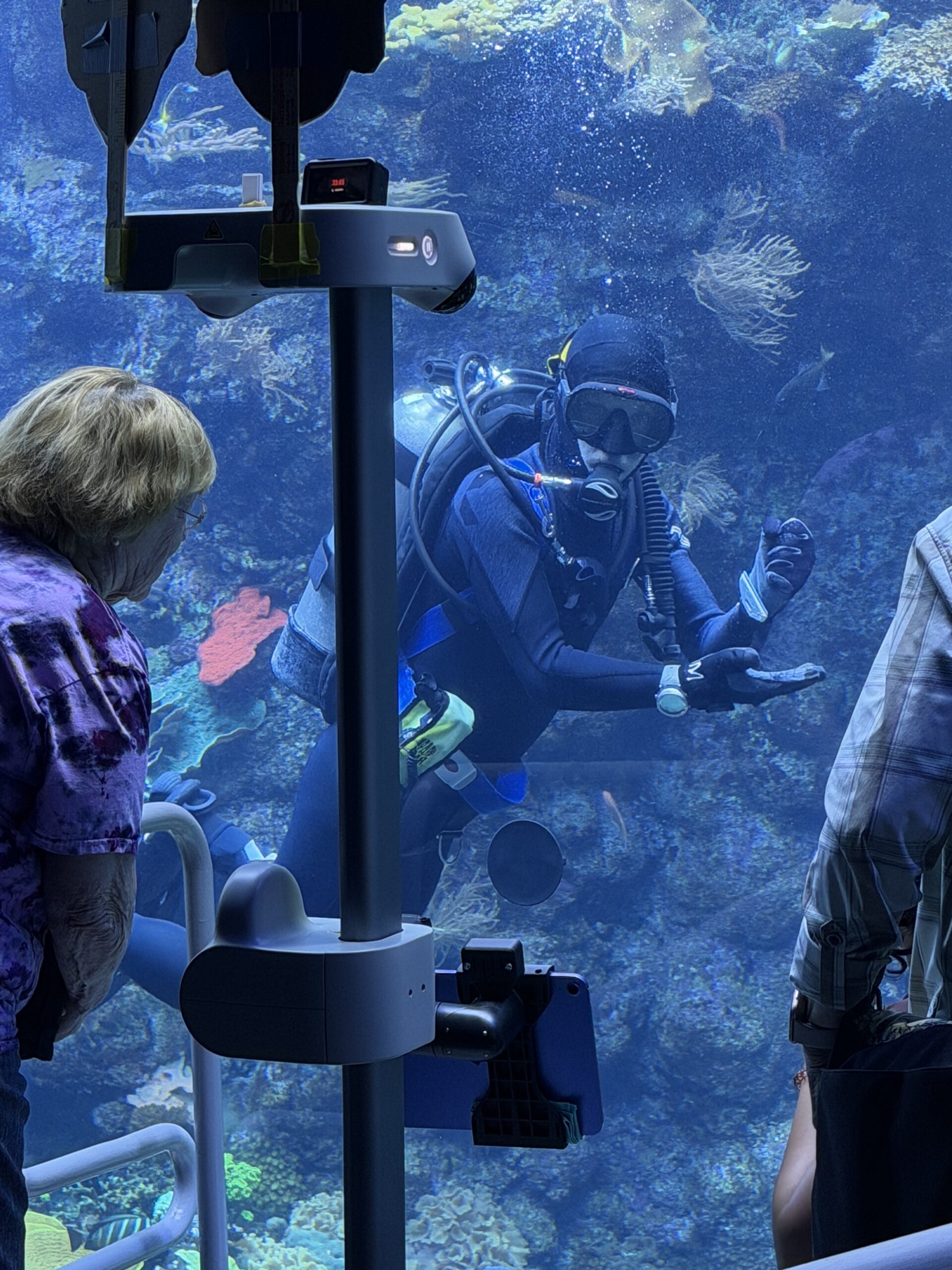
Georgena is playing rock, paper, scissors via the Stretch robot at the aquarium. | Source: Hello Robot
Kemp and Edsinger told the story of Georgena, an early Stretch 4 user in Portland. Georgena has multiple sclerosis, which makes it difficult for her to leave the house. This didn’t stop her, however, from virtually taking a trip to the aquarium with her sisters.
“Her sisters actually traveled to the aquarium, and then she toured the aquarium using the robot,” Kemp said. With an easy-to-swap-out end effector, which this time was a tablet, Georgena was able to interact with people at the aquarium.
“Then the divers came out and did their thing, and afterwards, they’re hanging out, and she drives over and gets to chat with the divers or gesture. They end up playing rock, paper, scissors through the aquarium wall,” Edsinger said.
What’s next for Hello Robot?
Stretch 4 is just one stop on Hello Robot’s roadmap to producing an assistive product that is ready for market.
“One of our main goals [with Stretch 4] was to make it so that we could pilot [the robot] with people with severe mobility impairments and have confidence that the robot can be successful there to set us up for having a next version, which would actually be an assistive product,” Kemp said.
Kemp said he believes that Hello Robot will need another iteration before it starts selling the assistive version of Stretch. While the Martinez, Calif.-based company is focused on making a robot that can assist people in the home, it can handle some industrial tasks.
“We’ve been doing a pilot on the enterprise side, and I think they’ve been incredibly positive as well,” Edsinger said. “I think the main thing is the speed at which we can get up and running and do useful tasks.”
“Our main goal for piloting in the coming year is daily use over long periods of time,” Kemp said. “In general, we feel like one of the big mistakes that’s commonly made in robotics is to prematurely scale. We really don’t want to scale that use case until we have examples of people piloting it on a daily basis, where they are happy to use it over extended periods of time. Until we’ve achieved that, it wouldn’t make sense to scale up.”
Editor’s note: Hello Robot will be bringing Stretch 4 to the Robotics Summit & Expo, which will be in Boston on May 27 and 28. The company will be on the show floor in Booth 839.
 Register now and help us celebrate 20 years of RoboBusiness!

Tell Us What You Think!