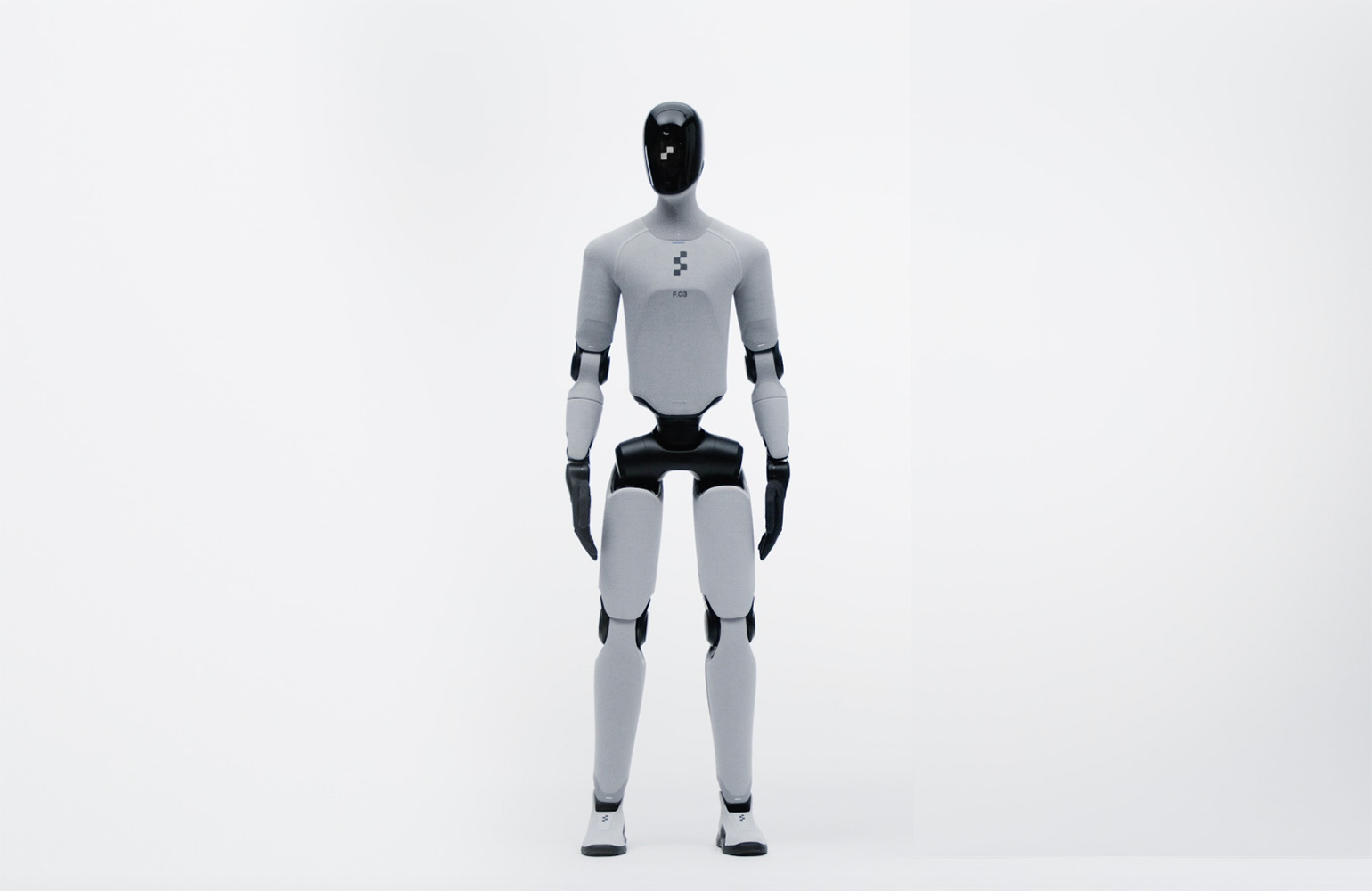
The new humanoid features a redesigned sensory suite and hand system to reduce manufacturing costs and make it better fit for the household use, said Figure AI. The San Jose, Calif.-based company recently established a new supply chain and an entirely new process for manufacturing humanoid robots.
Humanoids have dominated industry headlines in the past few years, and Figure has emerged as a leader in the space. Last month, the company closed its Series C funding round. With the round, it surpassed $1 billion in committed capital, bringing its post-money valuation to $39 billion.
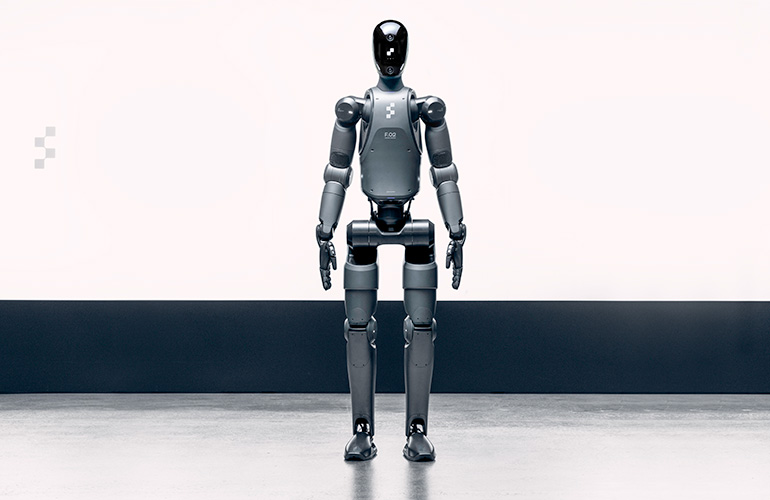
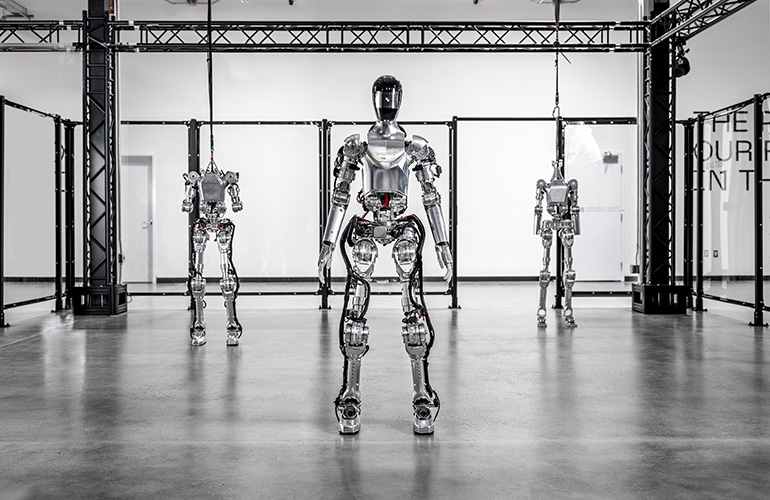
In December 2024, Figure delivered Figure 02 systems to a paying customer. It won a 2024 RBR50 Robotics Innovation Award for the fast pace of development of its systems, with Figure 01 taking its first public steps in 2023. Now, Figure plans to ship 100,000 humanoids over the next four years.
Figure 03 is designed for AI
Figure AI said there is no path to scaling humanoid robots without artificial intelligence. This is why it built Figure 03 to enable reasoning throughout the world with Helix, its physical AI model. Figure 03 introduces a fully redesigned sensory suite and hand system, purpose-built to bring Helix to life, the company claimed.
Figure 03 also includes a new vision system engineered for high-frequency visuomotor control. Its new camera architecture delivers twice the frame rate, one-quarter the latency, and a 60% wider field of view per camera than its predecessor, said Figure. The robot does all of this within a more compact form factor, it asserted.
Combined with an expanded depth of field, this architecture provides Helix with a denser, more stable perceptual stream. These advancements are necessary for intelligent navigation and precise manipulation in complex, cluttered spaces such as homes, Figure said.
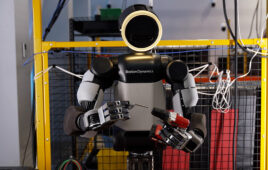
Each hand now integrates an embedded palm camera with a wide field of view and low-latency sensing. This enables redundant, close-range visual feedback during grasps. These cameras allow Helix to maintain visual awareness even when its main cameras are occluded, such as when reaching into a cabinet or working in confined spaces. They enable continuous, adaptive control in real time, explained the company.
Figure 03 gains a more sensitive touch
Figure 03 hands represent a major leap in compliant and tactile design, according to Figure AI. Softer, more adaptive fingertips increase surface contact area, enabling more stable grasps across objects of varied shapes and sizes.
After surveying existing market options, Figure found that current tactile sensors had inherent limitations that could not withstand real-world use. This led to the internal development of its first-generation tactile sensor. The company was guided by three principles: extreme durability, long-term reliability, and high-fidelity sensing.
Each fingertip sensor can detect forces as small as three grams of pressure. This makes it sensitive enough to register the weight of a paperclip resting on your finger. This precision enables Helix to distinguish between a secure grip and an impending slip before it occurs, allowing fine-grained, dexterous control over fragile, irregular, or moving objects.
Figure 03 also includes 10 Gbps mmWave data offload capability, allowing the entire fleet to upload terabytes of data for continuous learning and improvement.
Figure aims for home deployments
To operate effectively in the home, a robot must work seamlessly alongside people in their daily environments. With this in mind, Figure 03 introduces several design improvements focused on safety. It features strategically placed multi-density foam to protect against pinch points, and is covered in soft textiles rather than hard machined parts.
Figure 03 also has 9% less mass and significantly less volume than Figure 02, making it easier to maneuver through household spaces.
The Figure 03 battery incorporates multiple layers of protection against abuse or malfunction, the company said. This includes safeguards at the battery management system (BMS), cell, interconnect, and pack levels. The battery has already achieved certification to the UN38.3 standard.
Beyond safety, Figure 03 is designed for everyday usability. The soft portions are fully washable and can be removed or replaced without tools, allowing quick and easy swaps. The robot can also be customized with various clothing options, including garments made from cut-resistant and durable materials.
To make it easier to communicate naturally with the robot, Figure 03 features an upgraded audio hardware system for better real-time speech-to-speech. Compared with Figure 02, which was unveiled in August 2024, its speaker is twice the size and nearly four times more powerful. Figure AI also repositioned the microphone for improved performance and clarity.
Continuing its vision for a fully autonomous, wire-free system, Figure 03 is capable of wireless inductive charging alongside wireless data offload. Charging coils in the robot’s feet allow it to simply step onto a wireless stand and charge at 2 kW. In a home setting, this means the robot can automatically dock and recharge itself as needed throughout the day.
While many companies are developing humanoid robots, there aren’t many that are aiming for household use. 1X Technologies AS, which offers its NEO Gamma humanoid, is one of the few companies putting all of its efforts into home deployments. 1X designed NEO Gamma specifically to fit into people’s homes, with more natural movements and communication skills than its previous models. The company said NEO‘s latest improvements open the door to starting internal home testing.
Figure 03 also fit for industrial applications
Figure AI said its focus on the home doesn’t detract from Figure 03’s potential for the commercial market. By solving for the variability and intractability of the home, Figure said it is “developing a truly general-purpose product that can do the widest possible range of tasks in the workforce.”
The robot features actuators that can perform twice as fast as previous models with improved torque density (nm/kg). The most significant result of this is the company’s ability to pick and place items at faster speeds.
Figure added that its improvements to the hands and sensory suite for Helix are significant for commercial use cases. With the camera and perception system upgrades, Figure 03 will be able to intelligently navigate commercial environments and execute precise manipulation, said the company.
The added compliance, fingertip surface area, and tactile sensing will enable more stable grasps across an array of objects, such as small pieces of sheet metal and deformable poly bags.
Thanks to inductive charging, Figure 03 is capable of near-continuous operation as long as it can step onto a charging mat for a certain period of time during the use case. The fast wireless data offload also means that the robot can offload seamlessly during shift breaks just by returning to a dock.
Commercial customers can also design distinct uniforms for their Figure 03 fleet, with the option to use more durable or cut-proof materials, and they can make other design changes for specific environments. New side screens on Figure 03 allow quick identification across large fleets and can be fully customized to match each customer’s branding or operational needs, said Figure.
Figure 03 enables mass manufacturing
Humanoid robots have traditionally been designed as engineering prototypes, which are time-consuming and expensive to produce, Figure AI claimed. It said Figure 03 is its first robot built from the ground up for high-volume manufacturing.
The company said it achieved this through three major initiatives:
- Design and process reinvention
- Establishing an entirely new supply chain
- The invention of BotQ, its high-volume manufacturing facility
Moving from Figure 02 to Figure 03 required redesigning nearly every component of the robot with manufacturability and cost in mind. The mechanical and electrical engineering teams aggressively reduced part count, assembly steps, and any components that were not absolutely critical to meet design requirements.
While Figure 02 was primarily designed to be manufactured with CNC machining, Figure 03 relies heavily on tooled processes such as die-casting, injection molding, and stamping. This shift demanded a significant up-front investment in tooling, but the payoff is clear: each Figure 03 unit now costs dramatically less to build, claimed Figure, with the economics improving as volumes grow.
Figure AI revamps supply chain
To scale Figure 03, Figure said it had to build an entirely new supply chain for an industry that does not currently exist. The company chose to vertically integrate across many critical module builds, including actuators, batteries, sensors, structures, and electronics, all of which were designed completely in-house.
For individual components, Figure strategically identified and partnered with suppliers capable of meeting the required volumes, timelines, and strict quality standards demanded by the team. It said the result of this year-long effort is a global network of partners that can grow alongside the company and meet production goals of thousands and eventually millions of parts under an aggressive ramp schedule.
BotQ is Figure’s dedicated manufacturing facility designed to scale robot manufacturing. Its first-generation manufacturing line will initially be capable of producing up to 12,000 humanoid robots per year, with the goal of producing a total of 100,000 robots over the next four years.
Instead of relying on contract manufacturers, Figure brought production of its most critical systems in-house to maintain tight control over quality, iteration, and speed. The facility runs these integrated systems with an internally developed manufacturing execution system (MES).
“Every subassembly and final assembly passes through this line with full traceability, ensuring quality, repeatability, and continuous improvement,” said Figure AI.
Learn more about humanoids at RoboBusiness 2025
Before humanoid deployments can scale, providers must address safety concerns, demonstrate flexibility and superiority to manual processes and existing robots, and meet market demand still subject to a wide range of predictions, noted industry experts.
These topics and more will be discussed at RoboBusiness 2025, which will be next week at the Santa Clara Convention Center. The event will include tracks on humanoids, physical AI, enabling technologies, design and development, business, and field robotics.
Keynotes will include “Lessons Learned From the First Humanoid Deployments,” with Jim Fan, director of AI and a distinguished scientist at NVIDIA, and Pras Velagapudi, chief technology officer at Agility Robotics.
The humanoid track at RoboBusiness will include sessions on:
- “Humanoids for Real Applications: Mastering Safety and Performance,” with Nikolai Ensslen, CEO of Synapticon
- “Advancements in Humanoid Actuation,” with Jordan Schaeffler, strategic business development engineer at Novanta
- “Integrating Behavioral Science into Humanoid Design,” with Ram Devarajulu, vice president and head of robotics for North America at Cambridge Consultants
RoboBusiness, the premier event for developers and suppliers of commercial robots, will also feature more than 60 speakers, a startup workshop, and the annual Pitchfire competition. In addition, there will be numerous networking opportunities and over 100 exhibitors on the show floor.
Register now to attend RoboBusiness 2025.
 Register now and help us celebrate 20 years of RoboBusiness!
Tell Us What You Think!