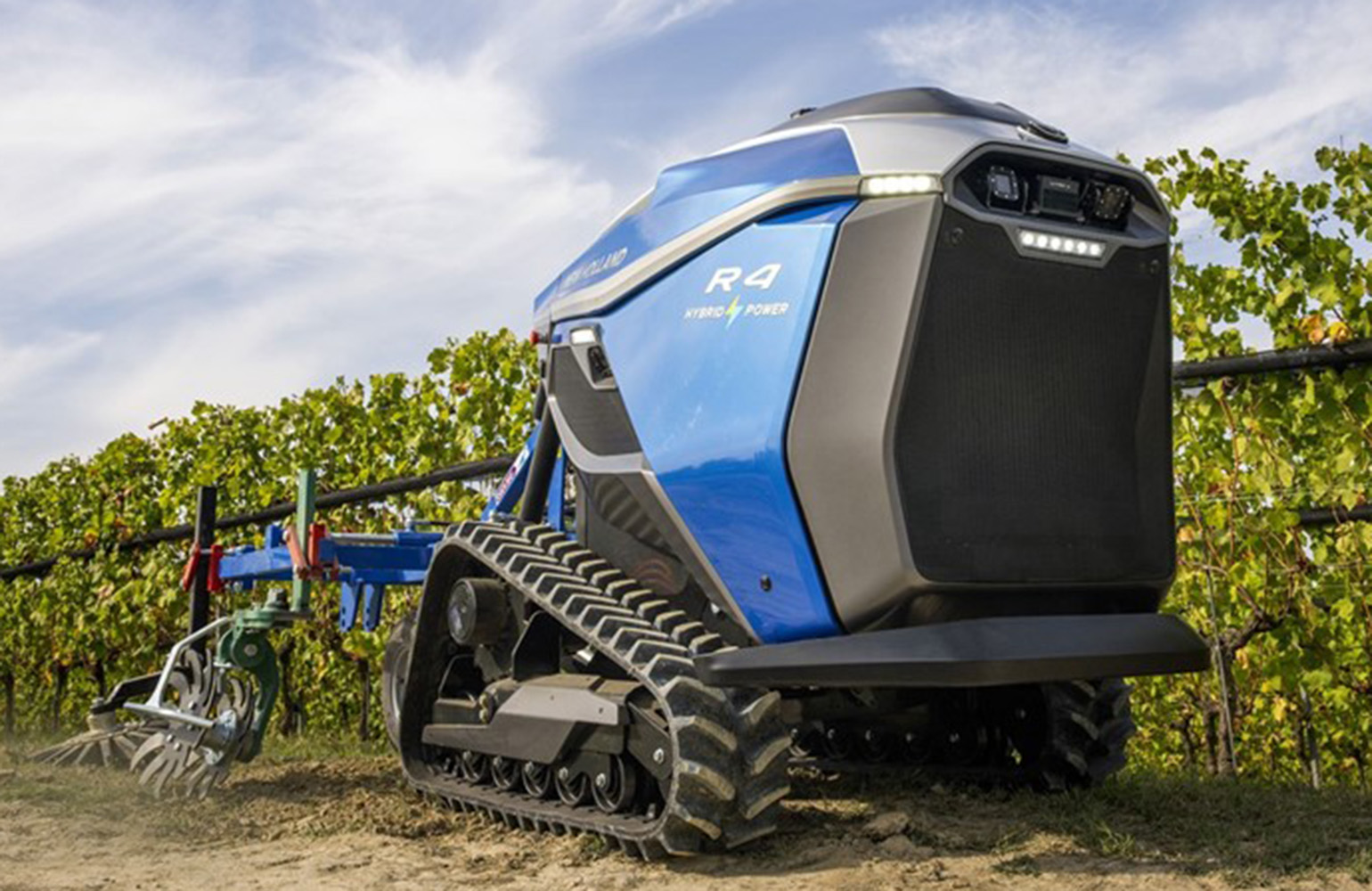
The R4 robot is designed to help vineyard, orchard and specialty crop growers overcome sector challenges. | Source: CNH Industrial
2026 has been a tumultuous year for farmers in America. Global trade wars mean farmers’ supplies are growing more expensive, while many crop prices have dropped. At the same time, changing weather conditions mean getting a good harvest is increasingly tricky. These pressures result in a need for a change in how we farm, and robotics could be the answer.
Luca Ferrari, a senior manager of robotics a breakthrough technologies at CNH Industrial, said labor availability, costs, productivity, and efficiency are common concerns from the company‘s customers.
“Our users need to get more done with fewer resources. They want something, and we see it with robotics but not just robotics, that is solving a real problem, that is easy to use, and that can create value,” he told The Robot Report. “Labor availability is one of the main challenges that our farmer and our growers are experiencing, especially during some critical operations like planting, spraying, and also harvesting.”
“They don’t adopt technology just because it’s fancy. They adopt technology because it’s really solving an issue and demonstration that it can improve the value of operations year by year,” Ferrari continued.
Recent advances in AI means robots are ready to step up
Already, most farms are using some form of advanced technology including autonomy. Now, Ferrari said, they’re becoming increasingly connecting and intelligent.
“We are seeing a shift to agentic systems. ‘Agentic,’ for me, is not an AI agent, but agentic means that we are moving from a paradigm where robotics and automation are not just assisting the operator with individual tasks in an operation,” Ferrari said.
To him, a truly agentic system is one that is capable of sensing the environment, making decisions, and executing entire operations. Recent advances in sensing, machine vision, and AI have enabled this shift. “We can really transform this data that we perceive from the environment in real operation,” Ferrari said.
At CNH, one example of this is FieldOps, which is offered through its subsidiary New Holland. FieldOps is a farm management web and mobile platform that brings real-time monitoring and remote display viewing.
“FieldOps is also making a shift for our farmers,” Ferrari said. “Instead of focusing on a single task and a single machine, different machines are connected together to allow them to focus on a wider picture.”
‘Data is the new oil’
With more advanced systems comes a lot of new data. If used correctly, this data could give farmers a new way to understand their operations.
“Data is the new oil,” Ferrari said. “It’s not just about the quantity of the data. We are collecting a lot of data, including machine data, field data, and agronomic data. The real challenge is to get value out of that data. Every piece of data our customers are collecting can be turned into an insight for them, for their field, for their operations, and for their machines.”
CNH approaches this in a multi-level way. It uses data on the machine-level to continue improving how individual machines perform, but it also uses this data to look at the entire operation and how machines work together.
“As we collect this data, season after season, we are also able to provide recommendations to our farmers and suggest improvements to the operation,” Ferrari explained. “In the longer term, there is a path to be able to connect more and more data coming from third party accessories. So, we can connect machine data, soil data, weather data, crop data, and through AI we can also provide more and more insights and suggestions for when to plant, when to spray, when to harvest, and so on.”
This is why interoperability is very important in agriculture. “Farmers and growers also have different machines from different brands. To maximize usage of that date, if our robot is operating in a field where there is another machine, it’s important to have interoperability,” Ferrari said.
Healthy soil is key to sustained production
As farmers are looking to do more with less, the precision that comes with robotics becomes even more important. Precision agriculture, Ferrari said, can be key to maintaining soil health.
“We need to consider that, for our farmer, the soil is really the most important asset. It’s really what is feeding the future. I know it’s a nice slogan, but it’s reality, because the soil is what is producing the crop,” Ferrari said. “We need to find ways that allow us to protect the soil, measure it, and improve it. A healthy soil is really the best foundation for the production of the crop the next year.”
Weeding plays a big part in this. When farmers use robotics to precisely spray, less herbicide goes into the soil. Ferrari said precision weeding can reduce herbicide use by up to 80%. New Holland also offers smaller, lighter systems, like its autonomous R4 robot, that reduce soil compaction while working.
“[R4] has been designed from the ground up to be autonomous, AI-powered. It combines GPS with lidar to perform navigation,” said Ferrari. “It also has a camera to detect obstacles, and to execute field operations with a very high precision. It is really to assist our farmers in operations that are highly repetitive, mainly focused on vineyard and orchard. It’s performing, for example, mowing, tillage, and spraying.”
Balancing complexity with ease of use
So, what’s holding robotics back in agriculture? Ferrari said there are some obvious environmental challenges.
“We operate in real fields, and when you operate in a real environment you have a lot of variability,” he noted. “You have terrain that’s not always flat. You have slope. You have the weather that can change between sunny, overcast, and rainy. Then we have dust, different crop conditions. You can also have people and other equipment,” Ferrari said.
The environment demands complexity. A robot needs GPS, lidar, cameras, AI, advanced software, and more to take on these environmental challenges. But that shouldn’t translate to the user experience, he said.
“We really need to develop machine and autonomous tech that are able to cope with all these different challenges, but at the same time, develop something that is easy to use for our customers,” Ferrari said.
Editor’s note: Field robotics is among the session track topics at RoboBusiness 2026, which will be on Oct. 20 and 21 in Santa Clara, Calif. Register now to attend.
 Register now and help us celebrate 20 years of RoboBusiness!

Tell Us What You Think!