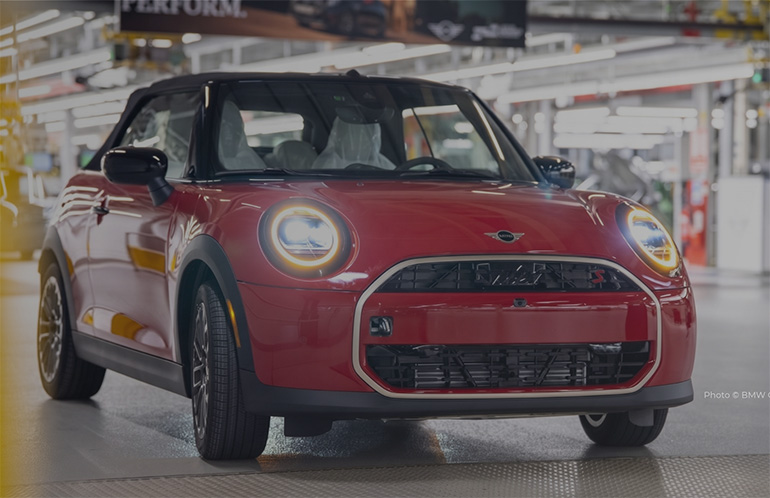
A MINI autonomously rolls off a U.K. production line using Embotech technology. Source: BMW Group
As vehicles come off the production line, human drivers typically need to get into each one to drive them to be parked or loaded onto trucks. Embotech and BMW today said they have moved 1 million vehicles using Embotech’s automated driving technology across four sites in the U.K. and Germany.
“Automated vehicle movements only create value when intelligence, safety, and reliability come together,” stated Andreas Kyrtatos, CEO of Embotech. “This milestone shows what is possible when proven technology is integrated into live production and operated reliably around the clock.”
Spun out of ETH Zurich in 2013, Embotech claimed that it is a global leader in safety-certified SAE Level 4 autonomous driving systems for industrial logistics and the first company worldwide to hold multiple TÜV-certified Level 4 solutions. Its two certified systems – Automated Vehicle Marshalling (AVM) and Autonomous Tractor Solution (ATS) – are built on a shared platform and are deployed in automotive factories, vehicle distribution centers, ports, and logistics yards.
The Zurich-based company said its technology can improve safety, productivity, resilience, and sustainability across logistics operations. In July, Embotech entered a strategic partnership with HTEC to scale deployment of autonomous driving across vehicles, customer programs, and industrial sites.
 Submit your innovation now!
Embotech helps automaker increase flexibility
While automotive OEMs are already major users of industrial automation, they are continuing to digitize and adopt new technologies to make production processes more efficient, noted Embotech. However, much of the market remains at the pilot stage, autonomously operating only a limited number of vehicles, it said.
The Automated Driving In-Plant is vehicle- and OEM-agnostic and connects to existing drive-by-wire capabilities.
“Perception for [AVM] is in the infrastructure — vehicles don’t need self-driving capabilities or extra sensors,” Eva Beck, chief commercial officer at Embotech, told The Robot Report. “Hesai lidars are mounted in the production environment, so there are no hardware modifications. In the factory, we have a standardized software interface, offboard computers, and servers that optimize driving trajectories 10 times per second.”
Embotech provides key components, including its AI-based software for perception, prediction, and planning, which enables vehicles to operate in complex industrial environments. They also include a separate, deterministic architecture, independently certified by TÜV SÜD, that defines and enforces the safety boundary.
“Safety is one of the main motivations of the OEMs, as is reducing manual errors or damage caused by manual behavior,” explained Beck. “Vehicle movements need to be precise and to integrate into OEM space constraints. Our system can work alongside factory workers and manually driven vehicles. This enables us to integrate into existing processes and work in all weather conditions.”
A fleet manager gets destinations from the OEM’s back-end systems, defines vehicle routes, and manages communications among automated vehicles, she said.
The value for manufacturers goes beyond individual vehicles, asserted Embotech. Automated movements can support smoother vehicle flow, more stable and flexible operations, and round-the-clock capability independent of shift staffing.
BMW scales from pilot to network deployment
“The 1 million vehicle milestone demonstrates the scale that BMW Group has achieved with Automated Driving In-Plant, spanning different sites, brands, vehicle types, and production and logistics processes,” said Embotech. The partners added that they have demonstrated that the system is precise and reliable enough to scale within BMW‘s live production network.
BMW and Embotech have brought the Automated Driving In-Plant system to about 3,500 vehicle movements a day, with more than 99.5% availability. In manufacturing environments where unexpected downtime can disrupt wider operations, maintaining that level of availability is essential to keeping automated vehicle movements integrated, said Embotech.
Since an initial pilot in 2022, Embotech deployments have expanded to four BMW sites including Dingolfing, Leipzig, and Regensburg in Germany and MINI Plant Oxford in the U.K. The technology supports different use cases in defined production and logistics areas in each factory.
“One million vehicles moved using automated driving technology and the deployment of this technology at four sites to date demonstrates the innovative strength and scaling capabilities of our production network,” said Raymond Wittmann, the member of BMW AG’s board responsible for production. “We recognized the potential of Automated Driving In-Plant early, tested it in a pilot phase, and systematically developed it to series maturity. We are now rolling out this technology worldwide.
“Automated Driving In-Plant is a prime example of how we are translating the vision of the BMW iFACTORY into industrial practice and driving the efficiency, digitalization and intelligent connectivity across our production,” he added.
Embotech said its Munich team has worked closely with BMW to develop supporting tools and processes for deployment, monitoring, diagnosis, and recovery. “Operational experience supports the continuous improvement of Embotech’s perception, prediction, and planning software, helping future deployments and software releases build on what has been learned in live production,” it said.
“What excites us over and above the 1 million milestone is the pace at which that experience is compounding,” said Kyrtatos. “With BMW Group, we completed the first 500,000 automated vehicle movements in 15 months and the next 500,000 in just seven. For Embotech, the next phase is about taking what we have learned into more use cases, sites, customers, and industrial environments.”
“We’re also looking to roll out Automated Driving In-Plant next year at BMW Spartanburg,” Beck said, referring to the South Carolina factory where BMW has tested Figure AI humanoid robots. “We are scaling our solution further across use cases and customers.”


Tell Us What You Think!