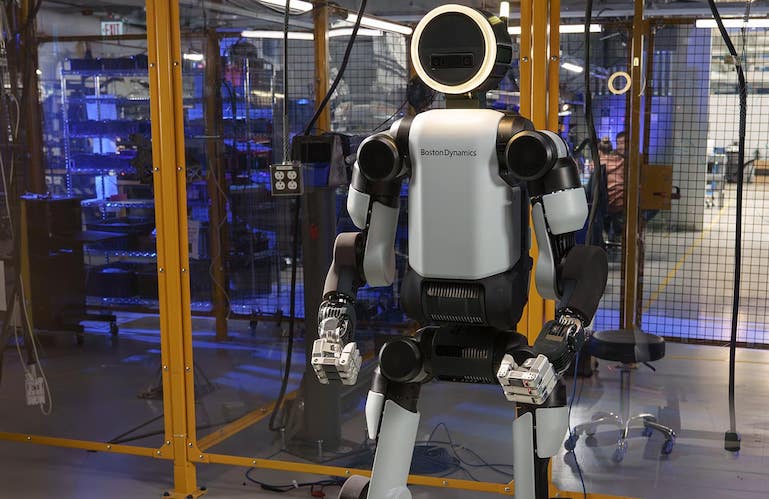
Boston Dynamics’ Atlas humanoid, shown here, is an example of a robot ready for AI.
For decades, engineers have been trying to create robots that look and act like humans. Now, rapid advances in artificial intelligence are bringing humanoid robots out of the lab and onto the factory floor. As fears grow that AI will displace workers, a global race is underway to develop humanoid robots capable of performing human work.
Competitors include Tesla, startups backed by Amazon and NVIDIA, and state-owned Chinese companies. Waltham, Mass.-based Boston Dynamics, valued at over $1 billion, is among the humanoid leaders with its Atlas robot. South Korean automaker Hyundai owns an 88% stake in the company.
Hyundai‘s massive auto plant is arguably the most advanced in the world. More than 1,000 robots work alongside nearly 1,500 humans, lifting, stamping, and welding parts in robotic unison. Atlas, at 175 cm (68.8 in.) tall and 90 kg (198.4 lb.) in weight, has left the lab and is doing real work.
Atlas and AI learn with human help
Atlas’s development is led by Zach Jackowski. He holds two degrees in mechanical engineering from MIT, and his mission is to transform the robot into a productive worker on the factory floor. Atlas confidently helps sort roof racks for the assembly line without human intervention. It operates autonomously; many roboticists would have considered this insane five or six years ago.
In 2021, Atlas was a bulky, hydraulic robot that could only run and jump. Back then, Atlas relied on algorithms written by engineers. The next-generation Atlas, with its sleek, all-electric body and AI, runs on cutting-edge NVIDIA chips, making it intelligent enough to autonomously perform incredible stunts.
Scott Kindersma led robotics research department at Boston Dynamics before moving to Google DeepMind. He explained that modern robots have learned to master movements that until recently were considered too complex for a machine. This is largely due to how these robots are programmed: more emphasis is placed on demonstrations and machine learning than on manual programming.
This humanoid can learn. Atlas learns in a variety of ways. In supervised training, machine learning specialist Kevin Bergerman (now also at Google DeepMind), wearing a virtual reality headset, took direct control of the humanoid, guiding its hand and arm movements step by step through each task until Atlas masters it. If this teleoperator can perform the task we want the robot to perform, this generates data that is subsequently used to train the robot’s AI models to perform that task autonomously.
The stylish suit you wear will actually record all your body movements to train Atlas to accurately mimic your movements. In this way, you will serve as a physical prototype for a 200-lb. metal robot. All your movements—walking, hand gestures—are captured by these sensors.
Engineers then feed this data into a machine learning process. Atlas’s body is different from yours, so they had to teach it to virtually imitate human movements. Over 4,000 digital Atlases were trained for six hours in a simulation. The simulation added complex challenges for the avatars, such as slippery floors, bending, and stiff joints.
Ultimately, this could lead to many copies of Atlas, each having loaded new skills into the AI system. Once one robot is trained, they are all trained. Using the same processes, Atlas was taught to crawl and cartwheel. It wasn’t as good at duck walking.
Indeed, Atlas, or any other humanoid, can’t yet do most of the things a person does in their daily lives. For example, simply getting dressed in the morning or pouring a cup of coffee and carrying it around the house are too complex for Atlas.
What particularly stands out about Atlas is its brain. NVIDIA chips—the same ones that helped launch the AI revolution with GPT chat—process a stream of collected data, bringing this humanoid robot closer to a semblance of common sense. Atlas can see its surroundings and understands how the physical world works.
One day, you’ll be able to place such a robot in a factory and simply explain to it what you want it to do. It will have enough knowledge of how the world works to perform the tasks assigned to it.
Spot platform demonstrates legged robot utility
There’s currently a lot of excitement in the industry about the potential of creating robots smart enough to be truly versatile. Robert Playter, CEO of Boston Dynamics, led the company’s robotics development until stepping down earlier this year.
The cornerstone was the robotic dog Spot, introduced almost 10 years ago. The quadruped is trained to work in hot, cold, and rugged conditions, roaming the halls of Boston Dynamics.
It has multiple cameras, thermal sensors, acoustic sensors, and an array of sensors on its back that allow it to collect data on the plant’s condition. Spot conducts quality checks at the Hyundai plant, ensuring that cars are equipped with the necessary parts. They conduct safety checks and industrial inspections at hundreds of facilities around the world. What began with Spot has evolved into Atlas. This robot is capable of superhuman movement.
Therefore, it will be able to surpass what we can do. “So, you’re creating a robot that should surpass human capabilities.”
“Why not, right? We’d love to invent creatures that could be stronger than us, withstand higher temperatures than us, or enter dangerous places.” Superhuman capabilities—for many people, that sounds terrifying. You’re not envisioning a Terminator world.
Absolutely not. If you saw how hard it takes to get robots to perform some of the simple tasks required of them, it would allay fears about intelligent and out-of-control machines. Could people have more pressing concerns?
It’s guaranteed that there will be people who say, “I’ll lose my job to a robot.” Work is truly changing. So monotonous, grueling work will eventually be performed by robots.
But these robots aren’t so autonomous that they don’t need to be managed. They need to be built, trained, and maintained. It could be several years before Atlas joins the Hyundai team permanently. Goldman Sachs predicts the humanoid robot market will reach $38 billion within a decade.
The humanoid robot race continues
Boston Dynamics and other U.S. robot makers are vying for the lead, but they’re not alone in the competition. Chinese companies are proving themselves to be formidable competitors. They’re determined to win.
Are they ahead of us?
The Chinese government is on a mission: to win the robotics race. Technically, we’re still ahead, but there’s a real risk that, simply due to the scale of our investments, we could fall behind.
To stay ahead, Hyundai has made a major investment in Boston Dynamics. This is the beginning of a long journey. The ultimate goal is the human-like future we mentioned at the beginning. Robots like us, working alongside us, walking among us.
Editor’s note: Physical AI and humanoids are among the session track topics at RoboBusiness 2026, which will be on Oct. 20 and 21 in Santa Clara, Calif. Register now to attend.
 Register now and help us celebrate 20 years of RoboBusiness!
AI moves toward superhuman capabilities
When Demis Hassabis won the Nobel Prize in 2024, he celebrated by playing poker with the world chess champion. Hassabis loves games, which is how he became an artificial intelligence pioneer. The British scientist is co-founder and CEO of Google DeepMind.
A few years ago, chatbots heralded a new era. Now, Hassabis and others are striving to create what’s known as artificial general intelligence—a silicon-based intelligence as versatile as a human, but with superhuman speed and knowledge.
“I’ve always been driven and intrigued by understanding the world around us,” said Hassabis. “Since childhood, I’ve been fascinated by big questions: the meaning of life, the nature of consciousness, the nature of reality itself.”
“I loved reading about the great scientists and philosophers who worked on these problems, and I wanted to see if we could advance human knowledge,” he recalled. “For me, the expression of this desire has been the creation of what I consider the perfect tool for advancing human knowledge: artificial intelligence.”
Hassabis noted that AI is advancing quickly, attracting attention, resources, and talent. Early chatbots only explored the internet. An app called Astra perceives the world. It was able to make up stories after being shown paintings. But such systems are still learning about context and may develop unexpected skills.
“So, new capabilities or properties may emerge as a result of learning. This may worry people,” Hassabis acknowledged. “The duality of these types of systems is that they are capable of incredible things, going beyond what we can design or understand ourselves.”
From AGI to robotics
As AI begins to take on tasks such as booking flights and shopping online, it is taking steps toward AGI. By 2030, we could have systems that truly understand their surroundings and are integrated into our daily lives. This is where robots come in.
Once a robot can perceive, understand, decide, and act, it can begin to do truly useful things. Researchers Alex Lee and Julia Vassallo have demonstrated a robot that understands what it sees. It’s not easy. And it reasons by following vague instructions. “Place the blocks whose colors correspond to the combination of yellow and blue into the corresponding ball.” The combination of yellow and blue is green. And the robot figured it out.
Is Hassabis working on a system that would be self-aware?
“I don’t think any modern system feels self-aware or, you know, conscious in any sense,” he replied. “Obviously, everyone needs to make their own decisions when interacting with these chatbots. I think it’s theoretically possible. But is self-awareness your goal? It might happen implicitly. These systems might acquire some sense of self-awareness. It’s important for these systems to understand you, themselves, and others, and that’s the beginning of self-awareness.”
“If a machine becomes self-aware, we might not recognize it,” continued Hassabis. “There are two reasons why we consider each other conscious. One is that you exhibit the behavior of a conscious being. The second is that you operate on the same foundation. We are made of the same carbon material, and our brains are soft and flexible. Machines operate on silicon. So, even if they exhibit the same behavior and say the same things, that doesn’t necessarily mean the sense of consciousness we experience is the same as theirs.”
Hassabis told us that AI could lead to what he called “radical abundance,” the elimination of scarcity. But he also gave a warning.
“There are two things that worry me. One is that malicious actors will repurpose these systems for harm,” said Hassabis. “The second question concerns the AI systems themselves. As they become increasingly autonomous and powerful, can we ensure that we can control these systems, that they align with our values, that they do what we want, that they benefit society, and that they remain within established constraints?”
Can an AI agent be taught morality? “I think so,” Hassabis responded. “They learn by doing, by teaching others. And I think this is one of the challenges we must address: giving them a value system, guidance, and some constraints, just like we teach a child.”
Google DeepMind is competing with dozens of other companies striving to create AGI that you won’t be able to distinguish from human intelligence. It announced its Gemini 2 foundation model in August and Gemini 4 Argon this week.
Anduril founder says robots and AI can reduce risk
Some international groups call such weapons killer robots. But Palmer Luckey, founder of Anduril Industries, said they represent the future of warfare—a working product that eliminates risks. Once a child prodigy, Luckey sold Oculus to Facebook for $2 billion.
He ultimately decided to move into the defense industry. The billionaire owns an autonomous speedboat called Dive XL. It is not remote-controlled, and Anduril claimed that it can travel 1,000 miles fully submerged. Australia has already invested $58 million in such submarines.
Tucked away inside a hangar is an Anduril unmanned fighter jet called the Fury. It has no cockpit, control stick, or rudder because there’s no pilot. Some in the defense industry viewed Anduril as just another tech startup until it beat out several leading defense contractors in the competition to build an unmanned fighter jet for the U.S. Air Force.
 About the author
Elena Krosheva is a freelance journalist, marketing analyst, and SEO specialist. She graduated with honors from the Faculty of Journalism at the Institute of Modern Knowledge in Minsk, Belarus, in 2007.
Krosheva covers topics such as digitalization, IT, the modern economy, and transhumanism. She loves computers and cyberpunk, having graduated from a technical college before graduating from the Faculty of Journalism.

Tell Us What You Think!