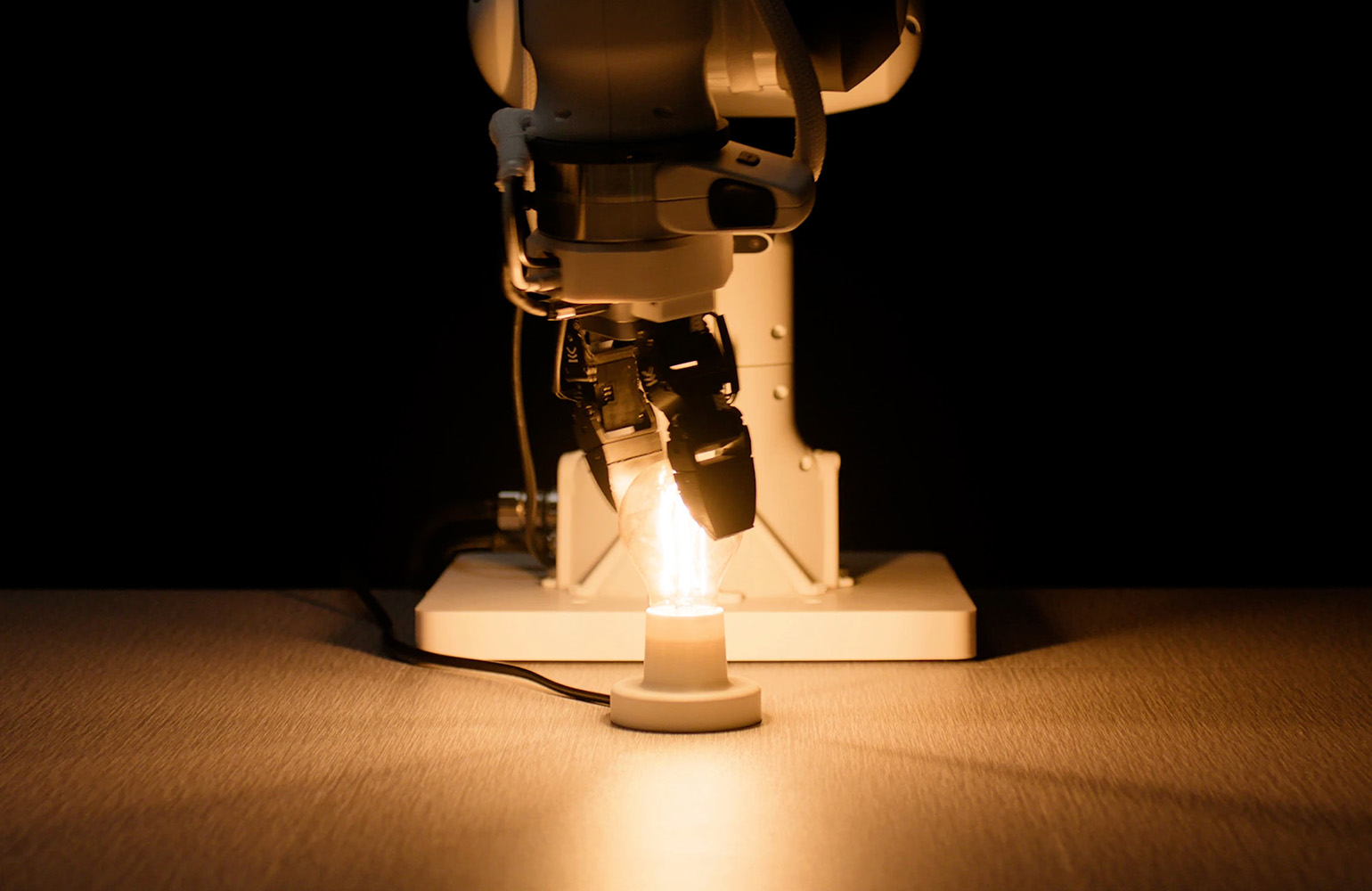
Eka says its model can generalize across objects, tasks, and environments. | Source: Eka Robotics
Eka Robotics this week said it has raised $150 million in Series A funding. The startup said the new funding will help it scale its technology and customer deployments.
Founded in 2024, Eka is building a vision-force-action (VFA) model to develop an intuition of physics through reinforcement learning at scale. The Cambridge, Mass.-based company said that robots using its AI can pick a wide variety of objects outside the training distribution at a speed of roughly 1,500 operations per hour.
The same robots can screw in a light bulb and insert wires, Eka asserted.
Robots shouldn’t just mimic humans, says Eka Robotics
Eka Robotics said it is targeting dexterous manipulation. The company said that for robots to handle complicated work, they need the versatility to handle changing conditions and the performance to deliver useful work every day.
Eka also said it believes that robots should master physics, not mimic human data, to be truly general-purpose. This would allow the robot to build “intuition” for tasks the same way a human can by jointly reasoning about vision and forces.
The company uses simulation learning, and it said its VFA model is demonstrating that the typical sim-to-real barrier is falling. In simulation, the company can generate thousands of hours of robot experience in minutes, varying objects, environments, and physical conditions.
Eka claimed that transferring this learning to the real world unlocks a scalable, performant, and capital-efficient path to a foundation model for manipulation. “Reinforcement learning at scale buys performance, and breadth of experience buys generality,” it said.
Investors seek to level up dexterous manipulation
Andreessen Horowitz (a16z) and F-Prime, a venture capital fund affiliated with FMR LLC, the parent company of Fidelity Investments, led the round.
“Eka’s Vision-Force-Action model is the first approach I’ve seen that truly solves manipulation with the generality and throughput needed for deployments,” stated Raghu Raghuram, a general partner at a16z. “This team has the ideal DNA to push the frontier of robotics research while scaling commercial operations.”
Eka Robotics’ Series A included continued support from the lead investors in its seed round, Obvious Ventures and E14 Fund. Other funding came from MFV Partners, Bison Ventures, Glasswing Ventures, Samsung Next, and several Fortune 500 strategics.
“From the factory floor, a robot’s value comes down to two things: its success rate and its speed over thousands of repetitions,” said Shyam Kamadolli, a managing director at Fine Structure Ventures. “Early on, I recognized that current approaches to generalization simply won’t get us there. Achieving the next level of performance requires a deep understanding of physics and, crucially, breaking free from our dependence on human demonstrations.”
“Eka’s VFA model, trained through simulation and reinforcement learning, achieves this for the hardest problem in robotics, dexterous manipulation, in a way no other company has,” he added. “I truly believe Eka’s approach is the only one that will hold up in real-world deployments of complex tasks.”
 Register now and help us celebrate 20 years of RoboBusiness!



Tell Us What You Think!