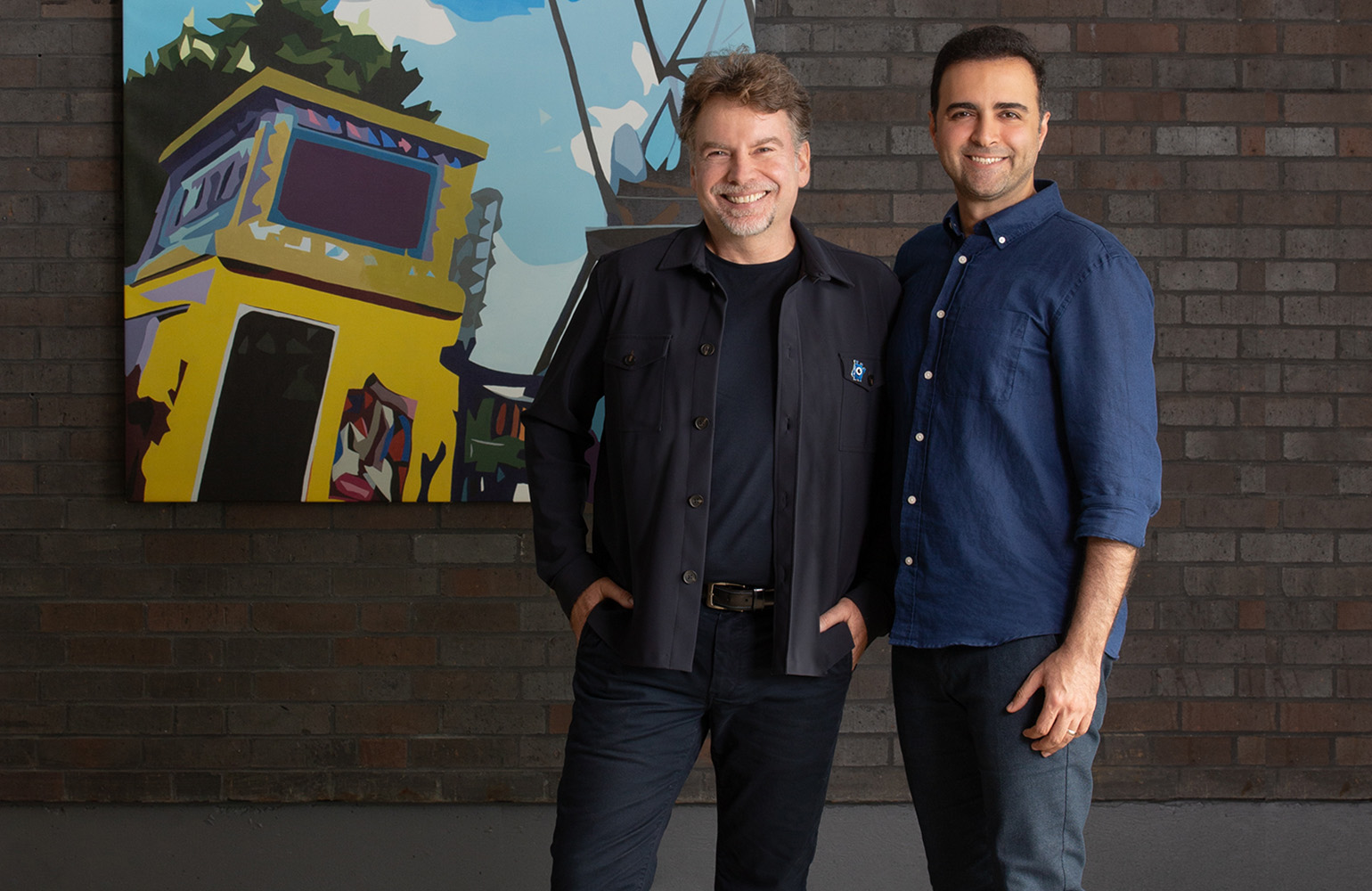
Dynamic Creatures co-founder and CEO Marc Theermann (left) and co-founder and CTO Farbod Farshidian. | Source: Dynamic Creatures | Source: Dynamic Creatures
Boston Dynamics is focused on commercializing robots for industrial work, but it’s always had time for some fun, too. We’ve seen Spot and Atlas dance, flip, compete on America’s Got Talent, take part in the FIFA World Cup, and more. Now, two Boston Dynamics veterans are launching Dynamic Creatures. The new company is focused on creating robotic characters for entertainment.
Dynamic Creatures was co-founded by CEO Marc Theermann, former chief strategy officer at Boston Dynamics, and CTO Farbod Farshidian, former research leader at the Robotics and AI Institute. Theermann told The Robot Report the name company name pays homage to Boston Dynamics and Jim Henson’s Creature Shop.
“We always put out those videos, A, because it’s super fun, and B, because we wanted to bring the general public along,” Theermann said. “We always thought that, ultimately, these robots are going to be everywhere in our daily lives, so we wanted to show these robots in these fun environments, just to make sure that people understand the capabilities of these robots in terms of their abilities to locomote.”
With these videos and excursions, Theermann began seeing interest in robots for entertainment. “Humans love to see robots dancing and love to see robots in these fun environments,” Theermann said.
Dynamic Creatures is targeting a range of entertainment use cases at theme parks, casinos, cruise shapes, and hospitality settings. It is also Boston Dynamics’ official entertainment and hospitality partner.
“Dynamic Creatures is opening an important new frontier for advanced robotics,” said Amanda McMaster, the Interim CEO of Boston Dynamics. “As our official entertainment and hospitality partner, the company is combining proven robotic platforms with character design, adaptive behavior and real-time interaction to create experiences the market has not had access to before. Marc and Farbod bring the rare combination of commercial and technical expertise required to turn that vision into compelling, guest-facing systems.”
Dynamic Creatures is backed by a mix of U.S. and European institutional investors. These include Eniac Ventures, Kindred Ventures, Heliad, Sunshine Lake and BlueGrass Ventures, along with strategic angel investors Marc Raibert, the executive director of the RAI Institute and founder of Boston Dynamics, and Lukas Ziegler.
Dynamic Creatures launches SnowJay
Dynamic Creatures introduced SnowJay, its integrated AI and robotics platform. This serves as the operating layer for the company’s robots. Theermann said the platform is in charge of two main things: natural movement and human-robot interaction.
“One of the cores of our platform is that we can make any robot walk in these very natural ways,” Theermann said. “The way that we do it is either through motion capture or through animations, where we use NVIDIA tools and reinforcement learning to teach these robots these organic behaviors.”
Theermann said most of the locomotion work is led by Farshidian, who helped to give Atlas a more natural gait during its debut at CES 2026.
“If you look at many robots out there, they’re deaf and mute. We think that in order for robots to be accepted into society, in restaurants and in general spaces outside, they need to be better at human-robot interaction,” Theermann said. “In robotics, at the moment, everybody is talking about vision learning action models, where something happens to the robot. The robot processes that input and then reacts with an output. Lots of people are focused on dexterous manipulation as the next big hurdle in robotics, which is certainly super important, but that’s not what we’re focused on. We’re focused on human-robot interaction as the output.”
What kind of characters will Dynamic Creatures create?
Dynamic Creatures is building on top of third-party hardware at the moment, in particular Boston Dynamics’ Spot quadruped and Atlas humanoid. However, the company’s technology is also compatible with Unitree robots. “We do have ambitions to build our own humanoid hardware. We want to become a full stack robotics company,” Theermann said.
Dynamic Creatures has two prototype characters that it has developed in-house. One, shown in its launch video, is a purple poodle named Danielle. It’s also working on a Tyrolean mountain troll, Theermann said, similar to a Yeti.
However, the company’s first two partners are looking for customer characters from famous IP.
“The partnerships that we are currently working on are partners coming to us with their IP and saying, ‘Can you bring my IP to life? I have an IP already from a movie or from a TV show, can you bring that IP to life in my theme park or for my red carpet event?’” Theermann said.
Managed pilots in 2027
For its early deployments, Dynamic Creatures said it will be using operators to control the robots, allowing them to gather critical data to train its model. Theermann said this kind of data can only be collected by interacting with humans, which is why hospitality and events are so important.
“We can have these interactions with humans and really start to understand what makes people laugh, what gets a chuckle out of them, how do they react to a robot when the robot does certain things. That’s really what we’re setting out to learn over the next couple of years with this platform,” Theermann said.
“We want to become the best at human-robot interaction. At the moment, we’ve actually hired puppeteers to help us figure out different emotions for our robot to see what works and what doesn’t work,” he continued.
Dynamic Creatures hopes to have its first customer deployments in early 2027. These will start out with a mixture of teleoperation and autonomy, which they call assisted autonomy.
“It will be managed pilots. We will send humans and robots, and we will closely monitor what happens so we can learn together with our clients,” Theermann said. “In our case, it might be assisted autonomy, plus puppeteering. Then, over time, hopefully you go from teleoperation to telemonitoring, and then telemonitoring offsite. At the same time, the relationship of operator to robot goes from one-to-one to one-to-many.”
Theermann said, alongside human-robot collaboration, safety and semantic navigation are the big research thrusts for the company.
“Humanoid robot safety hasn’t fully been figured out yet. Right now, in factory environments, deployed humanoid robots typically are behind a light curtain. When a human walks through the light curtain, the robot slows down and then fully stops. We want to get to a point where you can hug the robot,” Theermann said. “We need to approach safety from a totally different viewpoint.”


Tell Us What You Think!