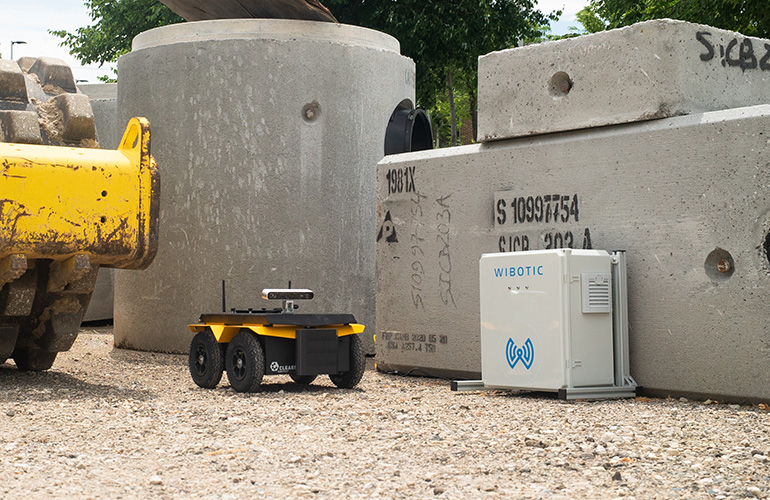
Wireless chargers are being deployed in a number of indoor and outdoor applications for charging the mobile robots. | Credit: WiBotic
As robot fleets scale, charging becomes an operational challenge. Understanding how to optimize charging for fleets of mobile robots is key to getting the best performance from the fleet throughout the day.

Ben Waters, CEO of WiBotic
With growing deployments, charging is becoming more than a question of how long a battery lasts or how quickly it can recharge. Charging strategy can affect fleet uptime, facility infrastructure, maintenance requirements, and even the size of the batteries that robot manufacturers need to carry.
Ben Waters, CEO of WiBotic, recently joined The Robot Report Podcast to discuss how those considerations are changing as robot fleets scale.
He also discussed opportunity charging, the tradeoffs around fast charging, WiBotic’s move toward higher-power systems, and how charging data could help operators identify power problems.
This is an excerpt from the podcast interview. Listen to the full audio anywhere you get your podcasts or online in the show notes.
WiBotic expands beyond its traditional robotics markets
What has changed recently at WiBotic, and how is the market maturing?
Waters: Overall, WiBotic has diversified into a few different markets, but all the while, robotics has really been growing, as we all know, over the last last one to two years for sure.
That was a big motivator for us to pursue getting into some adjacent markets. Take, for example, floor care, medical carts, space, and defense applications, all of which are markets that really use the same product as our longstanding robotics customers from a wireless charging, autonomous charging perspective.
Flash-forward a year of focusing on that and putting all the internal operational, sales, and engineering teams in place to support different markets. Here we are a year and a half later, and robotics is booming everywhere you look, right? I mean, all of our legacy customers in robotics have had significant volume growth this year.
We are seeing huge growth in automotive AMR adoption. We are seeing growth in outdoor robotic inspection for energy substations, and a lot of outdoor applications are growing. And then there’s the wild card of humanoids.
Wireless charging is a really interesting dynamic in humanoids as far as what it can enable and how it can improve uptime and eliminate some of these Achilles’ heels issues that humanoids have around downtime.
Opportunity charging changes the equation for large robot fleets
As fleets of mobile robots grow, where does charging start creating operational friction?
Waters: The big trend as charging relates to operational impact is what we’ve probably talked about before with Gene [Demaitre]. WiBotic has always looked at as a great opportunity for wireless charging. But, you know, it takes a while for fleets to get big enough for it to truly make sense. And I think we’re finally at that place. And what I’m referring to is opportunity charging.
So it’s the concept of “Don’t just put the chargers on the sides of the factories.” And then when the battery on the robot gets to 20%, that robot might be on the far side of the factory. Now it’s got to drive 10 minutes while watching out for everything else and while being ignored by the fleet management for doing a task, even though it’s in an area where a task needs to get done, right? Because it has to go charge.
That strategy, which is arguably easier to implement at a small scale, because you can truly just say, “If any one of these robots’ batteries hits 20%, stop and go drive to the charging station.” That’s fairly easy to implement. That gets really complicated, and that leads to a lot of unwanted downtime when the fleets start to get bigger. Even like fleets of 20 to 40, this becomes a bottleneck.
We need to implement opportunity charging. And it doesn’t make sense to do opportunity charging with anything but wireless. Because if you did it with contacts, your robots would be hitting the contacts so many more times. And even if you had the world’s most strongest contact, it still would require maintenance at some point, times all of the chargers in your fleet.
If the robot does a task and it’s got 10 seconds to sit there, well, a charging station should be positioned right where that robot naturally is going to sit.
You could look at that as well. It’s only charging for 10 seconds, but if you do that often enough, it’s adding substantial energy back into the batteries across the fleet and allowing these things to run 24/7.
You can completely eliminate that. Just allow the robots to stay in the loops where they’re operating when you employ opportunity charging. So that’s really the trend that we’ve been seeing and the demand we’ve been getting, and the main reason why companies are looking for wireless power.
 Submit your innovation now!
Charging should be part of the robot design process
How should companies think about charging during system design instead of treating it as an accessory at the end?
Waters: If I boil it down to three things, I think companies should be thinking about power infrastructure. I’ll come back to a few details on these. Where are your electrical outlets, and how many of them do you have, and are they rated for enough power to handle all the chargers you want to deploy? So think about that up front. That bites people. We’ve seen a lot when you think about that too late.
I think people are really questioning. How big of a battery do I need? Do I need a battery that supports an eight-hour runtime? Do I need a battery that supports super fast charging? In the world of batteries, most of these types of things trade off with each other.
They might be overdesigning it. They might be adding way too much battery cost for what they really need, especially if they’re thinking about charging strategies.
We still hear a lot of customers be like, “We need to charge these things as fast as humanly possible.” And we’re going to listen, and we’re going to assume the customers made the right choices for the right reasons.
But sometimes, we do have a strong relationship with someone, we get into these topics. It’s not our job necessarily to push back, but we are curious battery guys, and we’re a friendly company to work with. So we sometimes ask: “Do you really want to charge at 3°C all the time? Have you seen a data sheet from the battery manufacturer that says what that’s gonna do to lifetime? Is that worth it?”
And then the third thing for sure is maintenance. If you wait till you’ve already finished your design, and you’re starting to deploy and haven’t thought about those things, then almost surely, you will get bit by every one of those things within at least a couple of months, if not sooner.
WiBotic develops chargers for outdoor robots, drones and humanoids
As WiBotic moves into new applications, how have its products evolved?
Waters: WiBotic has always really tried to think about what product serves the maximum number of customers and people, right? We’re not a consulting business where we customize every system.
As far as developing circuits and certifying systems, we want to be a company that makes standard products and sells systems to customers that they can depend on that are supported and certified.
We most recently launched in our 1 kW product family an IP65-rated version of the charger. When we first launched our 1 kW product a couple years ago, it was just available in our typical black box IP20 form factor.
So we now have an IP65 form factor, which is really needed for outdoor applications and robotics. Really desirable from, you know, indoor applications like floor care where water and dust are very much parts of those systems.
Right now, we are actively developing more around two areas of innovation. One is size and weight. We are seeing a lot of interest in drone applications. WiBotic certainly has had a long history with drones.
We’re developing lightweight, high-power systems for drones, which just so happens to be kind of the same thing that humanoids need as well.
The more mass you add to a humanoid, the more energy it has to spend because it’s balancing that mass. And there’s not a lot of space. So yeah, we’re focusing on a lot of small form-factor, high-power applications, as well as pushing the power of our current products up to a 3 kW level.

Tell Us What You Think!