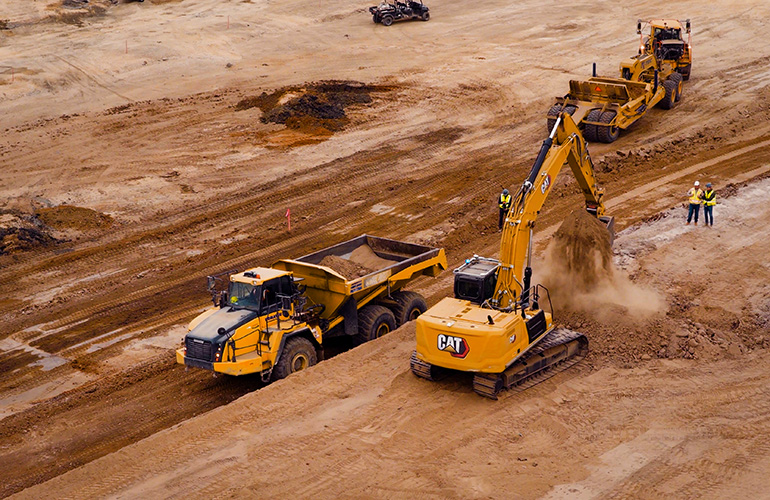
Bedrock is automating earth-moving equipment to improve site safety and fill skilled labor shortages. | Credit: Bedrock Robotics
Bedrock Robotics Inc. has deployed fully autonomous, retrofitted heavy excavators onto active infrastructure projects in Texas and Nevada. These AI-driven heavy equipment projects directly address the construction industry’s severe labor shortages, safety hazards, and cost overruns.
As the U.S. faces a looming labor crisis—with over 40% of the construction workforce expected to retire within five years—Bedrock said its technology comes at a pivotal moment for national infrastructure ambitions. Backed by $350 million in venture capital and led by former Waymo autonomy veterans, the startup’s plug-and-play retrofit system turns complex, high-risk earthwork into software-driven operations.
The San Francisco-based company asserted that it is helping the physical economy transition from digital AI concepts to self-orchestrating machine fleets on live job sites.
First projects with fully autonomous excavators
The first few projects for Bedrock Robotics include a water treatment facility in partnership with Sundt Construction in Nevada, a multi-million cubic yard earthwork site with Champion Site Prep in Texas, and a 1.2 million cubic yard civil sitework project with Zachry Construction Corp.
Bedrock claimed that these deployments mark a significant shift, as AI increasingly performs work of genuine economic value in the physical world. It’s also a critical step toward something larger: fleets that can self-orchestrate across machine types to plan, share, and execute jobs on a construction site at a pace and scale the industry has never seen.
What is the scope of the current projects? “Right now, we’re doing a lot of clearing earth, like the early earthwork, cut and fill operations, the prep work for foundations, the prep work for the big sort of like rough cuts ahead of more detailed work,” Kevin Peterson, chief technology officer of Bedrock Robotics, told The Robot Report.
While Bedrock’s design will eventually enable retrofits of existing late-model excavators in the future, right now, the company is only deploying new equipment that has been outfitted and tested at its headquarters. Peterson said he expects that by the end of the year, the company will be running on partner equipment.
Editor’s note: Physical AI and field robotics will be among the session track topics at RoboBusiness 2026, which will be on Oct. 20 and 21 in Santa Clara, Calif. Register now to attend.
 Register now and save on your pass to RoboBusiness 2026
Bedrock Robotics does not compromise on safety
Safety is the No. 1 priority for system deployment, according to Peterson.
“We can’t compromise safety,” he said. “[The machines] operate around people; water trucks drive up, and the machine has to react. That’s really what we care about. So when you’re outfitting [existing] machines, one of the things you start to run into is we care about all the sensors on the machine. We care about signals coming back and about the machine health.”
The Bedrock systems can work safely without an operator in the seat. “The system monitors itself, and it looks to see what it’s doing, whether it’s making progress, and it’ll call home if it gets stuck,” explained Peterson. “If it gets stuck, there’s a process for managing that.”
Having a “person in the loop” ensures that the operations are successful, while minimizing interruptions onsite, said Bedrock.
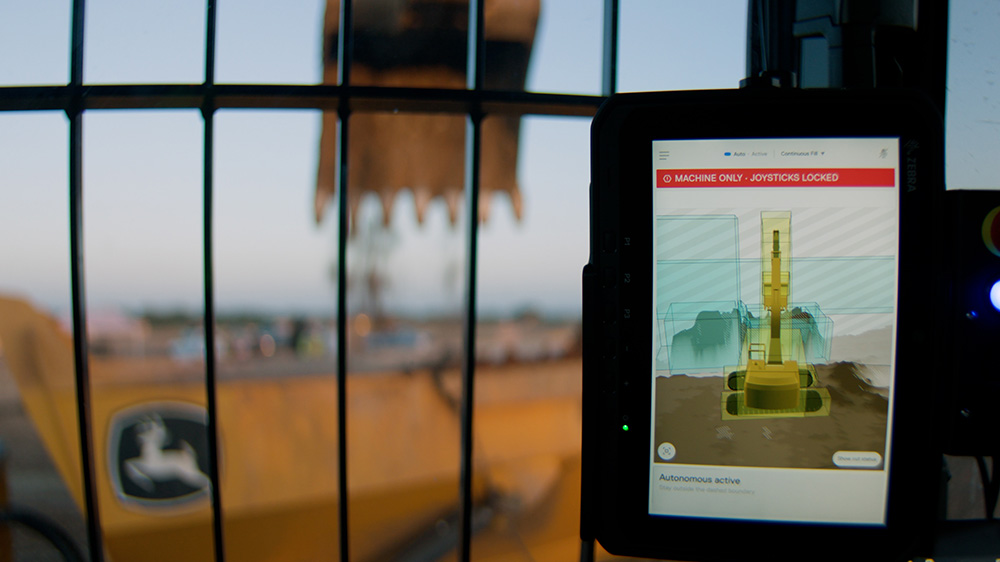
Bedrock has begun to operate autonomous excavators without an operator in the cab. | Credit: Bedrock Robotics
Startup looks to scale
“There are three big things that we’re doing next,” noted Peterson. “One is just scaling up our deployments. We want to get more customers using these machines that gives us experience.”
“The other dimension is doing more tasks,” he said. “So we’re getting into a handful of more finesse kind of work that opens up more and more scope that we can do.”
“There’s a lot a ton of other things that we’re pushing on,” Peterson said. “We’re really starting to think about orchestrating multiple machines, and so that’s been a longer-term thing, but coming soon on the roadmap are clusters of machines that work together. You might have an excavator, a bulldozer, a truck, and maybe there’s a grader, and those work together as a team. We want to accelerate these building projects — it could be simple work, or it could be complex work — but to accelerate them, you need these machines that work together.”
Construction is ripe for autonomy
The sector is reaching its limits, said Bedrock Robotics. Twenty percent of construction workers are over the age of 55, and analysts estimate that more than 40% of the construction industry will retire in the next five years.
Large projects already run an average of 20% over schedule and 80% over budget. Exacerbating these challenges is the inherent danger of the industry: Construction workers make up 7.5% of the workforce and 20% of workplace deaths.
“The physical economy is the next great frontier for machine learning,” stated Boris Sofman, co-founder and CEO of Bedrock Robotics. “While we have excavators moving earth independently today, we are moving toward coordinated fleets that self-orchestrate entire scopes of work.”
“Getting here took real partnership with contractors who are designing these solutions alongside us and an uncompromising commitment to doing this safely, responsibly, and with optimism about the future,” he said. “This fundamentally redefines not just the productivity of a single machine, but the very scale of what contractors — and our country — can achieve.”
Sofman was a guest on Episode 236 The Robot Report Podcast earlier this year. On the show, he discussed his long-term vision for the company.
Bedrock masters the critical first phase of excavation
Bedrock Robotics said it prioritized excavators, the most complex and highly utilized machine on a job site, often making up 25% of a contractor’s fleet. Mastering an excavator typically takes five years or more, which makes it among the hardest machines to predictably staff with skilled operators.
Starting with earthwork brings more predictability to the foundation of every major project, the company said. Until earthwork is complete, no subsequent phase — concrete, steel, mechanical, or electrical — can proceed.
The Bedrock Operator retrofits existing fleets with a sophisticated sensor and compute suite in a same-day installation that requires no permanent changes or new machinery. Trained across tens of thousands of hours in the field, Bedrock said its end-to-end machine learning model enables the system to perceive its environment, plan its motion, and execute complex tasks autonomously once a site manager sets the initial plan.
After a year of rigorous testing on active job sites under human supervision, Bedrock-equipped machines have proven their readiness.
“Our partnership with Bedrock Robotics is helping us tackle some of the challenges that matter most in construction: making schedules and costs more predictable, getting more consistent use out of our equipment, and allowing our skilled crews to focus on the work where their experience matters most,” said Cade Rowley, CEO of Sundt Construction Inc.
“AI is creating opportunities in our industry that we could not have imagined just a few years ago, both in the office and in the field,” he said. “As an employee-owned company, these tools can help us take on more, perform at a higher level, and create even greater opportunities for our people.”


Tell Us What You Think!