
The Aescape Recovery solution offers completely automated, preprogrammed body recovery treatments. | Credit: Aescape
If you’ve built a robotics company in the past 10 years, chances are you’ve at least flirted with the idea of robotics as a service, or RaaS. It’s attractive: recurring revenue, smoother adoption for customers, VC‑friendly narratives, and comparisons to SaaS.
But as my recent conversation with Frank Britt, CEO of Aescape Inc., made clear, the reality is more complicated. The company has lived through the consequences of misaligned capital structure and go‑to‑market design, and it is now pivoting from a pure RaaS story to what Britt called “platform‑powered robots.”
Britt came out of the venture capital world and had worked at Starbucks for more than four years. He said his experience at Starbucks helped him realize that such a business is an “execution machine.” The difficulty for most technology companies is bridging the gap between being an engineering startup and an execution machine, according to Britt.
It’s been a little over a year since Aescape closed an $83 million funding round that was expected to get it to mass adoption. However, the company restructured earlier this year.
Britt recently spoke with The Robot Report about the retooling of Aescape as it went through a general assignment milestone, essentially a more investor-friendly and less expensive restart than a bankruptcy.
The renewed company emerged with an established and growing customer base. Britt took over the helm as CEO from co-founder and ex-CEO Eric Litman. New York-based Aescape also has new sales leadership and a new sales model.
Britt discussed the struggles that many young RaaS-based organizations go through and how Aescape was able to press the reset button to emerge in a healthier financial state, ready to grow its core business of automated recovery stations, or robotic massage tables.
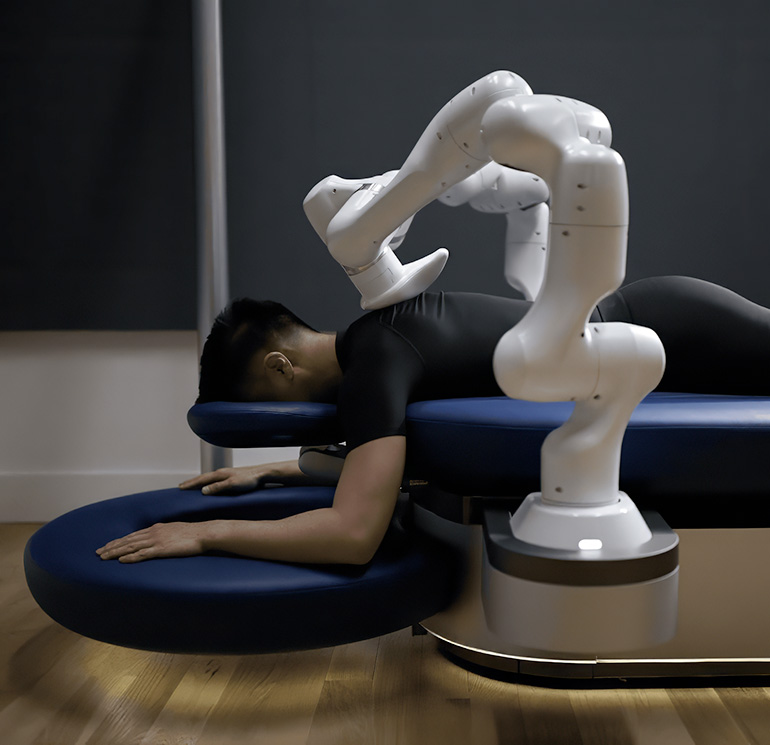
Aescape uses two Franka force-controlled cobots to deliver the recovery program for users. | Credit: Aescape
The core Aescape platform employs two Franka Robotics Research 3 force-sensitive robots positioned over a normal massage table. Users select the body areas that need work from a tablet as they lay face down on the table. The recovery experience is unsupervised.
Aescape’s primary target market includes hotels and gyms around the world, since its system can be set up anywhere in a facility, making use of unused space. The recovery service can be used 24/7, enabling patrons who have had a long travel day or a hard workout to immediately get a massage.
Britt was open about his company’s struggles and journey, and it’s a cautionary tale for any hardware‑focused, capital‑intensive product development organization. Let’s take a look at five key lessons learned.
1. Align your capital structure with your business model
Entrepreneurs tend to talk about business models in terms of pricing and packaging: subscription versus usage versus upfront sale (or opex versus capex). The hardest part of securing funding to build a business is aligning the capital structure to your go-to-market plan.
Aescape spent nine years as a research and development organization, building a sophisticated embodied AI system. When the company went to market, it did what many robotics startups do: It adopted a RaaS model. Aescape kept ownership of the hardware and charged customers recurring fees for access.
On paper, that looks like a subscription business. In reality, it means a VC‑backed startup with very expensive capital is now also the owner and financier of a large fleet of physical assets.
Britt observed that venture capital is a high‑cost, dilution‑intensive form of capital. It works beautifully when you’re scaling low‑marginal‑cost software. However, it can become risky when you also have to fund and carry a large, depreciating asset base.
Lesson learned: It’s okay to use venture capital to fund R&D and early commercialization. But be prepared to modify your capital structure once you get traction and your customer base begins to grow. At this milestone, you need to find investors whose cost of capital and asset risk are aligned with your stage and balance sheet. If those are misaligned, the physics eventually catch up with you.
2. Don’t become a bank by accident
In Britt’s words: “A pure RaaS model is more than a pricing decision; it’s a balance sheet decision, and robotics companies should not be a bank.”
When a robotics company retains ownership of the hardware and offers it as a service, it is implicitly acting like a bank:
- You buy and own the equipment.
- You take on the asset risk.
- Your customers (often with stronger, lower‑cost balance sheets than yours) get flexible, opex (operational expenditure)‑friendly payment terms.
This doesn’t mean RaaS is always wrong. But if you’re going to do it, you need to be honest with yourself. You are now in financial services as well as robotics. That’s a different level of complexity in terms of revenue recognition, risk management, cash flow, and capitalization.
Aescape’s pivot here is instructive. Instead of financing the hardware itself, the company has:
- Lowered the hardware price (roughly cutting the original effective price in half)
- Arranged third‑party financing so customers who want financing can still get it
- Focused their recurring revenue on software, content, and service, not on being the lender of record
Lesson learned: If you want recurring revenue, build it around the platform, service, and outcomes. Then let professional financiers handle the financing.
3. Separate hardware ownership from the service experience
The core of Aescape’s new model is what it calls “platform‑powered robots.” In practice, it’s a hybrid economic model:
- The enterprise customer owns the hardware as a capex (capital expenditure) purchase.
- Aescape sells a recurring platform/service layer that powers the experience.
This structure effectively decouples the hardware economics from the service economics:
- Hardware:
- Lives on the customer’s balance sheet
- Can be financed, depreciated, and ultimately resold or repurposed
- Platform:
- Delivers the ongoing value: new “content units” (experiences), software updates, monitoring, diagnostics, and service-level agreements (SLAs)
- Is billed annually per table, like a SaaS fee
From Aescape’s perspective, the business still has an attractive recurring revenue component—but without the crushing burden of being on the hook for every piece of hardware in the field. From the customer’s perspective, it get a capital asset plus a living, improving service layer.
Lesson learned: When you design your model, treat hardware and platform as two different economic layers. Let the customers own the assets if they’re better equipped to bear that risk, and earn your recurring revenue by continually earning your place as their experience and intelligence layer.
Warning: Don’t mix capex and opex options on your price list. It’s risky to be a pure RaaS company that occasionally sells units to customers who demand a capex sale. This is a nightmare from a revenue recognition and sales incentive perspective. The new Aescape business model is capex-only, with a recurring service revenue component rather than a pure RaaS model.
One advantage that RaaS has over traditional capex business models is that the customer isn’t guaranteed a new robot. In other words, it’s at the RaaS provider’s discretion whether to deploy a new or refurbished robot to the client. This enables the RaaS provider to refurbish and redeploy robots as customer churn occurs or as needed for flexible SLAs.
4. Remember that ownership changes customer behavior
One of the most interesting points Britt posited with the new Aescape business model was the behavioral effect of ownership. When hotels, gyms, or spas own Aescape systems:
- They embed it into their operational workflows.
- They assign it space, signage, and pricing.
- They market it to guests and members.
- They care about utilization and return on investment (ROI).
In other words, they behave like owners and are incentivized to push the services to their clients/patrons.
Economically, treating the robot as capex can also unlock benefits:
- Depreciation over the life of the asset
- A credible residual value, corroborated by the fact that financing companies are willing to underwrite it
- The ability to turn “dead space” into a profit center—very similar to how electric vehicle charging networks monetize parking lots or how cell towers monetize rooftops
For robotics entrepreneurs, there’s a deeper point here. The decision to push RaaS versus capex isn’t just about smoothing your revenue line, or improving your sales forecasting; it’s about how much skin in the game your customer has in making your robot successful in their environment.
The counterpoint to this argument is illustrated by the incredible success of Locus Robotics. In this case, when the RaaS service provider is on the hook for achieving the SLA, the provider will do everything necessary to optimize the system. This is only possible when the provider has real-time access to the data and can predict bottlenecks, adjust parameters, and anticipate issues, often without the end customer being aware of any concerns. The proof is in the result.
Lesson learned: Opex versus capex is application-specific. Design your model so that customer ownership improves both their economics and their commitment to driving utilization. Incentives matter, and ownership is a powerful incentive.
Research the fundamental buying behavior of the market that you are entering. Capex budgets function on an annual cycle, whereas opex budgets are the domain of the business-line director who often has the discretion to use the budget needed to meet their organization’s key performance indicators (KPIs). The net result is that the sales cycle is typically shorter with an opex offering.
5. R&D excellence is not enough – you need an execution machine
Aescape is a classic example of a company that nailed the technical design and then had to learn how to become an execution business. Its founding entrepreneurs built a highly sophisticated embodied AI system. It included industrial robotic arms repurposed for human bodywork, personalized content, and high uptime in consumer‑facing environments.
But as Britt pointed out, the mindset and operating model required to do frontier R&D are very different from those required to deploy and scale across over 100 locations with SLAs, support, and predictable economics.
Britt framed Starbucks as “execution machine,” with 40,000 stores, 100 million customers a week, 82 countries. That operational rigor — process, metrics, field support, reliability — is exactly what many robotics startups underestimate when they move from lab to field.
Aescape’s pivot isn’t just about pricing; it’s about:
- Contractual uptime commitments
- 24/7 remote diagnostics and support
- Clear economic value propositions to both the B2C user and the B2B operator
- A model that can be reproduced and scaled
Lessons learned from Aescape’s experience
If you’re a robotics founder, assume that product excellence and R&D are only half the battle. The other half is building an operational engine consisting of sales, deployment, support, financing architecture, and customer success.
Aescape’s story isn’t a simple “phoenix from the ashes” turnaround. It’s a case study in how a robotics company can mature its business model as it moves from innovation to real‑world deployment.
There are clear benefits and downsides to both business models, and sometimes the right answer is a hybrid solution, as in the case of Aescape with its “platform-powered robotics” solution.
For robotics entrepreneurs, the takeaway is clear: RaaS can be powerful, but it could also be a poison pill for a VC-funded organization, as Aescape experienced. Choosing the right ownership model and matching that to the right capital structure in later funding rounds is key to reducing the funder tension and market friction as your user base grows.
 Register now and save on your pass to RoboBusiness 2026
Tell Us What You Think!