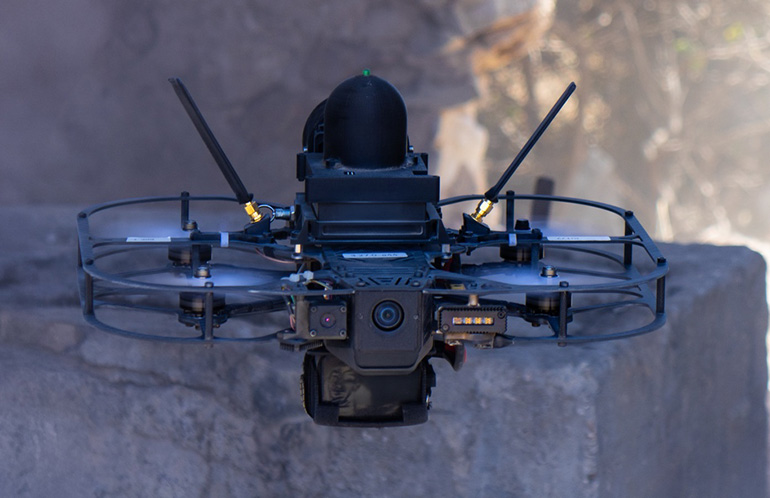
XTEND has developed systems to improve drone autonomy in challenging environments. Source: XTEND
XTEND Reality Inc. provides software and AI-powered robots for situations that are hazardous for humans. The company, which plans to merge with JFB Construction Holdings, last week secured a U.S. patent for technology that enables drones to autonomously navigate toward mission objectives.
U.S. Patent No. 12,222,735, with corresponding patent protection also granted in Israel, covers technology that enables continuous direction of an uncrewed aerial vehicle (UAV) toward an operator-designated destination, independent of the surrounding environment. The invention enables autonomous systems to adapt their navigation while maintaining progress toward mission objectives, reducing operator workload and supporting reliable mission execution in complex operational environments.
“Autonomy is not simply about moving a robot from Point A to Point B. It is about translating human intent into reliable mission execution, even in unfamiliar, dynamic environments,” said Aviv Shapira, co-founder and CEO of XTEND. “This patent aims to protect technology that enables operators to focus on the mission while autonomous systems manage the complexity of navigation.”
“As autonomous operations continue to expand across defense, security, and public safety applications, protecting these foundational technologies strengthens our competitive position and reinforces XOS as the software foundation for the next generation of autonomous robotic systems,” he said.
The proprietary XTEND Operating System (XOS) is designed to provide autonomy at the edge. Operating across defense, law enforcement, and private security missions through a platform of robots, drones, and robotic subsystems, XTEND said its open architecture platform facilitates scalability across partners and third-party applications.
Founded in 2018, XTEND said that more than 10,000 of its systems have been deployed in over 30 countries and that they have been validated in five combat zones. The Tampa, Fla.-based company added that it it delivers NDAA-compliant solutions through a global network of regional XFAB manufacturing facilities in the U.S., the U.K., Singapore, Israel, and Latvia.
XTEND patent expands operational reach
As autonomous systems become increasingly central to defense, public safety, and critical infrastructure missions, operators often must execute missions in environments that cannot be fully mapped or predicted in advance. XTEND said its technology enables robotic systems to navigate evolving terrain, structures, obstacles, and operational conditions while maintaining focus on the designated objective, helping improve operational efficiency and mission continuity.
The company said its latest patented technology complements its broader autonomy architecture. XOS, enables operators to supervise, coordinate, and deploy systems across air, ground, and maritime domains.
By combining artificial intelligence, autonomy, and human decision-making, XTEND said XOS translates operator intent into coordinated autonomous actions. This allows a single operator to extend operational reach while maintaining meaningful human oversight across increasingly complex missions.
In addition, XTEND said the newly granted patent further expands its growing intellectual property portfolio and “reflects XTEND’s continued investment in the foundational software technologies driving the future of autonomous operations.”
Also last week, XTEND said it was among the 19 companies to successfully qualify and advance in the Gauntlet II phase of the U.S. Department of War’s (DoW) $1 billion Drone Dominance Program. Gauntlet II will test autonomous, one-way attack systems and will take place in August at Fort Carson, Colo.
XTEND last month said it has obtained more than $12 million in cumulative defense orders, with $3 million in follow-on orders across two autonomous system programs.
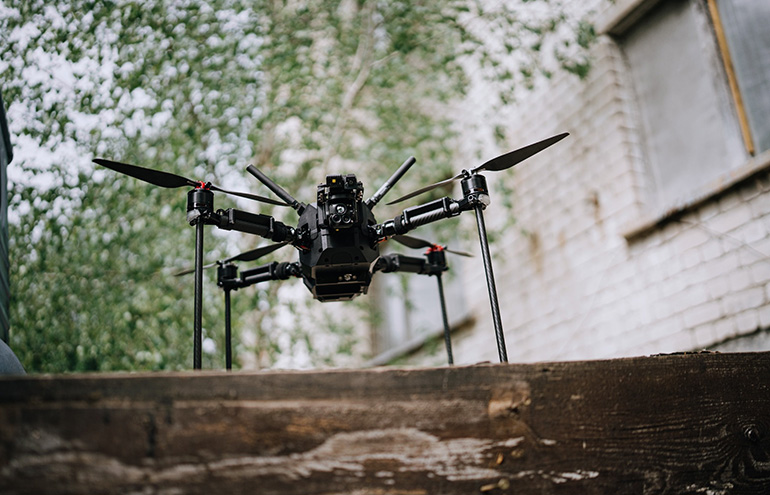
XOS optimizes operator control over multiple systems in multiple domains. Source: XTEND
JFB Construction Holdings combination is proceeding
In February, JFB Construction Holdings and XTEND agreed to an all-stock merger. JFB is a real estate development and construction company that has provided general contracting and construction management services in 36 U.S. states.
Existing XTEND shareholders will own approximately 70% of the combined company. Existing JFB shareholders will own approximately 30% on a fully diluted basis, excluding certain future equity incentive plans, according to the companies.
The deal was supported by strategic investments from Eric Trump, Unusual Machines, American Ventures, Protego Ventures, and Aliya Capital. JFB said it expects to complete the transaction midyear, pending regulatory approval and customary closing conditions. The combined company would trade on the Nasdaq under the ticker symbol “XTND.”
JFB and XTEND said the combination will accelerate deployment of autonomous systems; expand U.S.-based manufacturing; and establish a publicly traded defense robotics company positioned to serve the U.S., NATO allies, and other partner nations. The combined company, XTEND AI Robotics, will be led by Aviv Shapira.

Tell Us What You Think!