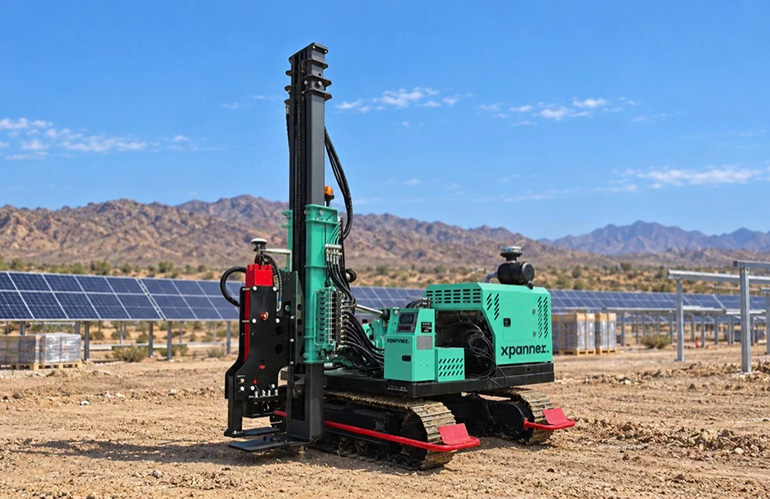
The Xpanner X1 Piling R6 is an automated pile-driving system for utility-scale solar and battery energy storage sites. | Credit: Xpanner
Xpanner today announced the X1 Piling R6, a fully automated pile-driving robot built to autonomously install posts for utility-scale solar and battery energy storage, or BESS, sites. Supervised by a single operator, the system uses high-precision GNSS and onboard sensors to place each pile accurately, helping builders keep pace with new power demand despite a shortage of skilled crews.
The core of the robot is Xpanner’s Everstar R6 crawler base machine. The R6 is equipped with the Santa Fe Springs, Calif.-based company‘s automation stack with onboard sensors and controls to autonomously complete the pile driving process for each post.
Xpanner designs for simplified operation
An operator uploads a plan, then walks X1 Piling R6 machine to the row using a remote control interface. The operator supervises the construction as the machine drives each pile accurately.
The R6 can autonomously navigate to the subsequent pile locations using high-precision GNSS antennas and receivers, precision sensors, and the Xpanner-developed automation controller. One operator can remotely manage the installation process.
“Solar and BESS builders are racing to bring new power online for the grid and for AI data centers, and they can’t find enough skilled crews to keep up,” said Henri Lee, co-founder and CEO of Xpanner. “X1 lets one operator drive every pile plumb with a single touch, keeps people away from the mast, and logs each pile as it goes in. It takes the automation EPCs [engineering, procurement, and construction firms] already trust on PD10 and puts it on a more powerful, more versatile machine.”
X1 connects to Xpanner Connect, the company’s web-based project dashboard. Project teams can load the pile schedule and coordinates, assign machines, and set up a site in minutes.
As X1 works, it records each pile’s position, depth, and plumb and posts it to a live project map, replacing manual counts, phone calls, spreadsheets, and end-of-day reports. Managers can also monitor machine state, cycle counts, and alerts across the fleet without a site visit.
Xpanner said business model is a mixed capex/SaaS subscription model. Customers purchase (or rent) the X1 Piling robot and then license the automation software on a monthly subscription basis for each active technology.
According to the company, the subscription is not tied to a specific project, site, or number of piles driven. Rather, the customer pays for the technology while it is actively being used. Once piling operations or the applicable task is completed, the equipment and technology can be transferred to another project and activated as needed.
Xpanner handles initial installation, calibration, operator training, and technical support, while the contractor provides the equipment operators on-site.
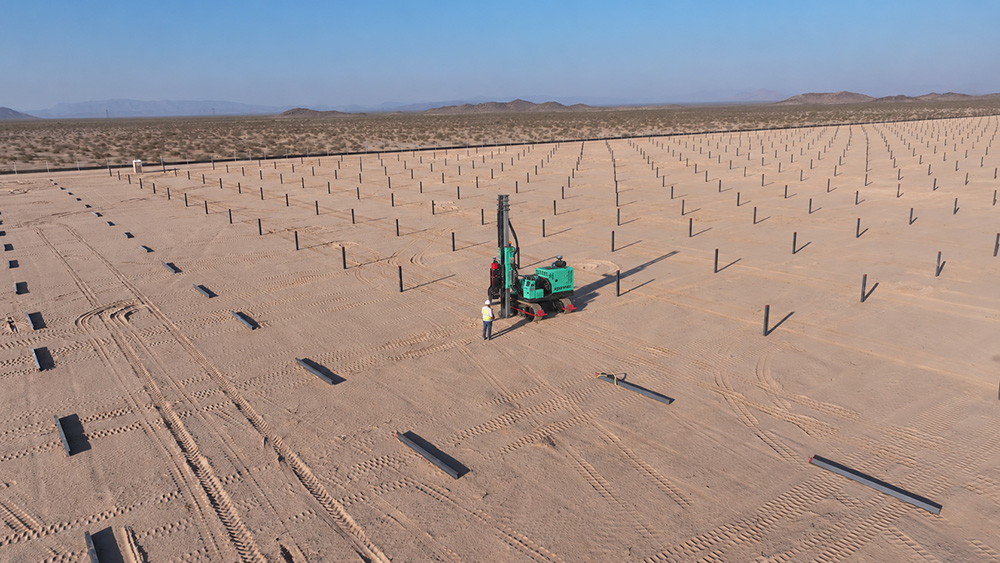
The Xpanner X1 Piling robot autonomously installs the posts for a solar panel farm. | Credit: Xpanner
Key features of the X1 Piling R6 robot
- Power for hard ground: The system includes a 97 kW (130 hp) engine and a high-frequency hydraulic hammer with up to 1,260 J (929 ft.-lb.) of impact energy and three energy settings to match soil conditions.
- Fine positioning without tramming: The guide rail slides 11.8 in. (300 mm) forward and back and 19.7 in. (500 mm) left and right, and the upper body rotates 180 degrees, putting the hammer on target from a single setup.
- Range of pile lengths: The X1 can drive piles up to 23 ft. (7.0 m) long, with a maximum driving depth of 15.7 ft. (4.8 m). Because the hammer lowers near the ground and piles can be driven flush to grade, one machine handles standard tracker piles, short motor piles, and BESS foundation piles without an adapter.
- Built for the field: Features include a mast that does not need disassembly for transport, a large fuel tank for long shifts, engine auto-idle, a large-capacity cooler, manual override, and e-stop.
- Multi-function mast (and potential capabilities): DTH drilling, auger drilling, and ground screwing on the same carrier, so one machine can pre-drill and drive.
The X1 Piling R6 is designed to work together with the X1 panel lift, which was released earlier this year, for autonomous solar panel installation.


Tell Us What You Think!