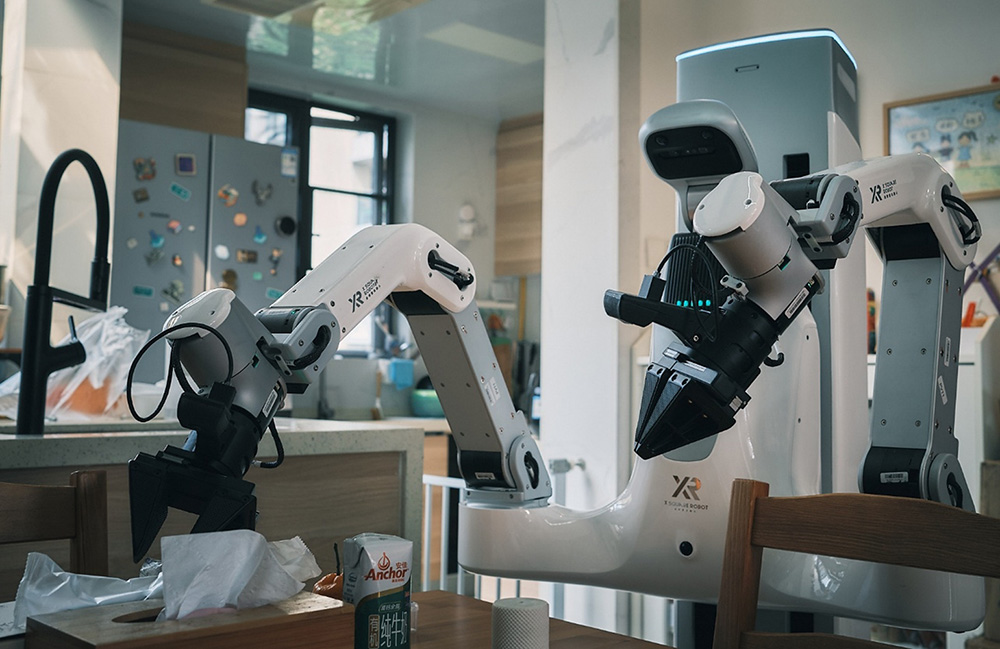
X Square Robot performing household tasks in a home environment. | Source: X Square Robot
X Square Robot Technology Co. today said it has closed four consecutive financing rounds, culminating in a Series C. These rounds bring the embodied AI and foundation model developer’s valuation to more than $2.8 billion.
The Shenzhen, China-based company said it will use the funding to further invest in foundational research and core technologies. X Square Robot said it plans to advance toward general-purpose embodied AI.
“Since Day 1, X Square Robot has focused on in-house development of foundation models, pursuing a challenging but necessary path,” stated Wang Qian, founder and CEO of X Square Robot. “Today, our investments in embodied AI models; a scalable, model-driven, high-quality data pipeline system; and real-world deployment are beginning to deliver clear results.”
Founded in 2023, X Square Robot develops “end-to-end” embodied AI systems. Rather than rely on traditional rule-based automation, the company said its approach enables robots to adapt to changing environments and generalize across a wide range of tasks.
The financing brings together strategic and financial investors, including leading technology companies, industrial partners, and venture capital firms, the company said. IDG participated in the Series C round, while HongShan and Xiaomi have backed X Square in multiple previous rounds.
 Submit your session idea for the 2026 RoboBusiness
X Square Robot focuses on end-to-end autonomy
X Square Robot said it is building a full-stack embodied AI system. Its system combines foundation models, robotics hardware, a proprietary data-pipeline system, and real-world deployments. At its core is a general-purpose embodied AI model designed to enable robots to perceive, reason, and act in complex physical environments.
In April 2026, the company introduced WALL-B, a foundation model built on its World Unified Model architecture. Unlike modular vision-language-action (VLA) approaches, WALL-B trains perception, language, action, and physical prediction within a unified network. This enables stronger multimodal understanding, spatial reasoning, and continual learning from real-world interactions, according to X Square.
The company has also open-sourced WALL-OSS-0.5 and WALL-WM, extending its unified approach to robot manipulation and world modeling. WALL-OSS-0.5 achieved over 80% autonomous completion on four of 17 real-robot tasks without post-training, X Square said.
WALL-WM introduces event-level prediction by aligning language, vision, and action data around meaningful events. This enables stronger cross-modal learning and physical-world prediction across reasoning, manipulation and generalization tasks.
To accelerate model development, X Square Robot has built a scalable, model-driven data pipeline spanning automated data collection, cleaning, annotation, quality control, and augmentation. When combined with real-world deployment, the company claimed that its system enables rapid model iteration while creating high-quality datasets for complex, long-tail scenarios.
X Square takes on the challenge of home robots
X Square Robot is deploying its model and hardware stack across household, industrial, and logistics scenarios. Among these, household settings represent one of the most complex and important testbeds for adoption and deployment.
In this area, the company has partnered with 58.com to launch an AI-powered cleaning service in Shenzhen and Beijing, where robots work alongside people in real residential environments. Since May, X Square Robot has also launched the “X Family Member Program,” where robots live with users’ families for up to one month as household companions, responding to a broader range of everyday needs.
Together, these initiatives bring embodied robots beyond staged demos and into real homes and everyday life, said X Square Robot. The company asserted that these deployments create a continuous feedback loop in which operational data improves model performance, helping accelerate progress toward general-purpose embodied intelligence.
“As AI moves beyond digital experiences into the physical world, progress will depend on close integration between models, data, and robotics,” Wang said. “We’re building that foundation so embodied AI can become part of everyday life.”

Tell Us What You Think!