The Robot Report

  • Home
  • News
  • Technologies
    • Batteries / Power Supplies
    • Cameras / Imaging / Vision
    • Controllers
    • End Effectors
    • Microprocessors / SoCs
    • Motion Control
    • Sensors
    • Soft Robotics
    • Software / Simulation
  • Development
    • Artificial Intelligence
    • Human Robot Interaction / Haptics
    • Mobility / Navigation
    • Research
  • Robots
    • AGVs
    • AMRs
    • Consumer
    • Collaborative Robots
    • Drones
    • Humanoids
    • Industrial
    • Self-Driving Vehicles
    • Unmanned Maritime Systems
  • Business
    • Financial
      • Investments
      • Mergers & Acquisitions
      • Earnings
    • Markets
      • Agriculture
      • Healthcare
      • Logistics
      • Manufacturing
      • Mining
      • Security
    • RBR50
      • RBR50 Winners 2025
      • RBR50 Winners 2024
      • RBR50 Winners 2023
      • RBR50 Winners 2022
      • RBR50 Winners 2021
  • Resources
    • Automated Warehouse Research Reports
    • Digital Issues
    • eBooks
    • Publications
      • Automated Warehouse
      • Collaborative Robotics Trends
    • Search Robotics Database
    • Videos
    • Webinars / Digital Events
  • Events
    • RoboBusiness
    • Robotics Summit & Expo
    • DeviceTalks
    • R&D 100
    • Robotics Weeks
  • Podcast
    • Episodes
  • Advertise
  • Subscribe

WiBotic launches a new lineup of power chargers for drones and autonomous mobile robots

By Mike Oitzman | August 17, 2021

Wibotic OC 262 power chargers

WiBotic OC 262 onboard power chargers provide custom charging of AMR batteries. | Image credit: Wibotic

WiBotic introduces several new cutting-edge chargers and transmitters for drones and autonomous mobile robots. The new products showcase WiBotic’s expertise in innovating efficient charging solutions for robots that operate in all sorts of environments, even under the harshest conditions.

WiBotic OC-262 onboard charger

The OC-262 is a passively cooled onboard charger that was developed as a ruggedized system for the Department of Defense, but is now being released for wider use in response to customer demand. Passive cooling is particularly beneficial in punishing environments where water, dust, dirt and corrosion are significant concerns, and the OC-262 offers considerable benefits to customers operating in the oil and gas, mining, construction, marine exploration and agriculture industries.

Providing up to 300W of power, the OC-262 has no moving parts, supports all common robot battery chemistries, and pairs with a weatherproof receiver antenna for a complete outdoor solution

Two models of the OC-262 are now available:

  • An ST model with IP20 rating for applications that require passive cooling but can be more open to the environment.
  • A WP model with IP67 rating for use in outdoor or extreme environments.

WiBotic OC-150 drone battery charger
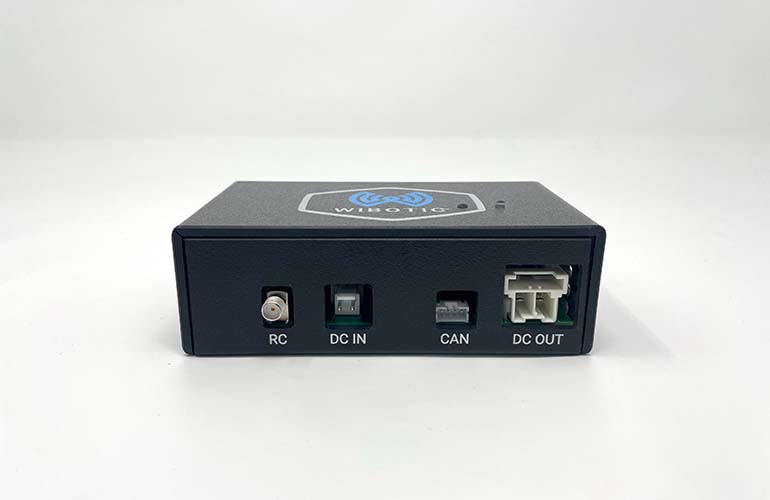
WiBotic OC 15j0

The WiBotic OC 150 is lightweight and designed to be deployed onboard a drone. | Image credit: WiBotic

OC-150 onboard charger. Designed for UAVs and smaller robots, the OC-150 is a compact and lightweight onboard charger that delivers up to 150W of total power and up to 10A of current depending upon battery voltage. As with other OCs, it supports multiple battery chemistries and has an output voltage range of 9V to 58.5V.

WiBotic TR-150 transmitter

Wibotic TR 150

The WiBotic TR 150. | Image credit: WiBotic

A compact transmitter, the TR-150 uses the latest high-efficiency GaN transistors from WiBotic partner GaN Systems Inc. It is designed primarily for use with the new OC-150 onboard charger but supports all WiBotic OCs when deployed in diverse robot fleets. Delivering up to 150W of power, its new GaN-driven power amplifier has an exemplary 95% efficiency – leading to end-to-end wireless power system efficiencies of 85% or more.

TR-300 transmitter. Like the TR-150, the TR-300 is a compact wireless power transmitter using GaN Systems’ technology for maximum efficiency. The TR-300 offers the same core benefits as the TR-150 but delivers up to 300W of power when paired with WiBotic’s OC-262 or OC-301 onboard chargers.

Paul Wiener, VP of Strategic Marketing at GaN Systems, congratulated WiBotic on the announcement: “These new products are just as exciting for GaN Systems as they are for WiBotic. We continue to believe the market for high-power wireless charging systems is going to explode in the coming years and companies like WiBotic are going to lead the way through the use of GaN technology.”
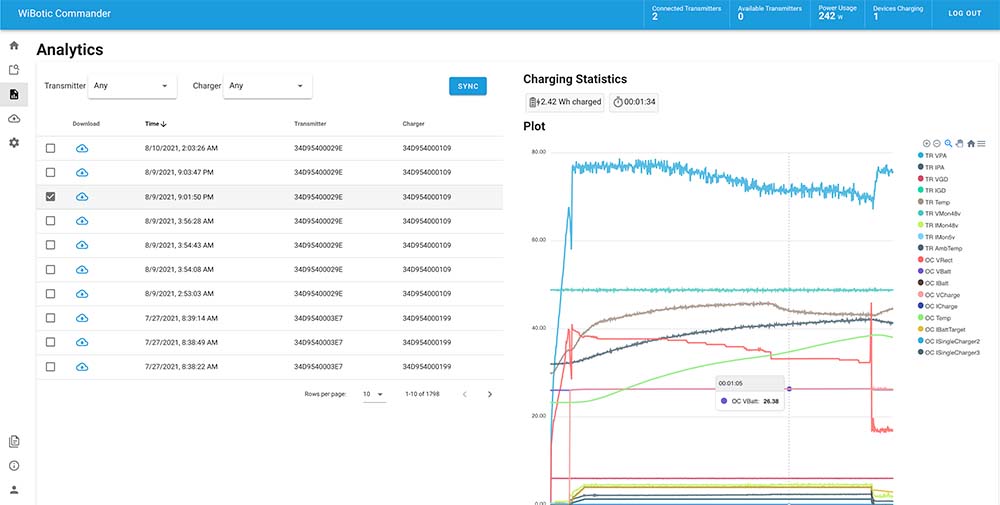
WiBotic Commander software

WiBotic Commander software provides a single place to view all charging operations. | Image credit: WiBotic

For drone operations, it can be difficult to keep track of individual battery health when large collections of diverse batteries are manually charged for repetitive field use. When used with WiBotic’s new Commander Fleet Energy Management software, lightweight WiBotic OCs can now track and report on individual battery charge cycles, termination voltage, charge rate (amps), and other critical factors that determine how a battery will perform day-to-day.

“When it comes to power delivery for autonomous drones and mobile robots, it’s crucial to innovate with new technologies such as GaN to maximize efficiency,” said Ben Waters, CEO at WiBotic. “These new products not only push that technical envelope but are also designed to survive in the most extreme operational conditions. And when used together with WiBotic software, they now let operators track and optimize the performance of individual batteries within large and diverse collections – whether charging is performed manually or fully autonomously.”

Listen to an interview with the WiBotic team on a recent The Robot Report Podcast episode.

You may also like:


  • WiBotic powers wireless charging for Clearpath AMRs
  • robot shipments
    Surging North American robot shipments; wireless charging future
  • WiBotic Commander
    WiBotic Commander offers energy management for robot fleets
  • WiBotic raises Series A funding to expand wireless robot charging
    Wireless robot charging provider WiBotic joins the ARM Institute

  • NASA initiative developing wireless charging for lunar robots

About The Author

Mike Oitzman

Mike Oitzman is a robotics industry veteran and Senior Editor of WTWH Media’s Robotics Group, covering automation for The Robot Report and co-hosting its podcast. With 25+ years of experience, including leadership roles at Adept Technology, Mike founded the Mobile Robot Guide (acquired by WTWH). He is a leading expert on Autonomous Mobile Robots (AMRs), physical AI, and RaaS business models, holding a Systems Engineering degree and an MBA. He can be reached at [email protected].

Tell Us What You Think! Cancel reply

This site uses Akismet to reduce spam. Learn how your comment data is processed.

Related Articles Read More >

A report looks at the state of humanoids
Mobile manipulators and humanoids: The future of robotics
The ARM Institute has issued Project Call 27-01 for defense-related manufacturing technology projects.
ARM Institute calls for defense manufacturing technology projects
Agility's Digit robot, Apptronik's Apollo, Persona AI's humanoid, and PSYONIC's robotic hand.
Experts to discuss the state of humanoid robots at RoboBusiness
A robot hand reaching out to a human hand.
BioflexBot robot hand aims to replicate key human hand motions

RBR50 Innovation Awards

“2026”
“rr
EXPAND YOUR KNOWLEDGE AND STAY CONNECTED
Get the latest info on technologies, tools and strategies for Robotics Professionals.

Latest Episode of The Robot Report Podcast

Automated Warehouse Research Reports

Sponsored Content

  • The 370-billion-dollar race: How integrated design can help humanoid manufacturers succeed in a rapidly growing market
  • humanoid robot sorts parts. 5 Physical AI infrastructure platforms shaping robotics in 2026
  • How integrated actuators improve humanoid robot joint performance and system integration
  • Boston Dynamics will discuss human-machine interaction for humanoid robots in a webinar. Boston Dynamics to discuss the art behind human-robot interaction
  • In robotics, ruggedization is no longer optional
More Sponsored Content >
The Robot Report
  • Automated Warehouse
  • RoboBusiness
  • Robotics Summit & Expo
  • About The Robot Report
  • Subscribe
  • Contact Us

Copyright © 2026 Arrowfly LLC. All Rights Reserved. The material on this site may not be reproduced, distributed, transmitted, cached or otherwise used, except with the prior written permission of Arrowfly
Privacy Policy | Advertising | About Us

Search The Robot Report

  • Home
  • News
  • Technologies
    • Batteries / Power Supplies
    • Cameras / Imaging / Vision
    • Controllers
    • End Effectors
    • Microprocessors / SoCs
    • Motion Control
    • Sensors
    • Soft Robotics
    • Software / Simulation
  • Development
    • Artificial Intelligence
    • Human Robot Interaction / Haptics
    • Mobility / Navigation
    • Research
  • Robots
    • AGVs
    • AMRs
    • Consumer
    • Collaborative Robots
    • Drones
    • Humanoids
    • Industrial
    • Self-Driving Vehicles
    • Unmanned Maritime Systems
  • Business
    • Financial
      • Investments
      • Mergers & Acquisitions
      • Earnings
    • Markets
      • Agriculture
      • Healthcare
      • Logistics
      • Manufacturing
      • Mining
      • Security
    • RBR50
      • RBR50 Winners 2025
      • RBR50 Winners 2024
      • RBR50 Winners 2023
      • RBR50 Winners 2022
      • RBR50 Winners 2021
  • Resources
    • Automated Warehouse Research Reports
    • Digital Issues
    • eBooks
    • Publications
      • Automated Warehouse
      • Collaborative Robotics Trends
    • Search Robotics Database
    • Videos
    • Webinars / Digital Events
  • Events
    • RoboBusiness
    • Robotics Summit & Expo
    • DeviceTalks
    • R&D 100
    • Robotics Weeks
  • Podcast
    • Episodes
  • Advertise
  • Subscribe