The Robot Report

  • Home
  • News
  • Technologies
    • Batteries / Power Supplies
    • Cameras / Imaging / Vision
    • Controllers
    • End Effectors
    • Microprocessors / SoCs
    • Motion Control
    • Sensors
    • Soft Robotics
    • Software / Simulation
  • Development
    • Artificial Intelligence
    • Human Robot Interaction / Haptics
    • Mobility / Navigation
    • Research
  • Robots
    • AGVs
    • AMRs
    • Consumer
    • Collaborative Robots
    • Drones
    • Humanoids
    • Industrial
    • Self-Driving Vehicles
    • Unmanned Maritime Systems
  • Business
    • Financial
      • Investments
      • Mergers & Acquisitions
      • Earnings
    • Markets
      • Agriculture
      • Healthcare
      • Logistics
      • Manufacturing
      • Mining
      • Security
    • RBR50
      • RBR50 Winners 2025
      • RBR50 Winners 2024
      • RBR50 Winners 2023
      • RBR50 Winners 2022
      • RBR50 Winners 2021
  • Resources
    • Automated Warehouse Research Reports
    • Digital Issues
    • eBooks
    • Publications
      • Automated Warehouse
      • Collaborative Robotics Trends
    • Search Robotics Database
    • Videos
    • Webinars / Digital Events
  • Events
    • RoboBusiness
    • Robotics Summit & Expo
    • DeviceTalks
    • R&D 100
    • Robotics Weeks
  • Podcast
    • Episodes
  • Advertise
  • Subscribe

Vention releases Rapid Operator AI to automate deep bin picking

By Brianna Wessling | March 23, 2026

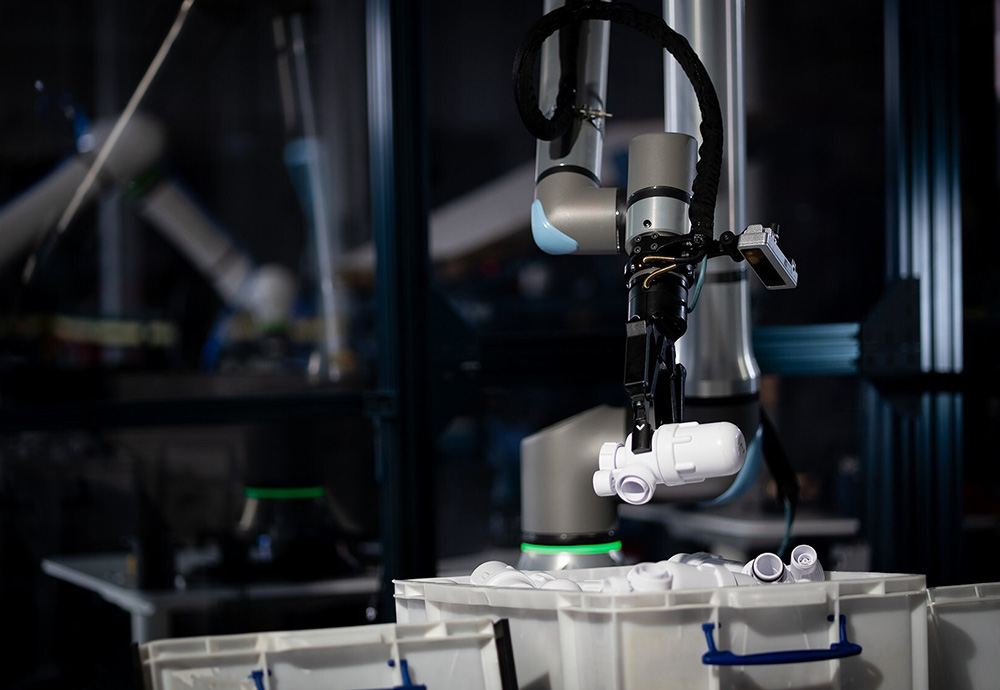
Rapid Operator AI by Vention autonomously performs deep bin picking, identifying and grasping randomly oriented parts from dense containers using AI-powered perception and motion planning.

Rapid Operator AI autonomously identifies and grasps randomly oriented parts from dense containers using AI-powered perception and motion planning. | Source: Vention

Vention Inc. has developed Rapid Operator AI to automate complex, unstructured tasks, beginning with deep bin picking. The company announced the system’s commercial launch at NVIDIA GTC 2026 last week.

“Rapid Operator AI is a productized, physical AI solution for unstructured manufacturing tasks. I’m not talking about warehousing here; I’m talking about manufacturing,” Etienne Lacroix, the founder and CEO of Vention, told The Robot Report. “The world of manufacturing is significantly more demanding.”

Lacroix said the new product is built on the company‘s Generalized Robotic Industrial Intelligence Pipeline (GRIIP). GRIIP delivers a unified pipeline from perception to motion by integrating Vention’s proprietary models with NVIDIA Isaac open models.

Vention is targeting midmarket and enterprise manufacturers operating multi-shift facilities where labor shortages and high production variability create operational strain with the system.

Why start with deep bin picking?

https://www.therobotreport.com/wp-content/uploads/2026/03/1000011156.mp4

Vention highlighted two reasons for targeting deep bin-picking tasks. First, its customers said it was a common problem.

“When we talk to customers in the industry, it’s just a very recurrent problem. In assembly or machine tending, you have a bin of parts, and then you have to take them out of the bin and then do an operation with them,” explained Francois Giguere, chief technology officer at Vention. “So, it’s a use case that very often has blocked us, because we didn’t have a scalable way to adapt to this type of environment.”

“Now, leveraging these new technologies, we’re in a much better position to say yes to these projects and implement something for the customers,” he added. “Everything comes in these big, deep bins. They have a fixed form factor, and they’re part of their operation, so you have to deal with it.”

The second reason Vention started with bin picking was because of how challenging the task was. Picking deeply in bins adds a lot of complexity, It’s hard to see what you’re trying to pick, and you need to ensure the robot or camera doesn’t collide with the bin itself or objects within the bin, Lacroix said.

However, the team knew that if they could tackle this issue, they would be able to tackle any other one in manufacturing.

“The first deployment we did was a client that had four different attempts to solve this with traditional vision,” recalled Lacroix. “Each of them had failed to the point that when we proposed to them this kind of use case as an R&D case for us to bring this technology to market, they were skeptical.”

Vention on building an efficient and flexible AI model

Vention said Rapid Operator allows robots to:

  • Detect randomly oriented parts in dense clutter, estimate precise 6-DoF (degree-of-freedom) pose, and plan collision-free grasps
  • Execute autonomous picks with adaptive retries for reliable, multi-shift operation with minimal supervision
  • Support opaque, translucent, and transparent materials; perform in bright light, low light, or darkness; handle containers up to 24 in. (60.9 cm) deep

To make a system that can do all of this quickly, Vention needed to take the best parts of AI pipelines and world models.

“AI pipelines are super efficient. They’re fast, they’re able to meet industrial-grade cycle times. World models, like the ones we very often see these days on humanoids, are very generalizable, but they’re slow and cannot meet the usual cycle times of manufacturers,” said Lacroix. “So, how do you get the best of both? You want generalization, and you want speed and performance.”

NVIDIA plays a role in development

Vention uses NVIDIA FoundationStereo for stereo matching, and NVIDIA FoundationPose for pose estimation.

“Building foundation models from scratch requires a lot of compute. It’s extremely expensive. Building these models also requires a lot of expertise,” Giguere said. “So, we’ve let [NVIDIA] do that portion of the effort, and we’ve integrated that into a pipeline for applications.”

Looking ahead, Lacroix said Rapid Operator AI will remain a manufacturing-focused system. However, with GRIIP, the company can offer a wider variety of tasks.

“Any manufacturer that operates a two-shift factory can now deploy physical AI within a two-year payback,” Lacroix said. “You get the speed of humans, the reliability of humans in terms of pick, and you’re able to navigate, at the same time, those very intricate, very constrained manufacturing environments without any collision.”


SITE AD for the 2026 RoboBusiness call for speakersRegister now and help us celebrate 20 years of RoboBusiness!
About The Author

Brianna Wessling

Brianna Wessling is an Associate Editor, Robotics, WTWH Media. She joined WTWH Media in November 2021, after graduating from the University of Kansas with degrees in Journalism and English. She covers a wide range of robotics topics, but specializes in women in robotics, robotics in healthcare, and space robotics.

She can be reached at [email protected]

Tell Us What You Think! Cancel reply

This site uses Akismet to reduce spam. Learn how your comment data is processed.

Related Articles Read More >

Vention and its partners have invested in space and equipment for its new physical AI lab.
Vention opens Physical AI Lab for manufacturing in Montreal
Robotics Australia Group and HowToRobot logos over a map of Australia.
HowToRobot and Robotics Australia Group partner on platform to encourage robot adoption
The leadership team at Avatar Robotics: Hamid Farzaneh, Founding Engineer (l), Colin Webb, Founder/CEO (m), Nenye Anagbogu, Chief Screwdriver (r).
Avatar Robotics raises seed round to address industrial labor constraints
two humanoid robotics hands picking cylindrical items from tables.
Tesollo initiates IPO process while developing humanoid hands

RBR50 Innovation Awards

“2026”
“rr
EXPAND YOUR KNOWLEDGE AND STAY CONNECTED
Get the latest info on technologies, tools and strategies for Robotics Professionals.

Latest Episode of The Robot Report Podcast

Automated Warehouse Research Reports

Sponsored Content

  • Designing long-travel axes: When rack and pinion outperforms ball screws and linear motors
  • How to select the right rack and pinion system for high-precision linear motion
  • The Missing Layer in Robot Safety Assurance
  • The 370-billion-dollar race: How integrated design can help humanoid manufacturers succeed in a rapidly growing market
  • humanoid robot sorts parts. 5 Physical AI infrastructure platforms shaping robotics in 2026
More Sponsored Content >
The Robot Report
  • Automated Warehouse
  • RoboBusiness
  • Robotics Summit & Expo
  • About The Robot Report
  • Subscribe
  • Contact Us

Copyright © 2026 Arrowfly LLC. All Rights Reserved. The material on this site may not be reproduced, distributed, transmitted, cached or otherwise used, except with the prior written permission of Arrowfly
Privacy Policy | Advertising | About Us

Search The Robot Report

  • Home
  • News
  • Technologies
    • Batteries / Power Supplies
    • Cameras / Imaging / Vision
    • Controllers
    • End Effectors
    • Microprocessors / SoCs
    • Motion Control
    • Sensors
    • Soft Robotics
    • Software / Simulation
  • Development
    • Artificial Intelligence
    • Human Robot Interaction / Haptics
    • Mobility / Navigation
    • Research
  • Robots
    • AGVs
    • AMRs
    • Consumer
    • Collaborative Robots
    • Drones
    • Humanoids
    • Industrial
    • Self-Driving Vehicles
    • Unmanned Maritime Systems
  • Business
    • Financial
      • Investments
      • Mergers & Acquisitions
      • Earnings
    • Markets
      • Agriculture
      • Healthcare
      • Logistics
      • Manufacturing
      • Mining
      • Security
    • RBR50
      • RBR50 Winners 2025
      • RBR50 Winners 2024
      • RBR50 Winners 2023
      • RBR50 Winners 2022
      • RBR50 Winners 2021
  • Resources
    • Automated Warehouse Research Reports
    • Digital Issues
    • eBooks
    • Publications
      • Automated Warehouse
      • Collaborative Robotics Trends
    • Search Robotics Database
    • Videos
    • Webinars / Digital Events
  • Events
    • RoboBusiness
    • Robotics Summit & Expo
    • DeviceTalks
    • R&D 100
    • Robotics Weeks
  • Podcast
    • Episodes
  • Advertise
  • Subscribe