The Robot Report

  • Home
  • News
  • Technologies
    • Batteries / Power Supplies
    • Cameras / Imaging / Vision
    • Controllers
    • End Effectors
    • Microprocessors / SoCs
    • Motion Control
    • Sensors
    • Soft Robotics
    • Software / Simulation
  • Development
    • Artificial Intelligence
    • Human Robot Interaction / Haptics
    • Mobility / Navigation
    • Research
  • Robots
    • AGVs
    • AMRs
    • Consumer
    • Collaborative Robots
    • Drones
    • Humanoids
    • Industrial
    • Self-Driving Vehicles
    • Unmanned Maritime Systems
  • Business
    • Financial
      • Investments
      • Mergers & Acquisitions
      • Earnings
    • Markets
      • Agriculture
      • Healthcare
      • Logistics
      • Manufacturing
      • Mining
      • Security
    • RBR50
      • RBR50 Winners 2025
      • RBR50 Winners 2024
      • RBR50 Winners 2023
      • RBR50 Winners 2022
      • RBR50 Winners 2021
  • Resources
    • Automated Warehouse Research Reports
    • Digital Issues
    • eBooks
    • Publications
      • Automated Warehouse
      • Collaborative Robotics Trends
    • Search Robotics Database
    • Videos
    • Webinars / Digital Events
  • Events
    • RoboBusiness
    • Robotics Summit & Expo
    • DeviceTalks
    • R&D 100
    • Robotics Weeks
  • Podcast
    • Episodes
  • Advertise
  • Subscribe

STEM education in the classroom, introducing BotBall

By Mike Oitzman | July 12, 2026

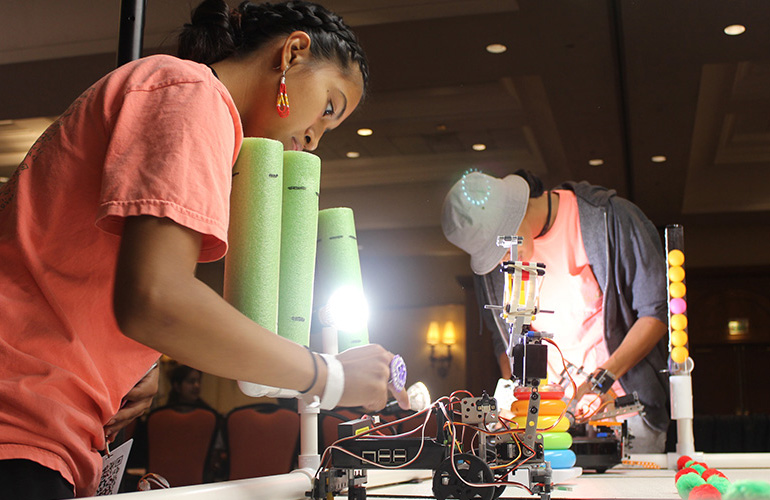
Two youths working with Botball robots on a tabletop field.

Botball provides students inquiry-based experiences to build creativity, critical thinking, and teamwork. | Credit: KISS Institute for Practical Robotics

The story of Botball and the Junior Botball Challenge is defined by a shift in perspective: moving away from a model where adults lead the way, and instead placing the full weight of discovery on the students.

According to Steve Goodgame, executive director of the KISS Institute of Practical Robotics (KIPR), the program was born from the idea that the same rigor applied to university-level robotics education could be adapted for high schoolers, middle schoolers, and eventually elementary students.

Botball follows ‘level playing field’ philosophy

Botball strictly adheres to the principle of student-led engineering. By providing a standardized kit, the competition ensures that success is determined by the logic of the code and the creativity of the design rather than a school’s budget.

Goodgame emphasized this core value of the program in a conversation with The Robot Report.

“Everybody in the world gets the same box of parts, so it’s a level playing field,” he said. “You can’t buy better parts, can’t make better parts. You have to use what’s in the box, and adults don’t touch the robots when they come to the competition—adults are out of the pits. It’s what the kids can do using the same materials.”

By removing the “mentorship model” during the heat of competition, students learn true accountability. They aren’t just building a robot; they are managing a project from inception to execution, said Goodgame.

Coding as a second language

While many elementary programs utilize simplified, block-based dragging and dropping, Botball challenges the notion that children can’t handle “real” code. The program introduces text-based languages such as C and Python at an early age, treating them with the same natural ease as learning to speak or write.

“We kicked around the idea: Could kids really do real programming right at an early age? And so we did a little pilot and found out, yeah, of course they can,” noted Goodgame. “So when they’re learning language anyway, it’s actually easier for them.”


ITE AD for the 2026 RoboBusiness call for speakersSubmit your session idea for the 2026 RoboBusiness

A new ecosystem for STEM

The Junior Botball Challenge (JBC) shifts the focus from head-to-head competition to inquiry-driven problem solving. Instead of one student controlling one robot, JBC uses a specialized controller that allows up to five students to program and run different segments of code on a single robot simultaneously.

As the summer ends and the new school year begins, more information about the upcoming schedule for competition is on the KIPR website.

Key aspects of the Botball ecosystem:

  • Autonomous operation: Every robot must be 100% autonomous, starting only with a light sensor, and stopping automatically after two minutes.
  • Integration with the classroom: The curriculum is designed to be used during the school day, not just as an after-school club.
  • The virtual simulator: Using the Botball Academy, students can iterate on their designs and code in a physics-based simulation before ever touching a physical robot. This allows them to “fail fast” and learn without the fear of damaging equipment.

The results: Breaking the 1950s industrial model

Traditional robotics often mimics an old assembly line: One student builds, one student programs, and another manages. Botball aims to break that mold, encouraging every student on the team to be a “polymath” who understands both the mechanics and the software.

This inclusive, classroom-based approach could help bridg the gender gap in STEM (science, technology, engineering, and mathematics). Because the program is integrated into the daily school experience, participation among girls jumps from 30% in traditional competitive models to more 55% in JBC classrooms, said the organization.

It isn’t just a competition; it’s a culture of collaborative, open-ended problem solving to prepare kids for a future where they must adapt to and master new tools every day.

Editor’s note: This article is a part of our ongoing STEM education and workforce development series.


You may also like:

  • A white and blue robotic arm holding up an ARM Institute flag in front of a crowd of people at the ARM Institute.
    ARM Institute expands RoboticsCareer.org into physical AI
  • headshot of Dr Robert Ambrose and Dhaval Jadav, and the podcast logo.
    The power of STEM: Shaping the next generation
  • Four girls working on projects as part of the jumpstart fellowship program.
    MassRobotics encourages high school girls interested in STEM to apply…
  • two students work on their robot between competition at a FIRST tournament.
    How STEM and competitive robotics are shaping tomorrow’s workforce

About The Author

Mike Oitzman

Mike Oitzman is a robotics industry veteran and Senior Editor of WTWH Media’s Robotics Group, covering automation for The Robot Report and co-hosting its podcast. With 25+ years of experience, including leadership roles at Adept Technology, Mike founded the Mobile Robot Guide (acquired by WTWH). He is a leading expert on Autonomous Mobile Robots (AMRs), physical AI, and RaaS business models, holding a Systems Engineering degree and an MBA. He can be reached at [email protected].

Tell Us What You Think! Cancel reply

This site uses Akismet to reduce spam. Learn how your comment data is processed.

Related Articles Read More >

automate show image with podcast logo.
Automate 2026 show recap
A white and blue robotic arm holding up an ARM Institute flag in front of a crowd of people at the ARM Institute.
ARM Institute expands RoboticsCareer.org into physical AI
Industrial robot adoption has continued to increase, according to the IFR.
Modernizing the global economy with industrial robotics is needed but not inevitable
MassRobotics' Form & Function winning teams at the Robotics Summit.
Boston University team wins MassRobotics Form & Function Challenge at Robotics Summit

RBR50 Innovation Awards

“2026”
“rr
EXPAND YOUR KNOWLEDGE AND STAY CONNECTED
Get the latest info on technologies, tools and strategies for Robotics Professionals.

Latest Episode of The Robot Report Podcast

Automated Warehouse Research Reports

Sponsored Content

  • In Robotics, Ruggedization Is No Longer Optional
  • Advantages of hypoid gearing over worm, bevel and bevel-planetary
  • Daimon Robotics and Galbot jointly launches RobOmni for benchmarking tactile perception and dexterous manipulation
  • genisom tradeshow booth with quadrupeds. GENISOM AI debuts deployable robotics platforms at ICRA 2026
  • How humanoids learn to read the room
More Sponsored Content >
The Robot Report
  • Automated Warehouse
  • RoboBusiness Event
  • Robotics Summit & Expo
  • About The Robot Report
  • Subscribe
  • Contact Us

Copyright © 2026 WTWH Media LLC. All Rights Reserved. The material on this site may not be reproduced, distributed, transmitted, cached or otherwise used, except with the prior written permission of WTWH Media
Privacy Policy | Advertising | About Us

Search The Robot Report

  • Home
  • News
  • Technologies
    • Batteries / Power Supplies
    • Cameras / Imaging / Vision
    • Controllers
    • End Effectors
    • Microprocessors / SoCs
    • Motion Control
    • Sensors
    • Soft Robotics
    • Software / Simulation
  • Development
    • Artificial Intelligence
    • Human Robot Interaction / Haptics
    • Mobility / Navigation
    • Research
  • Robots
    • AGVs
    • AMRs
    • Consumer
    • Collaborative Robots
    • Drones
    • Humanoids
    • Industrial
    • Self-Driving Vehicles
    • Unmanned Maritime Systems
  • Business
    • Financial
      • Investments
      • Mergers & Acquisitions
      • Earnings
    • Markets
      • Agriculture
      • Healthcare
      • Logistics
      • Manufacturing
      • Mining
      • Security
    • RBR50
      • RBR50 Winners 2025
      • RBR50 Winners 2024
      • RBR50 Winners 2023
      • RBR50 Winners 2022
      • RBR50 Winners 2021
  • Resources
    • Automated Warehouse Research Reports
    • Digital Issues
    • eBooks
    • Publications
      • Automated Warehouse
      • Collaborative Robotics Trends
    • Search Robotics Database
    • Videos
    • Webinars / Digital Events
  • Events
    • RoboBusiness
    • Robotics Summit & Expo
    • DeviceTalks
    • R&D 100
    • Robotics Weeks
  • Podcast
    • Episodes
  • Advertise
  • Subscribe