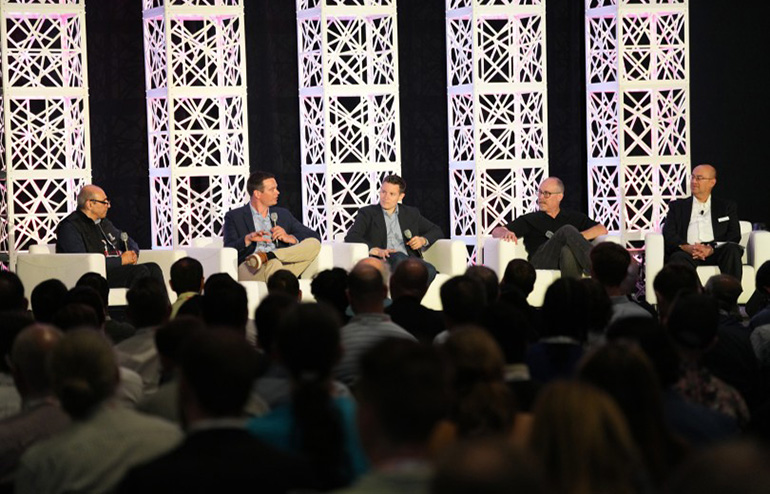
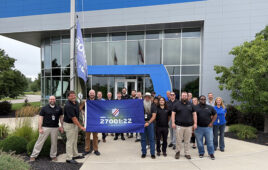
In the Robotics Summit opening keynote, QNX President John Wall, second from right, joined (from left) Locus Robotics’ Hamid Montazeri, Universal Robots’ Anders Beck, Amazon Robotics’ Aaron Parness, and moderator Eugene Demaitre. Source: QNX
BOSTON — At the Robotics Summit & Expo this week, QNX presented its latest research study, “Inside the Robot: Architecture Benchmark Report.” It examined how robotics development is changing as systems become more software‑driven, enabled by AI, and deployed alongside people.
“Robotics teams are clearly pushing toward more intelligent, autonomous systems, but the data shows they are also running up against the very real limits of architectures that were never designed for this level of complexity or accountability,” stated Jim Hirsch, global vice president of of sales and general embedded markets at QNX.
“Developers consistently cite four core challenges: integration complexity, certification delays, functional safety risks in human‑machine interaction, and ensuring predictable behavior when it matters most,” he added. “The good news is that these are all solvable problems and by focusing on stronger software foundations, developers can set the stage for faster innovation and a new generation of safe, reliable, and highly autonomous robots.”
QNX commissioned OnePoll to conduct an online survey of 1,000 software developers and engineers working in robotics across multiple sectors, in accordance with the Market Research Society’s code of conduct. It collected data between Feb. 2, 2025 and April 3, 2026. All participants double-opted in and were paid an amount depending on the length and complexity of the survey.
The study revealed the most significant inhibitors to progress, the gap between system ambitions and current capabilities, and developers’ views on the industry’s future, said QNX, a division of BlackBerry Ltd.
Hardware is no longer the biggest developer bottleneck
Almost one in three developers (27%) named software architecture and integration as their biggest performance bottleneck, according to the survey. Compared with just 16% who pointed to hardware, the research found that future progress hinges less on new hardware and more on building systems that are predictable, secure, and capable of handling mixed levels of criticality, noted QNX.
As robots move from controlled environments such as factories and warehouses into more dynamic environments such as city streets and hospital wards, developers are recognizing that software is becoming the deciding factor as to whether innovations succeed or stall, it said.
Looking ahead, 85% of developers said they expect software to play an even greater role in robotics over the next three to five years. Teams anticipated that their biggest investments will be in AI-driven decision making and cybersecurity (both at 51%), followed by operating systems and real-time control software (37%).
QNX said this further reflects how software foundations are becoming strategic assets as robotics systems grow more complex, interconnected, and distributed.
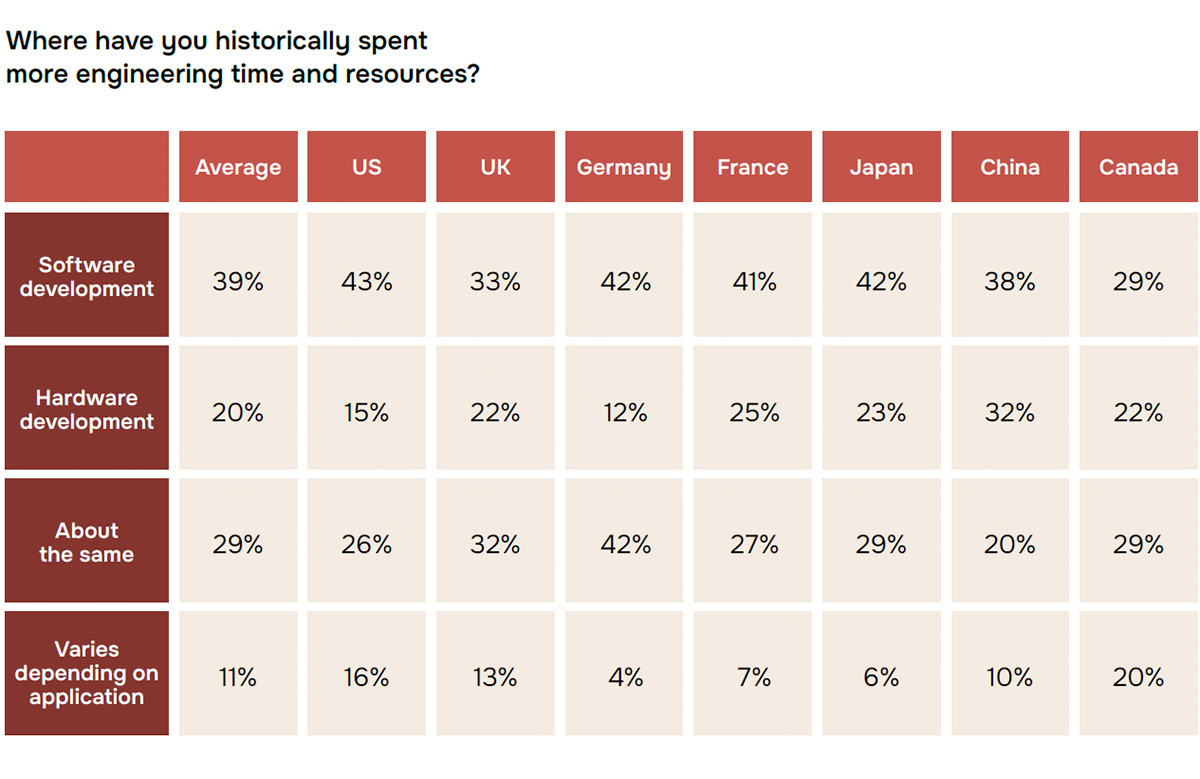
The survey found that software development now consumes more developer resources than hardware. Source: QNX
Deployments in human environments raise the stakes, says QNX
Robotics teams are already feeling the impact of widening deployments. More than four in five respondents (83%) said their systems are now operating alongside people.
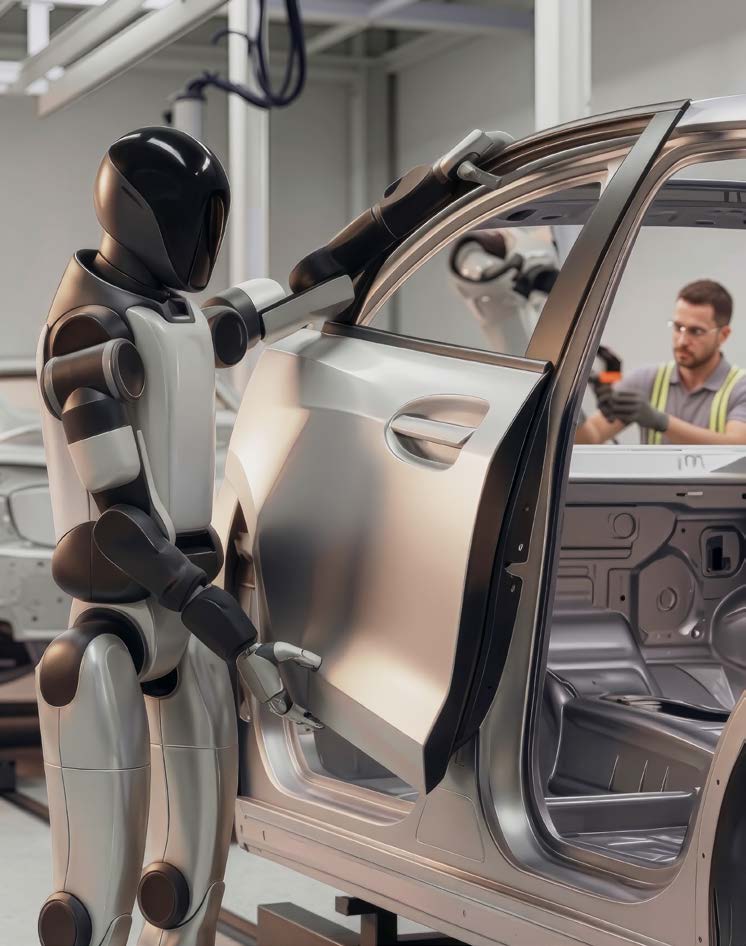
Increasing deployments of robots alongside people pose challenges. Source: QNX
Among organizations that have not yet deployed such systems today, two‑thirds (67%) said they expect to do so within three to five years. This expanding presence in less controlled environments, from surgical suites to busy shop floors is driving higher expectations around reliability, safety, and predictable behavior.
QNX observed that nearly all respondents (95%) said deterministic, real‑time execution is important to the systems they develop. Despite this priority, most development teams acknowledged that they continue to rely on software not designed for real‑time or safety‑critical use.
The research revealed that 91% of respondents run these workloads, at least in part, on general‑purpose operating systems (GPOS), even though safety‑certified commercial solutions are rated as the best fit for their needs. As a result, 86% of these GPOS users said they are open to changing their OS. QNX said this contrast reflects the growing tension between flexibility and the need for predictable, guaranteed behaviors as robotics deployments scale.
Certification delays, security demands add pressure
Regulatory and compliance demands further intensify these challenges, observed QNX. Two‑thirds of respondents (66%) reported project delays because of certification processes, rising to about 70% in the U.K. and Germany. In contrast, only 56% reported delays in China, where regulatory requirements are less stringent.
These delays can directly affect development costs, delivery timelines, and commercial risk, according to the company. Cybersecurity standards such as ISO/SAE 21434 and functional safety standards like ISO 10218 were among the most challenging areas to comply with, cited by 51% and 49% of respondents, respectively.
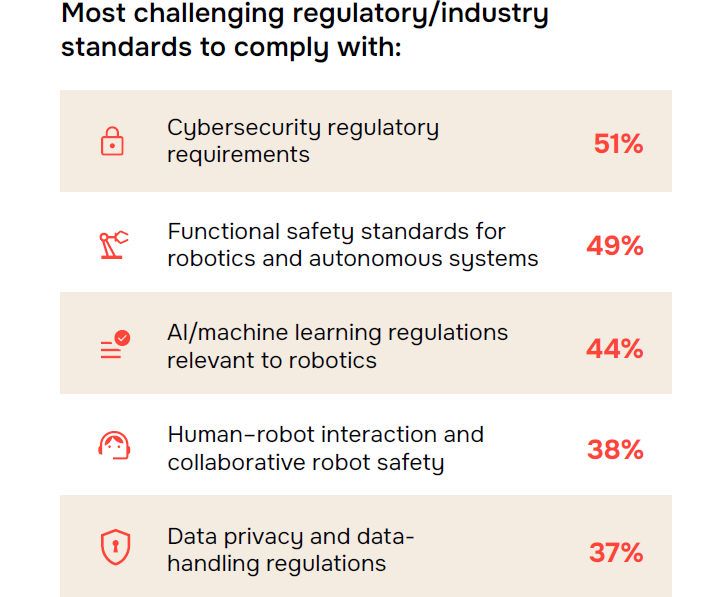
Cybersecurity and functional safety are top concerns of robotics developers, the survey found. Source: QNX
Interest in physical AI does not equal readiness, says QNX
Despite the software, deployment, and compliance pressures, ambition and optimism across the industry remain high, said QNX. Physical AI was firmly on survey respondents’ roadmaps, with 89% saying that AI‑enabled robots that can perceive, reason, and act autonomously in the physical world will be critical to their organizations’ strategy over the next three to five years. China led globally, said the report.
“Confidence in the long‑term potential of physical AI is strong, but readiness remains uneven,” QNX said. Only 29% of respondents felt “very confident” in their ability to make safe, predictable decisions in real‑world environments.
Ottawa-based QNX provides software-defined and physical AI systems for safety-critical applications, including operating systems, hypervisors, middleware, and development tools, as well as support and services from embedded software experts. The company was recognized with a 2026 RBR50 Robotics Innovation Award for its General Embedded Development Platform (GEDP), which is designed to help build safe, secure, and high-performance robots faster.
BlackBerry said its communications technology underpins hundreds of millions of vehicles on the road and a wide range of systems across industrial controls, robotics, medical devices, commercial transportation, rail, and aerospace and defense.
QNX explored the survey results in more detail in its blog and the Code the Future podcast featuring Lian Jye Su, chief analyst at Omdia (see below).


Great read, with really good insight