The Robot Report

  • Home
  • News
  • Technologies
    • Batteries / Power Supplies
    • Cameras / Imaging / Vision
    • Controllers
    • End Effectors
    • Microprocessors / SoCs
    • Motion Control
    • Sensors
    • Soft Robotics
    • Software / Simulation
  • Development
    • Artificial Intelligence
    • Human Robot Interaction / Haptics
    • Mobility / Navigation
    • Research
  • Robots
    • AGVs
    • AMRs
    • Consumer
    • Collaborative Robots
    • Drones
    • Humanoids
    • Industrial
    • Self-Driving Vehicles
    • Unmanned Maritime Systems
  • Business
    • Financial
      • Investments
      • Mergers & Acquisitions
      • Earnings
    • Markets
      • Agriculture
      • Healthcare
      • Logistics
      • Manufacturing
      • Mining
      • Security
    • RBR50
      • RBR50 Winners 2025
      • RBR50 Winners 2024
      • RBR50 Winners 2023
      • RBR50 Winners 2022
      • RBR50 Winners 2021
  • Resources
    • Automated Warehouse Research Reports
    • Digital Issues
    • eBooks
    • Publications
      • Automated Warehouse
      • Collaborative Robotics Trends
    • Search Robotics Database
    • Videos
    • Webinars / Digital Events
  • Events
    • RoboBusiness
    • Robotics Summit & Expo
    • DeviceTalks
    • R&D 100
    • Robotics Weeks
  • Podcast
    • Episodes
  • Advertise
  • Subscribe

Official ROS driver launches for UR cobots

By Steve Crowe | October 15, 2019

There is now an official Robot Operating System (ROS) driver that is compatible with Universal Robots collaborative robots. Third-party developers have created ROS drivers for UR, but the world’s leading cobot company has never before supported or developed any of these drivers.

The ROS driver works with all UR cobots that come with a CB3 or CB3 e-series controller and have specific minimum versions of Polyscope and system software installed. The ROS driver, available through UR’s GitHub account, will remain open-source and rely on future community contributions. The driver currently only targets ROS 1. There is no work planned for ROS 2, but that could change.

Jacob Bom Madsen, Software Product Manager at Universal Robots A/S, wrote on ROS Discourse that “it became difficult to find out which fork had the latest features, supported the right version of your UR software, or utilized the UR functionality in the best way.” To fix this problem, UR and the German research institute FZI created an official ROS driver for UR to ensure its stability and robustness. The project was also supported by the ROSIN EU H2020 project.

There are two modes of operation for the driver:

Remote Control Mode: The driver works like classic ROS drivers, assuming full remote control of the robot without interaction on the teach pendant. This mode targets easy programming research and embedding in OEM systems.

ROS usage in URCap: A sample URCap enables ROS control only where it is needed in the UR program. In this way it enables easier integration with ROS-compatible devices into UR applications. This mode is designed for developers of vision systems, force/torque control, picking algorithms or similar products that integrate with ROS.
UR16e

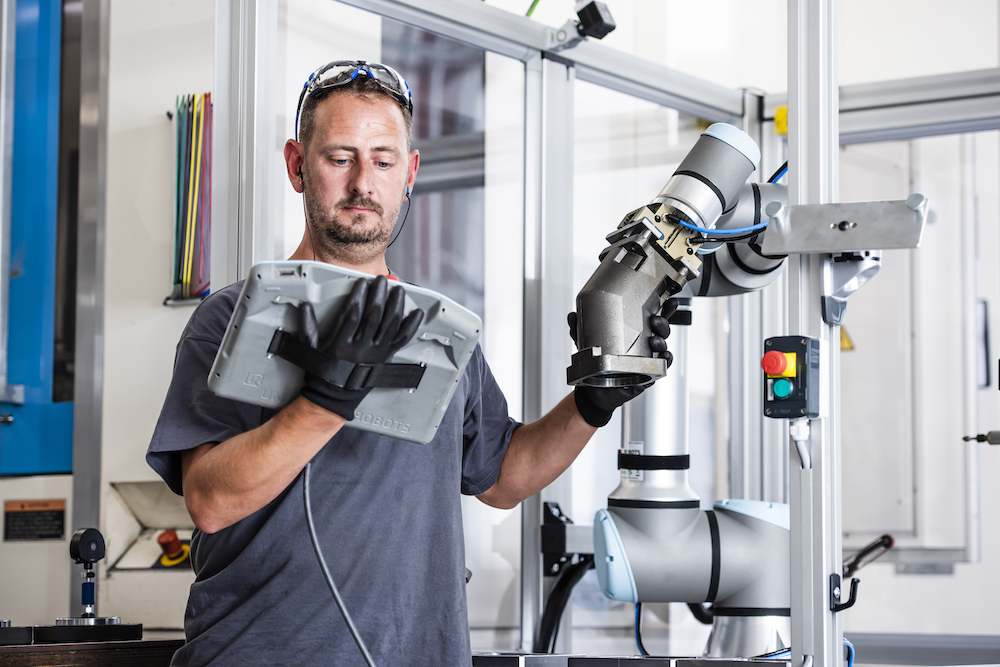
BWIndustrie uses the UR16e cobot in a deburring cell that handles parts ranging from 4 to 14 kgs. | Credit: Universal Robots

UR in mid-September introduced the UR16e, its strongest cobot ever. The UR16e features a 16 kg (35 lbs) payload, a 900 mm reach and ± 0.05 mm repeatability. The UR3e, UR5e and UR10e, the other cobots in UR’s e-Series, offer 3 kg (6.6 lbs), 5 kg (11 lbs) and 10 kg (22 lbs) payloads, respectively. The UR16e is designed for tasks such as heavy-duty material handling, heavy-part handling and machine tending.

UR has sold 37,000-plus cobots, which is by far the most sales of any cobot company. UR President Jürgen von told The Robot Report the UR16e is a milestone release for UR, which was founded in 2015 and acquired by Teradyne in 2015 for $285 million.

“The UR16e is the first step changing UR from a company that’s been pushing technology into a market to UR being more of a product management organization,” he said. “We’ve been listening to the market and customer needs.”

About The Author

Steve Crowe

Steve Crowe is Executive Editor, Robotics, WTWH Media, and chair of the Robotics Summit & Expo and RoboBusiness. He is also co-host of The Robot Report Podcast, the top-rated podcast for the robotics industry. He joined WTWH Media in January 2018 after spending four-plus years as Managing Editor of Robotics Trends Media. He can be reached at [email protected]

Tell Us What You Think! Cancel reply

This site uses Akismet to reduce spam. Learn how your comment data is processed.

Related Articles Read More >

With Gen 7, UR said its customers and partners can deploy advanced AI-powered applications into industrial operations with the same world-class robot experience operators, technicians, engineers and integrators prefer to work with every day.

Universal Robots launches its seventh generation robot platform at IMTS
ASI has worked with U.S. Sugar and Everglades Group to deploy autonomous tractors across South Florida.
How autonomous fleets are changing what’s possible in American agriculture
UltraSense says ultrasound can mitigate the wear and tear at the point of tactile sensing.
Ultrasound offers a scalable path to tactile intelligence for physical AI
headshot of salar al khafaji and podcast icon.
One brick at a time: How Monumental uses robotics to build walls

RBR50 Innovation Awards

“2026”
“rr
EXPAND YOUR KNOWLEDGE AND STAY CONNECTED
Get the latest info on technologies, tools and strategies for Robotics Professionals.

Latest Episode of The Robot Report Podcast

Automated Warehouse Research Reports

Sponsored Content

  • How to select the right rack and pinion system for high-precision linear motion
  • The Missing Layer in Robot Safety Assurance
  • The 370-billion-dollar race: How integrated design can help humanoid manufacturers succeed in a rapidly growing market
  • humanoid robot sorts parts. 5 Physical AI infrastructure platforms shaping robotics in 2026
  • How integrated actuators improve humanoid robot joint performance and system integration
More Sponsored Content >
The Robot Report
  • Automated Warehouse
  • RoboBusiness
  • Robotics Summit & Expo
  • About The Robot Report
  • Subscribe
  • Contact Us

Copyright © 2026 Arrowfly LLC. All Rights Reserved. The material on this site may not be reproduced, distributed, transmitted, cached or otherwise used, except with the prior written permission of Arrowfly
Privacy Policy | Advertising | About Us

Search The Robot Report

  • Home
  • News
  • Technologies
    • Batteries / Power Supplies
    • Cameras / Imaging / Vision
    • Controllers
    • End Effectors
    • Microprocessors / SoCs
    • Motion Control
    • Sensors
    • Soft Robotics
    • Software / Simulation
  • Development
    • Artificial Intelligence
    • Human Robot Interaction / Haptics
    • Mobility / Navigation
    • Research
  • Robots
    • AGVs
    • AMRs
    • Consumer
    • Collaborative Robots
    • Drones
    • Humanoids
    • Industrial
    • Self-Driving Vehicles
    • Unmanned Maritime Systems
  • Business
    • Financial
      • Investments
      • Mergers & Acquisitions
      • Earnings
    • Markets
      • Agriculture
      • Healthcare
      • Logistics
      • Manufacturing
      • Mining
      • Security
    • RBR50
      • RBR50 Winners 2025
      • RBR50 Winners 2024
      • RBR50 Winners 2023
      • RBR50 Winners 2022
      • RBR50 Winners 2021
  • Resources
    • Automated Warehouse Research Reports
    • Digital Issues
    • eBooks
    • Publications
      • Automated Warehouse
      • Collaborative Robotics Trends
    • Search Robotics Database
    • Videos
    • Webinars / Digital Events
  • Events
    • RoboBusiness
    • Robotics Summit & Expo
    • DeviceTalks
    • R&D 100
    • Robotics Weeks
  • Podcast
    • Episodes
  • Advertise
  • Subscribe