The Robot Report

  • Home
  • News
  • Technologies
    • Batteries / Power Supplies
    • Cameras / Imaging / Vision
    • Controllers
    • End Effectors
    • Microprocessors / SoCs
    • Motion Control
    • Sensors
    • Soft Robotics
    • Software / Simulation
  • Development
    • Artificial Intelligence
    • Human Robot Interaction / Haptics
    • Mobility / Navigation
    • Research
  • Robots
    • AGVs
    • AMRs
    • Consumer
    • Collaborative Robots
    • Drones
    • Humanoids
    • Industrial
    • Self-Driving Vehicles
    • Unmanned Maritime Systems
  • Business
    • Financial
      • Investments
      • Mergers & Acquisitions
      • Earnings
    • Markets
      • Agriculture
      • Healthcare
      • Logistics
      • Manufacturing
      • Mining
      • Security
    • RBR50
      • RBR50 Winners 2025
      • RBR50 Winners 2024
      • RBR50 Winners 2023
      • RBR50 Winners 2022
      • RBR50 Winners 2021
  • Resources
    • Automated Warehouse Research Reports
    • Digital Issues
    • eBooks
    • Publications
      • Automated Warehouse
      • Collaborative Robotics Trends
    • Search Robotics Database
    • Videos
    • Webinars / Digital Events
  • Events
    • RoboBusiness
    • Robotics Summit & Expo
    • DeviceTalks
    • R&D 100
    • Robotics Weeks
  • Podcast
    • Episodes
  • Advertise
  • Subscribe

Teaching robots to assess their performance

By The Robot Report Staff | May 15, 2018

Researchers are hoping to impart robots and other autonomous systems with the ability of self-assessment. Robots are ill-equipped to predict how well they can perform a task, or to sense if a task is going well, or even to know whether they did a good job once a task is completed, said Aaron Steinfeld, associate research professor in Carnegie Mellon University’s Robotics Institute.

People use a number of tactics to judge whether or how well they can do something, whether it is throwing a baseball, turning a valve or drilling a hole in a wall. As robots become increasingly autonomous, they will need this ability, as well, Steinfeld added.

Researchers from Carnegie Mellon, Brigham Young University, Tufts University and the University of Massachusetts Lowell have joined together in a five-year, $7.5 million Multidisciplinary University Research Initiative program, to develop methods and metrics for machine self-assessment.

This self-assessment could be as simple as a robot being able to detect whether a task was completed satisfactorily, or could include prediction and evaluation of proficiency. In some cases, it might include a robot providing an explanation to a human about its performance.
self-assessment

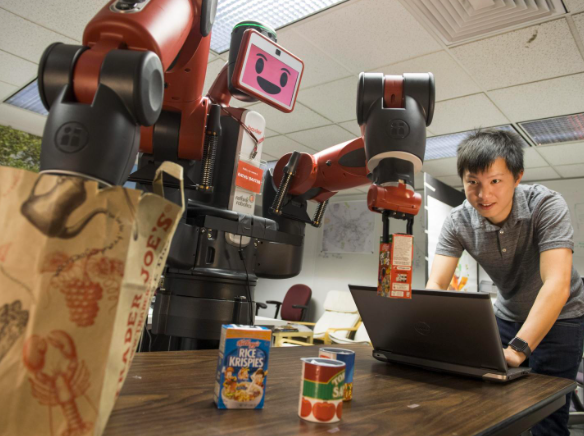
Xiang Zhi Tan, a Ph.D. student at Carnegie Mellon University’s Robotics Institute, works with a Baxter robot as part of a multi-university research program to enable robots to assess their own performance at tasks. (Credit: Carnegie Mellon University)

“You’d like the robot to be able to explain why it can or why it can’t do a task,” Steinfeld said, such as a self-driving car telling its occupants why it can’t drop them off at their requested destination. Identifying a lack of knowledge, dexterity, or strength could enable a robot to work more efficiently with human partners.

Researchers will test self-assessment approaches using dexterous search tasks for robots, such as maneuvering limbs to investigate obscured items, manipulating objects to reveal contents and adversarial manipulation, said Holly Yanco, a professor of computer science at UMass Lowell.

Such search tasks can be readily scaled up to applications such as robots deployed for emergency repairs, micro-drone swarms sent to map buildings, and urban search and rescue, she added.

In addition to Steinfeld and Yanco, the researchers include Jacob Crandall, associate professor of computer science, and Michael Goodrich, chair of computer science, both of Brigham Young; Matthias Scheutz, professor of cognitive and computer science at Tufts; and Henny Admoni, assistant professor of robotics at CMU. Reid Simmons, research professor of robotics and computer science at CMU, will join the team this fall. Extensive testing will be performed at Carnegie Mellon’s Robotics Institute and UMass Lowell’s New England Robotics Validation and Experimentation (NERVE) Center.
Tell Us What You Think! Cancel reply

This site uses Akismet to reduce spam. Learn how your comment data is processed.

Related Articles Read More >

A humanoid robot such as this is one platform that the Microsoft Rho-alpha model is intended to make more autonomous.
Microsoft Research reveals Rho-alpha vision-language-action model for robots
Top 5 global robotics trends from IFR.
IFR names top 5 global robotics trends of 2026
The 2025 Form and Function Challenge Winners.
MassRobotics opens applications for fourth Form and Function Robotics Challenge
A Roomba, a Fetch robot, robot arms training, and Melonee Wise standing with a KUKA arm.
Top 10 robotics developments of December 2025

RBR50 Innovation Awards

“rr
EXPAND YOUR KNOWLEDGE AND STAY CONNECTED
Get the latest info on technologies, tools and strategies for Robotics Professionals.

Latest Episode of The Robot Report Podcast

Automated Warehouse Research Reports

Sponsored Content

  • Supporting the future of medical robotics with smarter motor solutions
  • YUAN Unveils Next-Gen AI Robotics Powered by NVIDIA for Land, Sea & Air
  • ASMPT chooses Renishaw for high-quality motion control
  • Revolutionizing Manufacturing with Smart Factories
  • How to Set Up a Planetary Gear Motion with SOLIDWORKS
The Robot Report
  • Automated Warehouse
  • RoboBusiness Event
  • Robotics Summit & Expo
  • About The Robot Report
  • Subscribe
  • Contact Us

Copyright © 2026 WTWH Media LLC. All Rights Reserved. The material on this site may not be reproduced, distributed, transmitted, cached or otherwise used, except with the prior written permission of WTWH Media
Privacy Policy | Advertising | About Us

Search The Robot Report

  • Home
  • News
  • Technologies
    • Batteries / Power Supplies
    • Cameras / Imaging / Vision
    • Controllers
    • End Effectors
    • Microprocessors / SoCs
    • Motion Control
    • Sensors
    • Soft Robotics
    • Software / Simulation
  • Development
    • Artificial Intelligence
    • Human Robot Interaction / Haptics
    • Mobility / Navigation
    • Research
  • Robots
    • AGVs
    • AMRs
    • Consumer
    • Collaborative Robots
    • Drones
    • Humanoids
    • Industrial
    • Self-Driving Vehicles
    • Unmanned Maritime Systems
  • Business
    • Financial
      • Investments
      • Mergers & Acquisitions
      • Earnings
    • Markets
      • Agriculture
      • Healthcare
      • Logistics
      • Manufacturing
      • Mining
      • Security
    • RBR50
      • RBR50 Winners 2025
      • RBR50 Winners 2024
      • RBR50 Winners 2023
      • RBR50 Winners 2022
      • RBR50 Winners 2021
  • Resources
    • Automated Warehouse Research Reports
    • Digital Issues
    • eBooks
    • Publications
      • Automated Warehouse
      • Collaborative Robotics Trends
    • Search Robotics Database
    • Videos
    • Webinars / Digital Events
  • Events
    • RoboBusiness
    • Robotics Summit & Expo
    • DeviceTalks
    • R&D 100
    • Robotics Weeks
  • Podcast
    • Episodes
  • Advertise
  • Subscribe