The Robot Report

  • Home
  • News
  • Technologies
    • Batteries / Power Supplies
    • Cameras / Imaging / Vision
    • Controllers
    • End Effectors
    • Microprocessors / SoCs
    • Motion Control
    • Sensors
    • Soft Robotics
    • Software / Simulation
  • Development
    • Artificial Intelligence
    • Human Robot Interaction / Haptics
    • Mobility / Navigation
    • Research
  • Robots
    • AGVs
    • AMRs
    • Consumer
    • Collaborative Robots
    • Drones
    • Humanoids
    • Industrial
    • Self-Driving Vehicles
    • Unmanned Maritime Systems
  • Business
    • Financial
      • Investments
      • Mergers & Acquisitions
      • Earnings
    • Markets
      • Agriculture
      • Healthcare
      • Logistics
      • Manufacturing
      • Mining
      • Security
    • RBR50
      • RBR50 Winners 2025
      • RBR50 Winners 2024
      • RBR50 Winners 2023
      • RBR50 Winners 2022
      • RBR50 Winners 2021
  • Resources
    • Automated Warehouse Research Reports
    • Digital Issues
    • eBooks
    • Publications
      • Automated Warehouse
      • Collaborative Robotics Trends
    • Search Robotics Database
    • Videos
    • Webinars / Digital Events
  • Events
    • RoboBusiness
    • Robotics Summit & Expo
    • DeviceTalks
    • R&D 100
    • Robotics Weeks
  • Podcast
    • Episodes
  • Advertise
  • Subscribe

Researchers aim to create soft, shape-changing robots

By Brianna Wessling | March 14, 2022

active matter robots

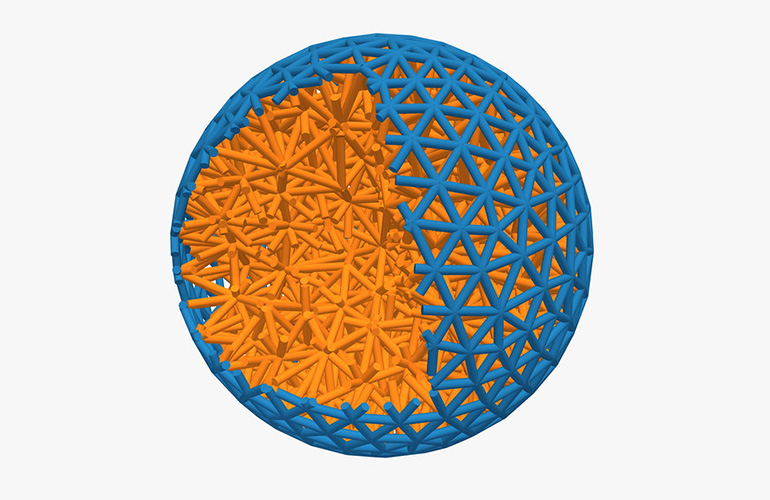
A simulated ball covered in tiny robots that can distort its shape. | Source: University of Bath

A research team from the Universities of Bath and Birmingham are hoping to reinvent the way we design robots. 

Typically, robots, like robotic arms, are controlled by a single central controller. The research team, however, is hoping to create robots that are made from many individual units that act individually but cooperatively to determine the machine’s movement. 

The researchers are doing this using active matter, collections of a large number of active agents that resist the way that ordinary soft materials move. Typical soft materials will shrink into a sphere, like water beading into droplets, to create the smallest surface area possible. 

Active matter could be used in many ways. For example, a layer of nanorobots wrapped around a rubber ball could distort the shape of the ball by working in unison. 

“Active matter makes us look at the familiar rules of nature – rules like the fact that surface tension has to be positive – in a new light,” Dr. Jack Binysh, the first author on the study, said. “Seeing what happens if we break these rules, and how we can harness the results, is an exciting place to be doing research.”

During the study, the researchers simulated a 3D soft solid with a surface that experiences active stresses. The stresses expand the surface of the material, pulling the solid underneath with it. This can cause the entire shape to change. This change could even be tailored by altering the elastic properties of the material. 

“This study is an important proof of concept and has many useful implications,” Dr. Anton Souslov, another author on the paper, said. “For instance, future technology could produce soft robots that are far squishier and better at picking up and manipulating delicate materials.”

Eventually, the scientists hope to develop machines with arms made of flexible material with tiny robots embedded in the surface. The technology could also be used to coat the surface of nanoparticles in a responsive, active material. This would allow them to customize the size and shape of drug delivery capsules. 

For now, the researchers have already started their next phase of work: applying the general principles they’ve learned to designing specific robots. The results of their study were published in Science Advances. 

About The Author

Brianna Wessling

Brianna Wessling is an Associate Editor, Robotics, WTWH Media. She joined WTWH Media in November 2021, after graduating from the University of Kansas with degrees in Journalism and English. She covers a wide range of robotics topics, but specializes in women in robotics, autonomous vehicles, and space robotics.

She can be reached at [email protected]

Tell Us What You Think! Cancel reply

This site uses Akismet to reduce spam. Learn how your comment data is processed.

Related Articles Read More >

An illustration of two Franka arms picking items in simulation.
PickNik expands support for Franka Research 3 robot on MoveIt Pro
A small drone flying into fog in a dark room.
Bats inspire WPI researchers to develop drones using echolocation
Three drones work together to carry a package using a new algorithm developed at TU Delft.
TU Delft algorithm to enables drones to work together to transport heavy payloads
Mr Tung Meng Fai, Executive Director, National Robotics Programme (NRP); Professor Tan Chorh Chuan, Chairman, Agency for Science, Technology and Research (A*STAR); Ms Vanessa Yamzon Orsi, CEO, Open Source Robotics Foundation; and Dr Wang Wei, Deputy Executive Director (R&D) at A*STAR SIMTech and A*STAR ARTC, attended ROSCon on 28 October 2025.
Singapore’s National Robotics Programme reveals initiatives to advance robot adoption

RBR50 Innovation Awards

“rr
EXPAND YOUR KNOWLEDGE AND STAY CONNECTED
Get the latest info on technologies, tools and strategies for Robotics Professionals.

Latest Episode of The Robot Report Podcast

Automated Warehouse Research Reports

Sponsored Content

  • Supporting the future of medical robotics with smarter motor solutions
  • YUAN Unveils Next-Gen AI Robotics Powered by NVIDIA for Land, Sea & Air
  • ASMPT chooses Renishaw for high-quality motion control
  • Revolutionizing Manufacturing with Smart Factories
  • How to Set Up a Planetary Gear Motion with SOLIDWORKS
The Robot Report
  • Automated Warehouse
  • RoboBusiness Event
  • Robotics Summit & Expo
  • About The Robot Report
  • Subscribe
  • Contact Us

Copyright © 2025 WTWH Media LLC. All Rights Reserved. The material on this site may not be reproduced, distributed, transmitted, cached or otherwise used, except with the prior written permission of WTWH Media
Privacy Policy | Advertising | About Us

Search The Robot Report

  • Home
  • News
  • Technologies
    • Batteries / Power Supplies
    • Cameras / Imaging / Vision
    • Controllers
    • End Effectors
    • Microprocessors / SoCs
    • Motion Control
    • Sensors
    • Soft Robotics
    • Software / Simulation
  • Development
    • Artificial Intelligence
    • Human Robot Interaction / Haptics
    • Mobility / Navigation
    • Research
  • Robots
    • AGVs
    • AMRs
    • Consumer
    • Collaborative Robots
    • Drones
    • Humanoids
    • Industrial
    • Self-Driving Vehicles
    • Unmanned Maritime Systems
  • Business
    • Financial
      • Investments
      • Mergers & Acquisitions
      • Earnings
    • Markets
      • Agriculture
      • Healthcare
      • Logistics
      • Manufacturing
      • Mining
      • Security
    • RBR50
      • RBR50 Winners 2025
      • RBR50 Winners 2024
      • RBR50 Winners 2023
      • RBR50 Winners 2022
      • RBR50 Winners 2021
  • Resources
    • Automated Warehouse Research Reports
    • Digital Issues
    • eBooks
    • Publications
      • Automated Warehouse
      • Collaborative Robotics Trends
    • Search Robotics Database
    • Videos
    • Webinars / Digital Events
  • Events
    • RoboBusiness
    • Robotics Summit & Expo
    • DeviceTalks
    • R&D 100
    • Robotics Weeks
  • Podcast
    • Episodes
  • Advertise
  • Subscribe