The Robot Report

  • Home
  • News
  • Technologies
    • Batteries / Power Supplies
    • Cameras / Imaging / Vision
    • Controllers
    • End Effectors
    • Microprocessors / SoCs
    • Motion Control
    • Sensors
    • Soft Robotics
    • Software / Simulation
  • Development
    • Artificial Intelligence
    • Human Robot Interaction / Haptics
    • Mobility / Navigation
    • Research
  • Robots
    • AGVs
    • AMRs
    • Consumer
    • Collaborative Robots
    • Drones
    • Humanoids
    • Industrial
    • Self-Driving Vehicles
    • Unmanned Maritime Systems
  • Business
    • Financial
      • Investments
      • Mergers & Acquisitions
      • Earnings
    • Markets
      • Agriculture
      • Healthcare
      • Logistics
      • Manufacturing
      • Mining
      • Security
    • RBR50
      • RBR50 Winners 2025
      • RBR50 Winners 2024
      • RBR50 Winners 2023
      • RBR50 Winners 2022
      • RBR50 Winners 2021
  • Resources
    • Automated Warehouse Research Reports
    • Digital Issues
    • eBooks
    • Publications
      • Automated Warehouse
      • Collaborative Robotics Trends
    • Search Robotics Database
    • Videos
    • Webinars / Digital Events
  • Events
    • RoboBusiness
    • Robotics Summit & Expo
    • DeviceTalks
    • R&D 100
    • Robotics Weeks
  • Podcast
    • Episodes
  • Advertise
  • Subscribe

More Mechatronic and Robotic Reflections

By Steve Meyer | April 14, 2008

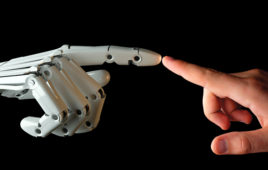
The blend of sensors and motion control become crucial in many applications. The dextrous robot hand of recent years cracks eggs like a chef with the aid of sophisticated pressure sensors at the tips of its “fingers”. Check out the Shadow Robot company for some amazing videos of their “air muscle” powered robot hand in action. Lots of interesting work has been done to mimic the human hand. A miracle of grace and efficiency that is hard to duplicate.

Which brings me to the mechatronics relationship. We spend a lot of time in the motion control part of mechatronics designing systems that are based on velocity and position. And this is the context where the “motion control” term is useful, as far as it goes.

In many of the applications we are concerned with, the positioning systems get all the attention. Probably because its more difficult. Positioning tends to be a more “real time” behavior than discrete control systems allow, and so historically, a lot of the hardware used for positioning systems has evolved on its own. (more on this subject later)

But sometimes we have to take a step back from the positioning problem and all its complexities and get perspective on the project goal. Such is the case with many crimping and press fit applications. Position alone simply won’t do. Position is necessary but not sufficient. As with the robot hand, a feeback sensor is needed to determine if proper pressure is being applied to the part.

And that isn’t always obvious, nor is the proper sensor arrangement a simple matter.

If you have to create a machine that crimps a can lid to a can body, there is a required amount of pressure. And the pressure is the most important attribute of the process. The pressure cannot be below a certain value, otherwise the crimp will fail. The pressure cannot be above a certain value, or the part could be damaged and scrapped.

You can implement a pressure strategy a couple of different ways, and the exact method makes a difference. The machine I had to deal with used a brushless dc servo and a lead screw to drive a crimping tool to close the parts to an air-bag igniter. An air bag igniter is a little like a miniature hand grenade, it contains a small explosive charge. So you want to handle it with care.

The engineer who designed the system was using the current values from the drive motor to calculate how much force was applied. In addition, an external load cell underneath the fixture gave a force value to the control system to verify each part. Data was stored in PLC memory and fed to a PC every certain number of units.

But the motion control system software did not have any programming to wait for the value of the load cell and motor current to be checked to insure that right force was applied to each part. So while everything appeared to be working correctly, parts were failing QA. It took quite a while to figure out.

So when you have a production project, make sure you know what the metrics of quality parts are. Make sure they are part of every aspect of the control system, both hardware and software.


About The Author

Steve Meyer

Tell Us What You Think! Cancel reply

This site uses Akismet to reduce spam. Learn how your comment data is processed.

Related Articles Read More >

SUNY Adirondack to launch new program in mechatronics
Eplan Data Portal migrates to Azure
Transcript: How mechatronics is taking additive manufacturing to the next level
Is there a need for closed loop feedback greater than 20,000 CPR?

RBR50 Innovation Awards

“rr
EXPAND YOUR KNOWLEDGE AND STAY CONNECTED
Get the latest info on technologies, tools and strategies for Robotics Professionals.

Latest Episode of The Robot Report Podcast

Automated Warehouse Research Reports

Sponsored Content

  • Supporting the future of medical robotics with smarter motor solutions
  • YUAN Unveils Next-Gen AI Robotics Powered by NVIDIA for Land, Sea & Air
  • ASMPT chooses Renishaw for high-quality motion control
  • Revolutionizing Manufacturing with Smart Factories
  • How to Set Up a Planetary Gear Motion with SOLIDWORKS
The Robot Report
  • Automated Warehouse
  • RoboBusiness Event
  • Robotics Summit & Expo
  • About The Robot Report
  • Subscribe
  • Contact Us

Copyright © 2026 WTWH Media LLC. All Rights Reserved. The material on this site may not be reproduced, distributed, transmitted, cached or otherwise used, except with the prior written permission of WTWH Media
Privacy Policy | Advertising | About Us

Search The Robot Report

  • Home
  • News
  • Technologies
    • Batteries / Power Supplies
    • Cameras / Imaging / Vision
    • Controllers
    • End Effectors
    • Microprocessors / SoCs
    • Motion Control
    • Sensors
    • Soft Robotics
    • Software / Simulation
  • Development
    • Artificial Intelligence
    • Human Robot Interaction / Haptics
    • Mobility / Navigation
    • Research
  • Robots
    • AGVs
    • AMRs
    • Consumer
    • Collaborative Robots
    • Drones
    • Humanoids
    • Industrial
    • Self-Driving Vehicles
    • Unmanned Maritime Systems
  • Business
    • Financial
      • Investments
      • Mergers & Acquisitions
      • Earnings
    • Markets
      • Agriculture
      • Healthcare
      • Logistics
      • Manufacturing
      • Mining
      • Security
    • RBR50
      • RBR50 Winners 2025
      • RBR50 Winners 2024
      • RBR50 Winners 2023
      • RBR50 Winners 2022
      • RBR50 Winners 2021
  • Resources
    • Automated Warehouse Research Reports
    • Digital Issues
    • eBooks
    • Publications
      • Automated Warehouse
      • Collaborative Robotics Trends
    • Search Robotics Database
    • Videos
    • Webinars / Digital Events
  • Events
    • RoboBusiness
    • Robotics Summit & Expo
    • DeviceTalks
    • R&D 100
    • Robotics Weeks
  • Podcast
    • Episodes
  • Advertise
  • Subscribe