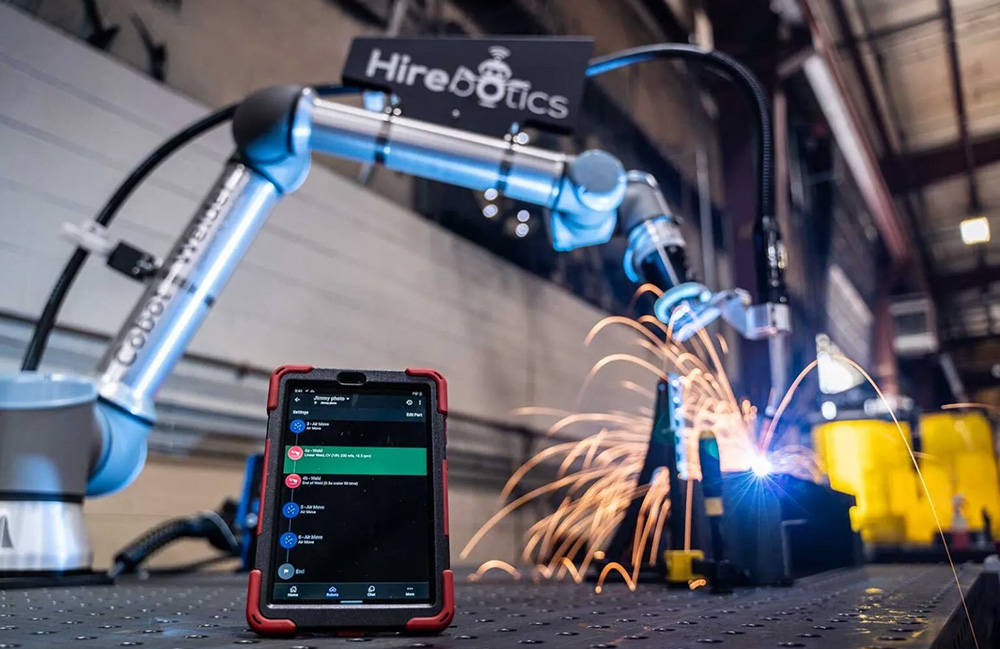
Hirebotics’ Beacon is a cloud-based automation platform that lets fabricators teach, run, and monitor welding, cutting, and painting cobots without programming. | Source: Hirebotics
We’ve been writing about collaborative robots – often referred to as cobots – for more than a decade, but their use in real applications has reached an all-time high. Cobots now represent 18% of total North American robot units, according to the latest report from the Association for Advancing Automation (A3), with roughly 90% of all cobot orders originating from non-automotive sectors such as food and consumer goods, semiconductors and electronics, and life sciences.
The metal fabrication, palletizing, and data center construction industries are also adopting robots at a record pace, according to Matt Bush, the co-founder and new CEO of Hirebotics, a Nashville-based cobot solutions provider specializing in metal fabrication and related industries.
Bush spoke with The Robot Report about how force- and power-limited robot arms are becoming a necessity for the manufacturing, welding, and construction industries. He also discussed what differentiates Hirebotics’ approach to automation and what he expects to see in these industries in the months and years ahead.
Why did Hirebotics target metal fabrication and construction?
Tell us about the history of Hirebotics and what encouraged you to target applications such as metal fabrication and construction.
Bush: Rob Goldiez, who retired as CEO earlier this year, and I officially launched Hirebotics in 2015 to solve a problem we were facing ourselves: finding enough labor to staff our manufacturing operations. “What if robots could be hired like people?” we asked. At the time, collaborative robots and cloud technology were both emerging, so we approached the problem by building a cloud-connected cobot solution.
We’d both been in manufacturing in a wide range of industries and applications since the mid-1990s, so we’ve lived the labor shortage issue. That experience shaped how we approach automation. We think about it from the operator’s point of view, not just from an engineering perspective. How’s it going to solve the operator’s challenges?
Automation was originally complex and costly. Programming slowed production. To eliminate this complexity and speed up production, we built systems that fabricators could actually use without engineers or code.
We started with machine tending and assembly, and in partnership with Red-D-Arc, launched BotX, the first rental welding cobot. We used our existing technology for the first BotX systems, but it was not ideal and was not as easy to use as we would have liked. So, we built Beacon, a mobile app that put programming in the hands of welders, and in 2021, we launched the Cobot Welder powered by Beacon.
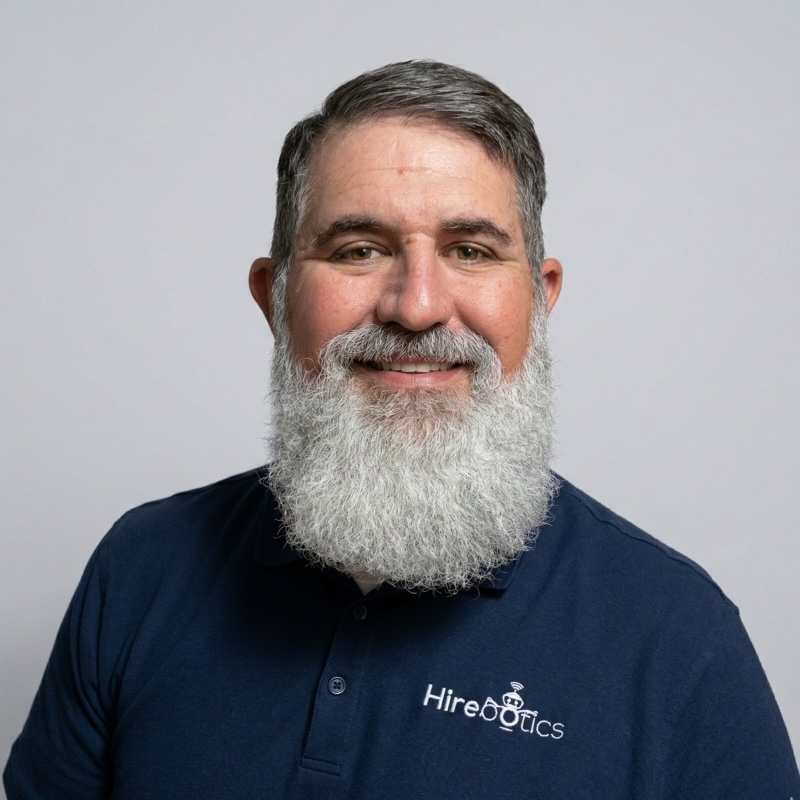
Matt Bush, the co-founder and CEO of Hirebotics. | Source: LinkedIn
What has changed since cobots were first launched?
Cobots have evolved significantly since they first came out. What have been the biggest improvements you’ve seen?
Bush: We follow advancements in cobots closely, paying special attention to how the increasing payloads, enhanced safety sensors, overall ease-of-use, and openness will benefit various workflows in metal fabrication and adjacent industries. And then enhance our cobot solutions to meet the needs of clients in this space.
For us, the biggest shift has been toward accessibility and “productized” turnkey solutions. I can remember seeing the first cobots at a tradeshow in 2014. They were just bare arms; you had to figure out how to use them and what to add to make them do the job at hand.
Today, most of the exhibits in the booths of companies such as Universal Robots will be turnkey, ready-to-run solutions that have been tailored to meet the needs of the customer right out of the box. We like to think we played a role in that shift by showing what a standardized, product built on top of the cobot could bring to the market.
How are cobots being used now?
Where are you seeing cobots used most today?
Bush: Cobots are being used across a wide range of applications: machine tending, pick-and-place, and increasingly palletizing. Welding has seen major growth, particularly since 2021, but we are also moving into “miserable” or “dull, dirty and dangerous” jobs that are hard to staff, such as powder coating, where workers must wear protective suits in summer heat.
We are also seeing a major push into construction and large-scale infrastructure. We have several customers who are welding the materials that make up large infrastructure projects, such as girders for bridges, structural beams for buildings, and major components in AI data centers.
The cobots are very good at welding long welds and especially welds where multiple passes need to be made, freeing the operators to handle inspections, layout, and fit-up tasks.
When welding, our cobot solutions can weld up to 90 in. [228.6 cm] per minute. That’s far faster than the typical human operator.
How closely are robots working with humans?
Within metal fabrication and construction, are you seeing more collaboration between humans and robots? Are workers in these industries overcoming the fear of robots replacing their jobs?
Bush: We’re absolutely seeing more collaboration between humans and robots. In these environments, the robots actually act as a workforce multiplier, and workers are noticing. One human welder can manage two or three robotic assistants, so in many cases, companies hire more people after adopting automation.
In fact, our very first welding customer grew their welding department significantly because the cobots allowed them to take on high-volume work they previously had to turn down. This freed their human welders to focus on high-value, custom fabrication. Robots are great at the monotonous, boring, repetitive tasks—they aren’t great at the creative problem-solving or quality judgment that stays human. It also makes the trade more attractive to younger, tech-savvy workers.
We’re also seeing a lot of flexibility in scale. While traditional robotic cells dominate high-volume automotive lines, cobots are filling the gap for shops that rely on manual welding. We now have systems welding parts as large as 40 ft. [12.1 m], and we’re seeing growth in marine manufacturing for large ships and agricultural equipment, where rural labor markets are particularly tight.
What challenges come with adopting robots?
What are the biggest challenges for small and midsize companies adopting robotics?
Bush: One of the biggest challenges – or misconceptions, really – is that robots solve the labor problem outright. In reality, companies often trade one challenge for another: they can’t find welders, and then they can’t find robot programmers.
Our focus has been on removing that barrier. We design systems so operators, not engineers, can use them. We don’t use a traditional robot teach pendant; we use a smartphone or tablet interface. The goal is to make automation as intuitive as possible, with minimal training required.
More companies like Hirebotics are trying to offer this capability, but we focus on meeting the operator where they are comfortable operating and providing support in that same interface when they do need assistance. This allows the users to stay with the equipment and be able to communicate directly with the team at Hirebotics about the issue at hand, whether it is equipment-related or a more common process-related issue
Are certain sectors adopting cobots faster than others?
Bush: Metal fabrication, palletizing, and now data center construction are leading the way. Data centers are often built in rural areas where finding skilled welders is difficult, if not impossible. We currently have robots deployed across multiple facilities for a major data center supplier to mitigate that risk.
What makes Hirebotics stand out?
What should manufacturers and contractors consider when investing in cobots?
Bush: First, make sure the system is designed for operators. You don’t want to be dependent on hard-to-find programmers. Second, evaluate the level of support. Manufacturing and construction run around the clock. You need a system where bug fixes and updates push automatically through the cloud so you aren’t dealing with version fragmentation.
Ask, “How do you access their support system; is it an 800 number, email, or something built directly into the interface? Can you preview their support articles, or do they keep them locked away behind a paywall where you cannot see them beforehand?”
What do you see as major differentiators for your company?
Bush: While most other companies remain on the robot teach pendant and therefore rely on the robot manufacturer’s proprietary language to program, Hirebotics allows an actual welder who knows what a good weld looks like to “teach” the robot by hand-guiding the arm and using a simple cloud-connected mobile interface on a device they are already intimately familiar with.
Since Day 1, every robot we’ve shipped has been cloud-connected, and since 2021, all our systems have been powered by Beacon. This allows for a unified interface in which a welding robot and a painting robot appear identical in the app and have a unified teaching experience, even though they are built on different underlying robot architectures with extremely different teaching experiences from the OEM.
This cloud connectivity also transforms support. If an operator has a problem, they use a support interface built into the app. Our AI assistant, “Jake,” handles about 85% of questions instantly. If he can’t solve it, the actual product development team jumps in.
 Submit your session idea for the 2026 RoboBusiness
Hirebotics looks at what’s next for cobots
Looking ahead, what trends will shape the future of cobots?
Bush: AI, especially physical AI, is going to be a major factor. As those technologies advance, robots will become more adaptive and require even less precise programming. We’re also watching the emergence of humanoid robots and expect some industry consolidation as the market matures.
Currently, we estimate we’ve only reached about 4% to 5% market penetration, so there is still a massive amount of education and growth ahead.


Tell Us What You Think!