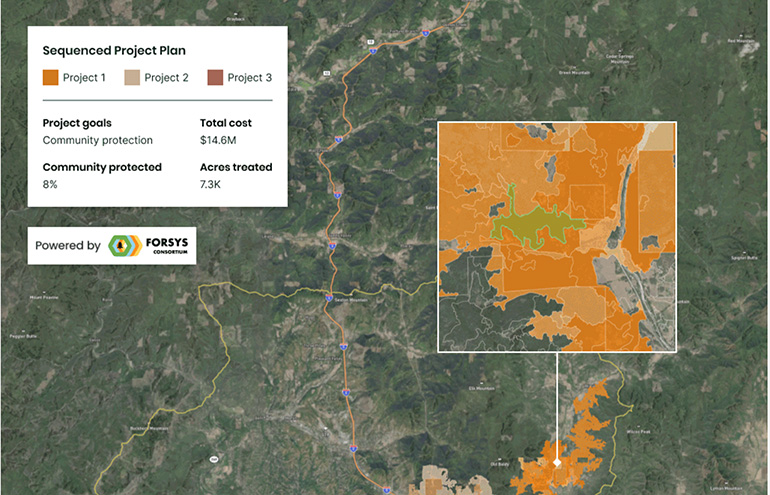
Vibrant Planet offers a dashboard for land management and fire mitigation, priorities of the federal government. Source: Vibrant Planet
No one wanted to go on the record, but everyone I spoke with shared contradictory experiences with the Trump administration last month. A frontier tech company depends on the government to approve licenses or waivers, such as launching low Earth orbit satellites or beyond visual line-of-sight delivery drones.
But what happens if the person or the office you filed with a few weeks earlier is no longer there? This is not a hypothetical question but the reality of the current government. At the same, the current White House is probably one of the biggest advocates for efficiency and technology.
In the rooms next to the Oval Office sits one of the most prominent innovators in U.S. history and an AI czar who has invested in the most successful Silicon Valley unicorns. So, it would come as no surprise that many tech companies are finding less red tape and quicker turnarounds for their regulatory approvals.
Fireside chat finds openness to collaboration
Last week, I moderated a fireside chat with Allison Wolff of Vibrant Planet hosted by Blue Vision Capital. The startup uses machine learning to proactively empower city planners, land managers, and governments to mitigate forest fires.
Its proprietary data analytics engine uses public data such as maps, weather patterns, and community budgets to create predictive AI models. Those models and fire hazard priorities proactively enable community actions to enhance environmental resilience with actions like controlled burns and clear-cutting shrubbery.
Wolff is working across party lines to bring together federal administrators, state government officials, and private landowners to collaborate to address one of the biggest climate emergencies — super fires. To everyone’s surprise in the room, Wolff shared that the Trump administration sees her technology as mission-critical in addressing these megafires, something the president declared after seeing firsthand damage from the Los Angeles fires.
It’s no longer about enormous bureaucracy or debating the cause of the current predicament. Everyone considers the positive effect of AI in preventing disasters as a “purple issue,” Wolff claimed.

Drones & Robotics AI Summit VC panel with Lisa Chai of Interwoven Ventures, Jordan Odinsky of GroundUp Ventures, Kaitlyn Glancy of Eclipse VC, Zeno Mercer of TMX Group, and moderator Sean Simpson of Newlab. Credit: NY Robotics Network 2025
Panelists examine regulations, defense
Wolff’s experience was not limited to climate tech, as speakers who attended my Drones & Robotics AI Summit in New York last month shared similar anecdotes. The event brought together more than 300 industry leaders, including government officials and lobbyists working with the U.S. Department of Defense, NASA, the FAA, and many other federal agencies.
Each shared their concern about how the Department of Government Efficiency (DOGE) will affect the ability of advanced technologies to move from academic labs to commercial sectors quickly. Two panels stood out: one on the changing regulatory environment, and the other on the growing defense tech market.
Tony Lin of Cooley moderated the first panel with panelists Phil Kenul, rear admiral (retired) of ASTM, Nathaniel Bazydlo of NUAIR, and Brendan Schulman of Boston Dynamics. The general sentiment was uncertainty mixed with interest in getting direct access to decision-makers, illustrating how the spirit of collaboration by federal agencies in working with the private sector is a priority for this administration.
This view was shared with the participants of the defense tech panel with Ret. Col. Pat Mahaney moderating David Bonfili of ACME; Christopher C. Miller, the former acting secretary of defense; and Bhargav Patel of the Department for Homeland Security. Across the entire day, leaders such as Andrea Thomaz of Diligent Robotics, Nicholaus Radford of Persona AI, Ryan Gariepy of Clearpath Robotics (acquired by Rockwell Automation), and Fangwei Li of Bear Robotics (acquired by LG) proved that innovation is not slowing with DOGE, tariffs, and capital market volatility, but amplified by the promise of generative AI in mechatronics.
This was further validated by some of the biggest investments in the robotics sector, illustrated by the recent funding announcements of Figure AI, Apptronik, and Deterixity.
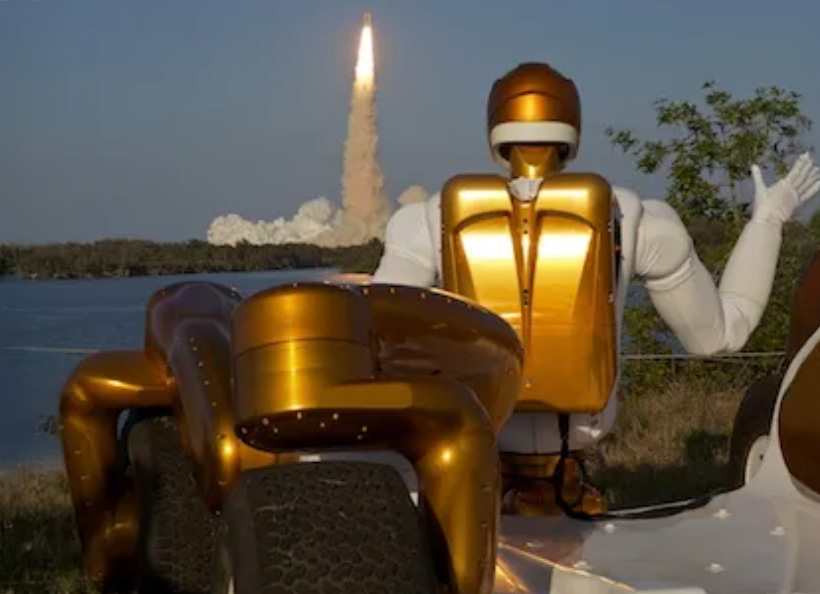
Nicholaus Radford, founder of humanoid startup Persona AI, keynoted his experiences launching Robonaut II to the ISS. Credit: Joe Bibby/NASA
Startups show range of robot types
The startup panel featured two ff Venture Capital portfolio companies, CivRobotics with moderator Tom Yeshurun and Burro with Mark Gaudiosi. Vikas Enti of Reframe Systems, Eric Litman of Aescape, and Eyal Zor of Airwayz also joined the discussion.
The panel exemplified the diversity of the innovations presented throughout the event, from massaging robots, humanoids, restaurant servers, and mobile hospital robots. Of course, plenty of construction bots, agricultural technologies, and logistics solutions were also on display.
Our partners included the NY Robotics Network and Genius NY, with their latest cohort of UAV startups. Seeing the breadth of the drone industry eased dystopian fears that only months earlier had rocked the New York metropolitan area with hundreds of low-flying uncrewed systems.

DOGE doesn’t dampen drone interest
Airwayz founder Zor shared his takeaway from the day and the discussions around DOGE: “Now, what’s happening with the new policy? I think there’s a transition time, and there’s a lot of uncertainty. I’m trying to understand how the new approach will ease the ways of doing business in the U.S. and help create a new policy that will enable private companies to work with DoD to accelerate [drone] solutions in the defense ecosystem.”
Zor has applied his battlefield experience at Airwayz to commercialize drones for dual-use applications. The Israeli startup is working on unmanned aircraft system traffic management (UTM).
“Defense first started managing the aerial picture in terms of aerospace,” noted Zor. “And then you know what to do with the [drones operators] who are unauthorized, in airspace management, you need to bring the infrastructure to the lower space, specifically the municipalities or different kinds of authorities.”
Like Wolff of Vibrant Planet, Zor works across local, state, and federal agencies to coordinate the airspace for commercial drones and threat detection.
“You see what’s happening in Ukraine. So, of course, drones over New Jersey could be a threat if you don’t know what’s happening in the skies,” he added. “So I think to solve the anti-drone problem, you need to control the [air] management problem first. Then you know who’s operating with and without authorization.”
Zor’s perspective has been embraced by the Defense Department, which last year published its “Strategy for Countering Unmanned Systems.” As former Secretary of Defense Lloyd Austin stated, “In recent years, adversary unmanned systems have evolved rapidly.”
“These cheap systems are increasingly changing the battlefield, threatening U.S. installations, and wounding or killing our troops,” he said. “To get after this threat, I directed the swift development of a classified, comprehensive, departmentwide strategy. It lays out a roadmap for countering the threat of adversary unmanned systems – today and far into the future.”
“Drones and other unmanned systems will increasingly transform the security environment,” said Austin. “Tackling these threats will not be easy. But the U.S. military is unrivaled in our ability to adapt to new challenges, and the department is moving out on making this strategy’s vision a reality. The character of war is changing, and we will change with it.”
It is unclear how this administration with DOGE will evolve in managing the national airspace and other issues related to mechatronics. The welcome collaborative spirit of the current policymakers is keeping the wheels of innovation turning in an open forum on issues from fighting megafires to commercial drones.
Austin’s December declaration has been advanced by Daniel Driscoll, the newly appointed secretary of the Army, a.k.a. the “disruptor and change agent” in the Pentagon.
He told Congress, “Wherever possible, and as required by Federal Acquisition Regulations, the Army should purchase non-development and COTS [commercial off-the-shelf] solutions to meet requirements. Some capabilities require the Army to undertake independent development, but many of the Army’s most pressing needs — small-unmanned aerial systems, counter-unmanned aerial systems, electronic warfare systems, and communications gear — have already been developed”
“The Army needs to accelerate its modernization and better prepare our forces for the advances in drone and autonomous warfare the world has witnessed in Ukraine,” asserted Driscoll. DOGE or not, drones, robotics, and AI are now a matter of national security that the entire force of government is focused on implementing.





Tell Us What You Think!