
Robots need edge processing to act safely in the real world, says Hailo. Source: Hailo AI
Artificial intelligence has evolved in distinct phases. Early systems focused on perception: identifying objects, recognizing speech, and extracting meaning from data. Generative AI expanded those capabilities, enabling machines to create content. More recently, agentic systems have begun coordinating complex workflows across digital environments.
But across all of these stages, artificial intelligence has largely remained confined to the digital world. That is now changing.
The next phase of AI is physical. Instead of producing outputs on a screen, physical AI systems interact directly with the real world – navigating environments, manipulating objects, and making decisions that carry immediate consequences. This shift introduces new requirements and is already reshaping how robotics systems are designed and deployed.
From perception to action
For years, AI in robotics was primarily about perception. Machines could “see” through cameras, “hear” through microphones, and interpret their surroundings using increasingly sophisticated models. But these systems are typically fed into predefined, rule-based control mechanisms. AI helped understand the environment, but it did not fully control how machines acted within it. Physical AI changes that model.
In real-world environments, machines must continuously interpret their surroundings, reason about what they observe, and act on those insights in real time. More importantly, they must adapt instantly as conditions change. This creates a different operating model: a continuous loop where sensing, reasoning, and action need to happen simultaneously.
Even in more routine scenarios, the limitations of today’s systems are clear. A typical cleaning robot may encounter something as simple as a sock left on the floor, run over it, and get stuck – requiring human intervention to resume operation. Newer systems, powered by AI-driven perception, can recognize and avoid such obstacles, continuing to clean around them.
But true autonomy goes a step further: identifying the sock, picking it up, and placing it where it belongs. This is where the “act” phase of the loop becomes critical. Executing that level of physical interaction reliably requires tightly integrated, on-device intelligence – making edge compute essential.
Editor’s note: The 2026 Robotics Summit & Expo in Boston next week will feature sessions on physical AI. Register now to attend.
 Submit your session idea for the 2026 RoboBusiness
Why the edge becomes essential for AI
This requirement has direct implications for where AI runs. Cloud infrastructure remains critical for training models, aggregating data, and improving system performance.
But when it comes to executing decisions in the physical world, reliance on the cloud introduces unacceptable risk. Latency, connectivity gaps, or unpredictable delays cannot be part of a control loop responsible for real-world actions. That is why physical AI belongs at the edge.
Running intelligence locally ensures systems can operate in real time without dependency on network conditions. It also improves reliability, privacy, and consistency – factors that become more important as AI systems take on real-world responsibility.
This does not replace the cloud. Instead, a hybrid model emerges in which the cloud trains and improves intelligence, while the edge executes it in the moment of action.
The humanoid reality
At the same time, advances in AI have fueled excitement around humanoid robots – machines that can replicate the full range of human tasks. While compelling, this vision obscures a more immediate reality.
The primary limitation in robotics today is not intelligence. AI systems are advancing rapidly in perception and reasoning. The constraint lies in the physical world: hardware capabilities, dexterity, energy efficiency, and cost.
Building a robot that can perform a wide range of human tasks requires highly sophisticated mechanical systems, including hands, joints, and actuators capable of human-level flexibility and precision. Those challenges remain significant.
As a result, general-purpose humanoid robots are likely to remain limited to niche, high-cost applications in the near term. The broader market is moving in a different direction.
The rise of task-specific systems
Rather than attempting to do everything, most robots being deployed today are designed to do one specific task very well.
Task-specific robots focus on defined use cases within controlled or semi-structured environments. A kitchen assistant may chop, mix, and clean surfaces, but it will not fold laundry. A warehouse robot may move goods efficiently, but it is not designed to navigate a household.
Autonomous agricultural equipment may monitor crop health or perform precision spraying, while robotic delivery systems are optimized specifically for last-mile logistics.
Consumer systems follow the same model. Robotic vacuum cleaners are designed specifically for floor care. Autonomous drones inspect infrastructure or monitor industrial sites. Robotic lawn mowers such as Husqvarna’s AI-enabled systems continuously navigate changing outdoor environments while avoiding obstacles and adjusting to terrain conditions.
These systems rely on real-time sense-think-act loops running locally on embedded AI processors, allowing them to operate autonomously without constant cloud dependency. In Husqvarna’s case, Hailo edge AI processors help enable that on-device intelligence and real-time decision-making.
These examples highlight the contrast between task-specific robotics and the vision of general-purpose humanoids. Rather than replicating every human capability, these machines are optimized to perform a narrower set of tasks with high reliability, efficiency, and scalability.
This specialization is not a limitation. It is a design choice.
By constraining scope, developers can optimize for reliability, safety, and cost. Systems become easier to deploy, scale, and operate in real-world conditions.
We already see this approach in robotic vacuum cleaners, lawn mowers, drones, and industrial systems. What is changing now is the level of intelligence these systems can bring to their tasks.
Advances in AI are enabling robots to move beyond scripted behavior toward more adaptive, context-aware operation. They can interpret environments, respond to unexpected events, and improve performance over time – all within a defined domain.
Scaling physical AI
This shift toward task-specific systems has important implications for scale. Humanoid robots, even if viable, are likely to remain expensive and therefore limited to niche, high-end applications rather than becoming a household necessity.
Task-specific robots, by contrast, are positioned to scale across industries, from homes and hospitals to warehouses, factories, and public infrastructure. These are high-volume markets where success depends not only on capability, but also on efficiency.
Running advanced AI across millions of devices requires hardware that can deliver real-time performance within strict constraints: low power consumption, minimal latency, and cost structures suitable for mass deployment.
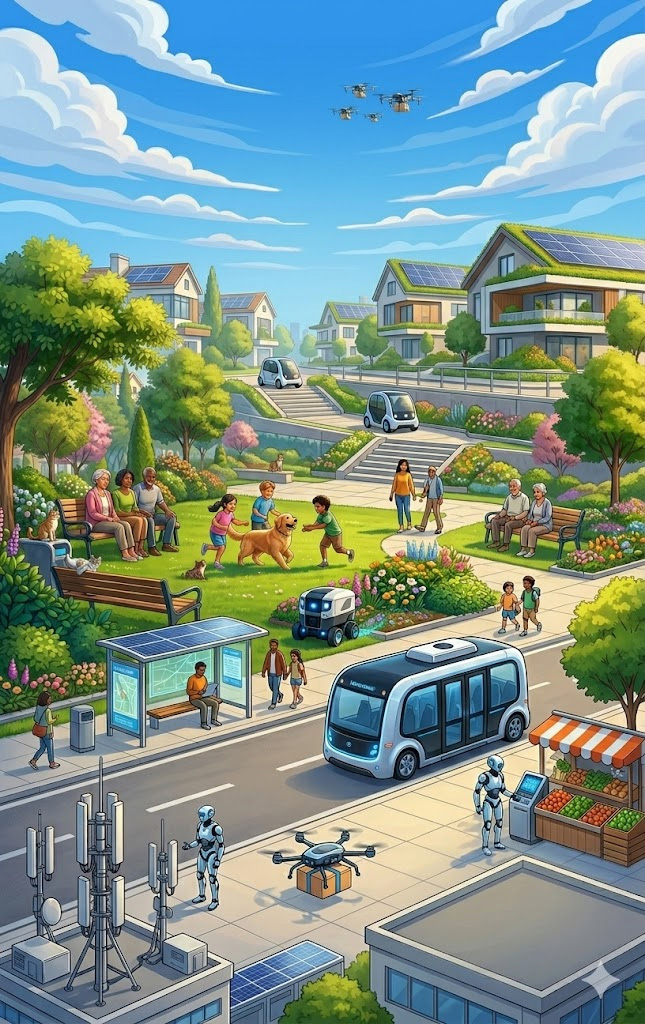
Hailo foresees a future with intelligent robots. Source: Google Gemini AI, Hailo
This is where edge architectures become critical. Physical AI will not be defined by the largest models or the most powerful cloud infrastructure. It will be defined by efficient systems that can operate reliably where they are deployed.
A different path forward
The future of robotics will not be defined by a small number of machines attempting to do everything. It will be defined by millions of intelligent systems, each designed for a specific purpose, operating where they create value.
These systems will rely on continuous sense-think-act loops, running locally on edge hardware. They will prioritize responsiveness, efficiency, and reliability over generality. And they will scale across industries that demand practical, cost-effective solutions.
In that sense, the next chapter of AI is about making intelligence actionable – embedded directly into the physical world, where decisions must be made instantly and performance is measured in outcomes. And in that world, the edge is not just an architectural choice. It is a requirement.
 About the author
Yaniv Sulkes is vice president for physical AI at Hailo, where he drives the company’s strategy for bringing advanced AI compute to robots, intelligent machines, and edge systems at scale. With more than 20 years of leadership experience across AI, automotive, and deep‑tech sectors, Sulkes has played a central role in transforming how edge devices perceive, decide, and act in real time.
Prior to Hailo, Sulkes served as vice president of business development and marketing at Autotalks, promoting global adoption of V2X technologies powering safer, more connected mobility. He previously led global marketing at Allot Communications, following several successful product leadership roles. Sulkes holds a B.Sc. in industrial engineering and an M.Sc. in electrical engineering from Tel‑Aviv University.


Task specific robots dramatically preceded the advent of AI and of course dominate the category of ‘robot’. Humanoid robots will also be task specific, the task will be interfacing with humans and systems designed for humans. This will likely be a substantial market, but of course robots built for other tasks will grossly outnumber the humanoid robots.