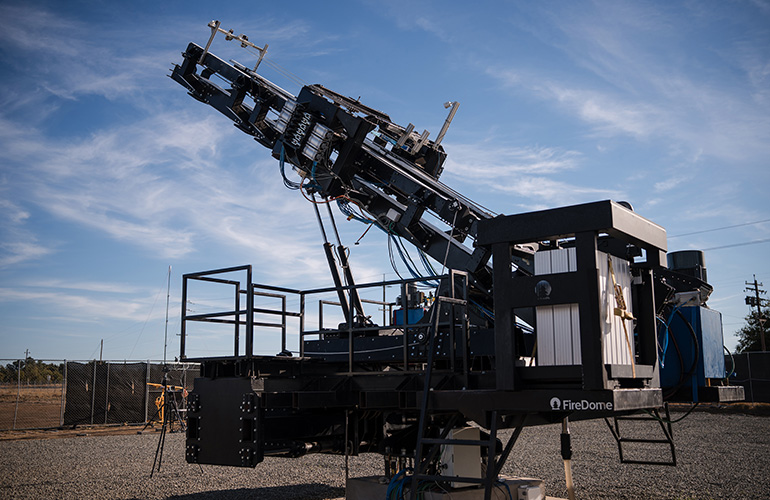
The FireDome launcher is fully autonomous, designed to launch projectiles containing water or fire retardant up to 1,000 ft. from the launcher. | Credit: FireDome
In wildfire country, minutes matter, but current fire technology still stops at detection. FireDome is trying to close that gap with an autonomous, ground-based launcher system designed to protect communities and critical infrastructure before firefighters arrive, laying down retardant firebreaks, coating vulnerable structures, and suppressing ember-driven spot fires before they cascade into neighborhood-scale losses.
I live in one of the most wildfire-prone parts of California. Fire prevention and response are constantly on the minds of me and every one of my neighbors. Wildfire season in the American West is no longer a season; it’s a year-round threat. For communities like mine in the wildland–urban interface (WUI), the risks are now financial as well as physical. If you can’t prove you’re fire safe, you may not even be able to get insurance.
Tel Aviv, Israel-based FireDome is a startup building an autonomous, ground-based fire suppression system that sits quietly on the edge of communities and critical infrastructure. It acts like an automated “artillery battery” when wildfire threatens.
I recently sat down with FireDome co-founder and CEO Gadi Benjamini to learn how the company started, what problem it’s actually solving, and how its launcher-based system works.
From climate tech uncertainty to wildfire autonomy
FireDome’s story starts far from California at a climate-tech conference in Israel in early 2024.
Benjamini had just come off a startup in the methane gas/climate mitigation space that ultimately shut down. He was in that familiar founder limbo: looking for the next problem that was big enough and technical enough to be worth years of his life.
At the conference, which happened to focus on the wildfire crisis, Benjamini met his future co-founder, Dr. Adi Naor Pomerantz, now FireDome’s chief technology officer. They realized that most wildfire innovation was stuck on detection, not action.
“Most of the technologies at that point were meant to detect fires when they’re early, and not to react to the fires,” Benjamini told The Robot Report. “You have detection, and then firefighters come to the scene. They come late, they have to spread out resources between different fronts, and that makes it much more difficult to succeed in firefighting.”
Benjamini and Pomerantz said they shared values that defined FireDome’s trajectory from Day 1:
- Deep technology: something that pushes the envelope in robotics, sensing, and autonomy
- Global impact: a problem whose importance will only grow over the coming decades
Initially, they imagined autonomous systems embedded directly in wildlands, providing end-to-end detection and suppression before fires ever approached communities. But they quickly ran into the hard realities of coverage and scale.
To be practical in the wildland itself, a system would need 1 to 1.5 mi. (1.6 to 2.4 km) of effective range. FireDome’s current launcher offers about 1,000 ft. (304.8 m) of radius, covering about 70 acres (28.3 hectares) around the device.
That realization pushed them toward a different starting point.
“We understood that there can’t be one solution to the wildfire problem. There’s no silver bullet,” Benjamini recalled. “Our vision for wildland systems is still alive, but we decided to focus first on protecting specific properties, communities, and critical infrastructure.”
Editor’s note: Field robotics is among the session track topics at RoboBusiness 2026, which will be on Oct. 20 and 21 in Santa Clara, Calif. Register now to attend.
 Register now and help us celebrate 20 years of RoboBusiness!
The real wildfire problem: embers, resources, and insurance
For most people in fire-prone regions, the crisis is felt on two fronts:
- Physical risk: homes, businesses, and infrastructure in the path of fast-moving fires
- Financial risk: the ability to retain insurance coverage at all
In my own community in Northern California, we conduct annual controlled burns and vegetation management. As a result, our homeowners association (HOA) has achieved “Firewise Community” status and can still obtain affordable insurance. Neighbors just outside the boundary aren’t so fortunate—they’re facing non-renewals and skyrocketing premiums.
FireDome sits at the intersection of those pressures.
Detection is not the bottleneck
Wildfire technology has improved significantly on the detection side. We now have: camera networks such as ALERTCalifornia, operated by UC San Diego; satellite-based fire detection; and sensor grids and public alert systems.
But as Benjamini points out, once a fire is detected, the response still depends heavily on human firefighters and aircraft:
- Ground crews must fight the fire front, defend structures, and protect lives.
- Aerial tankers and helicopters drop water or retardant from high altitudes, with significant loss of material to aerosolization and drift.
- Resources are spread thin across multiple fronts, often arriving late to key properties.
Ember-driven destruction and the domino effect
Perhaps the most sobering part of our conversation was FireDome’s focus on embers as the real destroyer of communities.
Looking at recent California events, including the LA-area fires, Benjamini noted that 85% to 90% of structure losses in the WUI were caused not by a wall of flame hitting homes directly, but by wind-driven embers.
Embers can ignite roofs, decks, and siding. Once a single home catches fire, it becomes a massive ember generator. Pieces of burning structure are lofted into the neighborhood, triggering a domino effect.
“This is what we want to prevent,” said Benjamini. “We want to cut off this domino effect by covering structures ahead of time, so when an ember meets the fire retardant, it doesn’t become a spot fire.”
In that light, FireDome is not just building a new fire suppressant. It’s trying to insert an autonomous, robotic layer between detection and traditional response. The core concept is to specifically target embers and spot fires before they cascade into neighborhood-scale loss.
Who FireDome is building for
FireDome’s initial go-to-market strategy focuses on customers that have a lot to lose and a clear wildfire/WUI exposure profile.
Core segments
- Residential communities and HOAs
- Especially those in high-risk wildfire regions
- Communities looking to bolster “fire safe” status and insurance resilience
- Resorts and hospitality properties
- Large campuses in forested or WUI locations
- High reputational and operational risk if a fire disrupts operations
- Critical infrastructure and industrial sites
- Data centers
- Oil and gas facilities
- Solar farms and other energy infrastructure
These are all large, spatially distributed properties where installing a single launcher can make economic sense.
Beyond wildfires: industrial fires and remote facilities
While wildfires are the initial focus, FireDome’s approach has obvious spillover to industrial fire scenarios, including remote sections of large plants that are difficult to access quickly. It could also apply to outdoor equipment yards and tank farms, as well as solar or energy facilities where fires can have cascading grid impacts
Most of these locations already have code-mandated indoor sprinklers and suppression systems. FireDome is positioning its launcher as an outer, autonomous defensive layer. It can detect and suppress local fires on site, create wet or retardant-coated zones to contain spread, and act as a robotic complement to human firefighting and fixed infrastructure, said the company.
FireDome offers service-first business model
For early customers, FireDome is positioning its offering as “protection as a service”:
- $10,000 to $15,000 per month for early adopters
- FireDome handles:
- Comprehensive fire risk survey
- System design and siting
- Installation and commissioning
- Annual maintenance and testing
For those who prefer ownership, the company also offers a CapEx model. Customers buy the hardware outright and pay a lower ongoing fee for maintenance and service.
Either way, FireDome is trying to lower the barrier for large property owners to experiment with a new robotic layer of wildfire defense.
Inside the FireDome system: launchers and ‘smart capsules’
From a robotics perspective, FireDome is a compelling example of field robotics applied to climate resilience. The system combines:
- Sensing — cameras, environmental sensors
- Planning and decision-making — mission computer and algorithms
- Actuation — a ground-based launcher and consumable capsules
Holistic site defense starts with a survey
Before a FireDome unit is ever installed, the company conducts a comprehensive fire risk survey of the site. It looks at:
- Topography: Slopes, ridgelines, access routes
- Vegetation: Fuel types and distribution
- Climate and microclimate: Wind patterns, humidity, historical data
- Asset layout: Structures, critical equipment, community footprint
The goal is to design multiple layers of protection. Perimeter defense goes around the property, while inside the property includes high-value structures and zones.
Those design decisions are then encoded into the system’s mission computer, which holds multiple pre-planned scenarios.
The launcher: autonomous, mechanical, not explosive
At the center of each deployment is the FireDome launcher. It includes ground-based autonomous launcher mounted on a concrete pad and 360° coverage. The system can protect up to 70 acres, depending on geometry of the parcel.
The launcher is protected from the elements by a cover that shields the mechanism while sitting idle and opens when an external alert or relevant condition triggers the system.
The robotic system is not a gun, and it does not use explosives to launch or initiate the capsule’s coverage. The launch mechanism is mechanical and designed for safety and reliability.
Smart capsules: flexible, addressable payloads
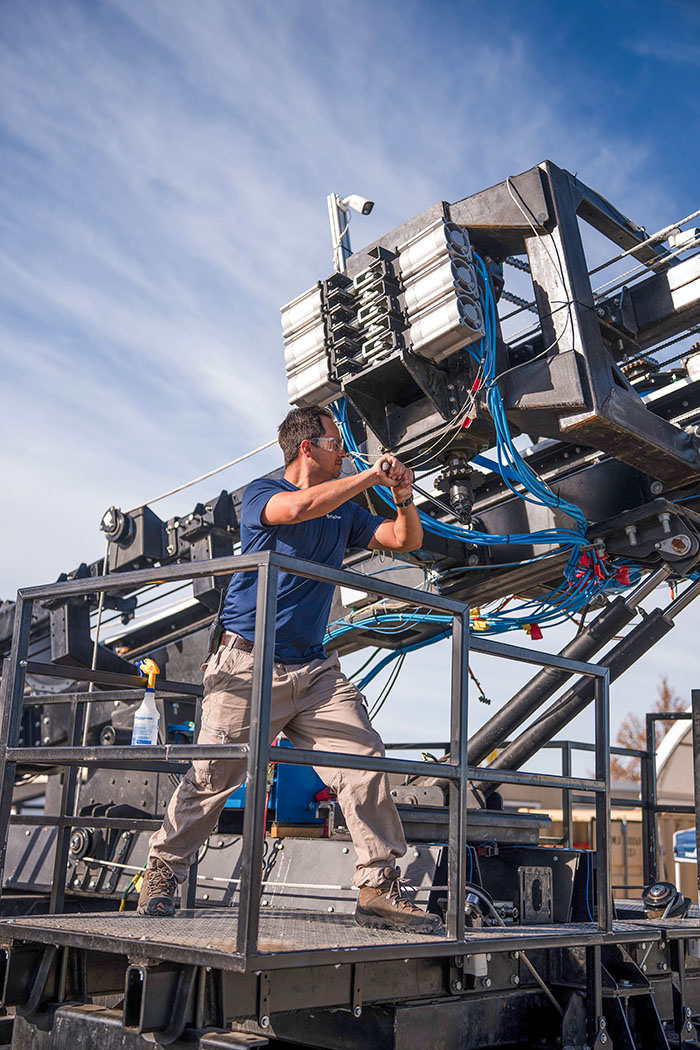
The FireDome launcher uses a mechanical launching mechanism. | Credit: FireDome
Instead of rigid shells, FireDome launches flexible “smart capsules.” Each capsule holds roughly 10 gal. (37.8 liters) of liquid. It can be standard or eco-friendly formulations of fire retardant, or water where appropriate.
The company can give capsules a specific address in space over the property, a point where they’re meant to open for optimal coverage. The capsules are mechanically activated a short distance above the ground (a few to a few dozen feet), not upon impact.
When a capsule opens, it creates an elliptical coverage pattern on the surface roughly 15 to 25 ft. (4.5 to 7.6 m) long and seven to 12 ft. (2.1 to 3.6 m) wide, depending on activation height. By overlapping these ellipses, the system can create a continuous firebreak or uniformly coat roofs and other surfaces.
Because activation happens close to the ground, almost no liquid is lost to aerosolization, unlike high-altitude air tanker drops, claimed FireDome.
Three layers of autonomous protection
FireDome’s defense concept is built around three layers, each triggered at different stages of a wildfire event.
Layer 1: perimeter firebreaks (pre-arrival)
When FireDome’s system receives an external alert that a wildfire is approaching the property it begins laying down retardant-based firebreaks around the property.
Multiple pre-programmed scenarios consider where the fire is coming from, plus wind conditions and other environmental factors. The system chooses the appropriate scenario and executes it autonomously, deploying capsules to form a perimeter line.
Layer 2: coating critical structures (pre-arrival)
The second pre-arrival step is to coat key structures on the property. These include roofs, walls, and other surfaces most vulnerable to embers, as well as buildings or assets pre-identified during the site survey
This is where FireDome directly targets the ember-driven domino effect:
- Structures are coated with retardant before embers arrive.
- Embers that land on treated surfaces are much less likely to ignite.
- Preventing that first structure ignition dramatically reduces the chance of house-to-house fire spread.
Layer 3: spot fire detection and suppression (reactive)
Once the main line and structures are protected, FireDome turns its attention to spot fires. On-site cameras and environmental sensors monitor the protected area.
The system detects and triangulates small fires caused by embers. Algorithms consider wind speed and direction, temperature and humidity, and topography and fuel layout.
The launcher then suppresses these spot fires in an optimized sequence, prioritizing threats that pose the greatest risk to the integrity of the property.
Autonomy, human control, and fire department integration
One of the most interesting design choices FireDome has made is around who gets to push the button to initiate, and when.
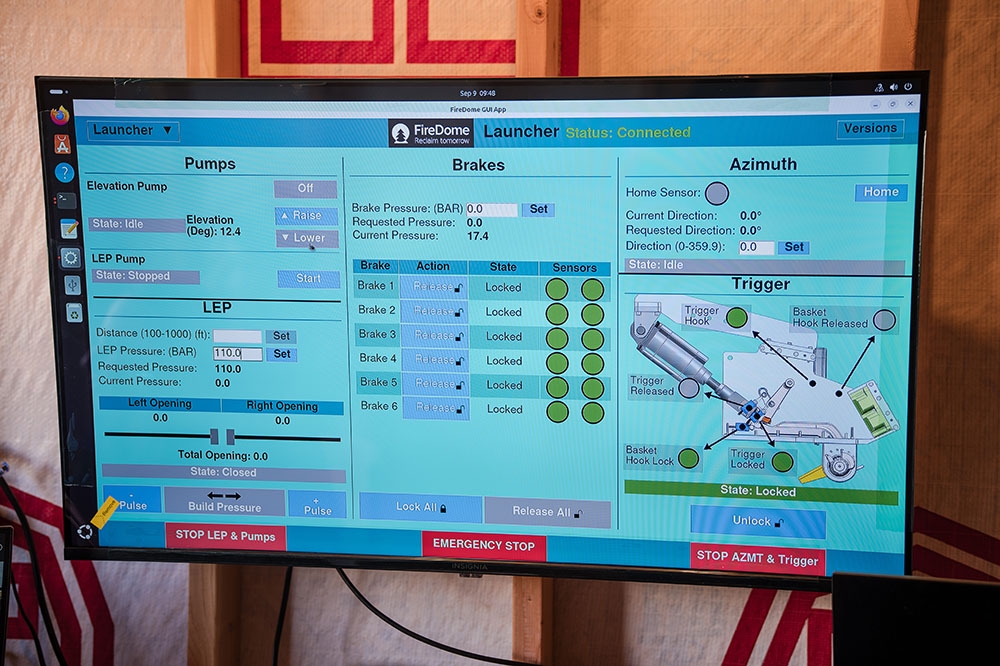
The FireDome software interface provides control over the launcher operations. | Credit: FireDome
Autonomous first, with the option to intervene
By default, FireDome operates fully autonomously. When the system detects that conditions meet its criteria, it initiates its response on its own, based on the pre-planning scenarios, agreed to by the property owner.
Property owners and incident commanders are notified as the event unfolds, rather than being asked to give a last-minute “go/no-go” under stress.
“The system is autonomous, and they can shut it off,” Benjamini explained. “It starts on its own, and both the customer and firefighters have the ability to intervene remotely.”
This removes dependence on a property manager being awake at 2:00 a.m., and critical time isn’t lost waiting for a human decision, he said.
Embedded in the incident command picture
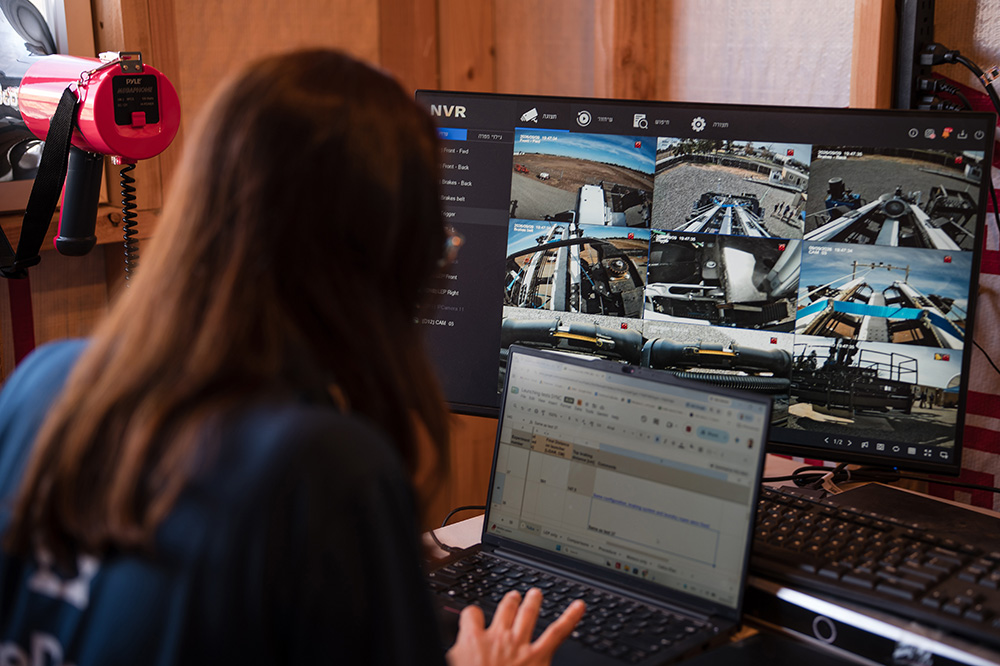
FireDome plans to integrate directly with incident command to give fire bosses control over the launcher in a given incident. | Credit: FireDome
FireDome is working closely with California fire chiefs to integrate its systems into existing incident command and control workflows. During a wildfire, incident command centers already coordinate ground forces and aerial assets. FireDome units show up as an additional type of resource on the commander’s screens.
The vision is that a fire boss will one day see:
- Engine companies and strike teams on the ground
- Tankers and helicopters overhead
- FireDome launchers as autonomous, self-sufficient artillery emplacements protecting key assets on the map
As a result, the fire boss can allocate critical resources as needed for the incident while leveraging FireDome for coverage at its deployment site.
From prototype in Yuba County to production in California
As of our conversation, FireDome has built and deployed its first full demo system at a site in Yuba County, California. The company is using this testbed to demo the system to various fire agencies and potential clients, while seeking feedback on the design and implementation.
In the next few months, the company will begin the final design and begin manufacturing the first units to be deployed in spring 2027. They are actively seeking early-adopter customer sites ahead of the next major fire season.
A new category in field robotics: climate defense infrastructure
For the robotics community, FireDome is an instructive case study in how to bring autonomy to climate resilience:
- It’s not a general-purpose platform looking for a problem; it’s a mission-specific robot addressing a tightly defined failure mode (ember-driven destruction).
- It blends robotics, sensing, decision-making, and consumable logistics in a harsh, safety-critical environment.
- And it’s being built to integrate with, not replace, existing human firefighting ecosystems.
As FireDome moves from prototype to production and begins real-world deployments, it will be worth watching how customers value an autonomous layer of protection in both wildfire and industrial contexts.
Also worth monitoring is how insurers respond to robotic, pre-emptive suppression as part of a broader risk mitigation stack. Incident commanders can learn to treat robotic artillery as another tool in their toolboxes.
For communities on the edge of fire country, the promise is straightforward: a system that may sit idle for years and, when the worst happens, it is already on site, awake, and ready to fight.




Tell Us What You Think!