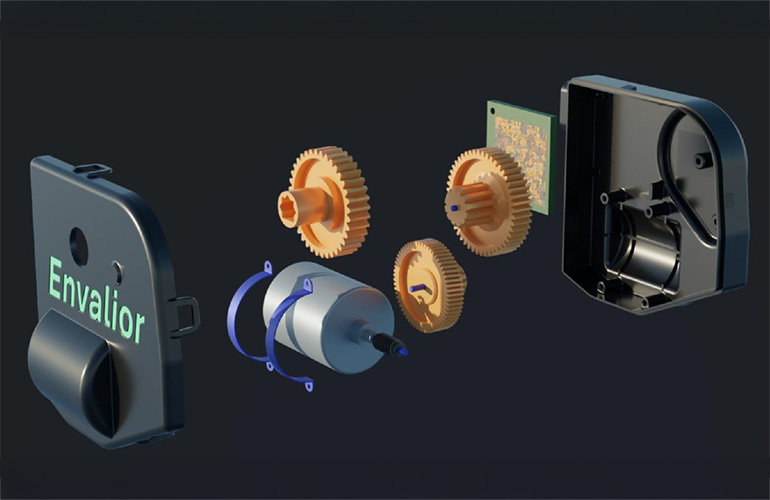
Envalior says that actuators are a key application area for Stanyl polyamide 46 compounds. Source: Envalior
As companies increasingly recognize that PFAS, or per- and polyfluoroalkyl materials — also known as “forever chemicals” — can be harmful to humans, they are seeking alternatives. Envalior has been working on alternative materials that can be used in high-wear and high-friction applications such as robot actuation.
The Dusseldorf, Germany-based company said it recognizes the growing demand for polytetrafluoroethylene (PTFE)-free materials that are sustainable, economical, and long-lasting. The challenge for tribology component manufacturers lies in the fact that no additive alternatives perform as effectively for wear and friction needs as PTFE, noted Envalior.
“If regulatory restrictions are enacted, many plastics that were sufficient in the past … may fall short of performance requirements when PTFE is removed or replaced with other additives,” it said.
Envalior was established in 2023 through the merger of Lanxess Performance Materials and DSM Engineering Materials. The company claimed that it is a global leader in engineering materials, with more than 4,000 employees worldwide.
It specializes in developing high-performance materials, including PA6, PA66, PBT, PA46, PPS, TPC, PET, PA4T, PA410, and thermoplastic composites. Envalior said it focuses on markets including mobility, electrical and electronics, and consumer goods.
Envalior develops high-performance PTFE-free materials
Envalior said Stanyl can satisfy performance requirements without requiring PTFE, making it suitable for timing systems, actuator gears, bearings seals, and bushings among others.
“Our Stanyl portfolio offers customers many options to fulfill high performance characteristics while meeting legal and application-specific requirements,” said Adnan Hasanovic, technical expert for tribological applications at Envalior. “Stanyl is able to offer to manufacturers ductility, robust tribological performance and design freedom via extruded parts.”
“As industries push the boundaries of performance, efficiency, and sustainability, the choice of materials used in wear and friction applications is becoming more complex and critical,” asserted Envalior. It cited its Stanyl polyamide 46 (PA46) portfolio.
“Our high-temperature polyamides often pave the way for innovations in a wide range of industries,” added Hasanovic. “For example, they are increasingly replacing metals and less durable plastics in gears, bearings, seals, and bushings for the automotive industry, robotics and household appliances.”
Stanyl PA46 is still a high-performance material at elevated temperatures, said Envalior. Due to its high crystallinity, it offers a combination of:
- Superior fatigue and wear resistance
- High impact and weld line strength
- Excellent flow behavior for thin-walled designs
- Outstanding stiffness and creep resistance at elevated temperatures
These properties serve wear and friction applications well, especially where high torque, speed, and temperature are involved, according to the company. Compared with traditional materials like PA66, POM, PPS, PPA, Stanyl can delivers higher performance and significantly lower cost compared to plastics like PEEK, it said.
New gears are lightweight, durable, and quiet
Increasing adoption of robotics and electric vehicles (EVs) and developments in household appliances have led to new requirements for gearbox and bearing components.
In the field of robotics, force- and power-limited robots, also known as collaborative robots or cobots, are touted for their ability to work safely alongside humans. However, traditional metal components of cobot gears can pose occupational safety risks due to inertia and weight, providing an opportunity for alternative parts.
In EVs, systems such as electric power steering, brake boosters, and thermal management valves require compact, lightweight actuators that deliver high torque and are reliable over the long term, even at high temperatures. Appliance manufacturers are increasingly replacing metal gears with plastic alternatives to improve production efficiency and product performance.
Envalior said Stanyl meets all these demands by enabling:
- Weight reduction: Up to 40% less material usage compared to PPS and PPA, resulting in lighter, more compact gears
- Noise reduction: Up to 10 decibel lower gear noise than metal alternatives, improving noise, vibration, and harshness (NVH) characteristics and enhancing the user experience
- High-temperature performance: Reliable operation at temperatures up to 180°C, critical for turbo actuator gears and other high-load applications
Envalior said its advanced gear-testing capabilities simulate real-life conditions, helping manufacturers select the optimal material grade and reduce costly re-testing and re-molding.
Stanyl provides high-speed option for bearings
Bearings in EVs face extreme conditions due to compact motor designs and high rotational speeds, which leads to high temperatures. Stanyl compounds enable thin-walled, lightweight designs that maintain mechanical integrity under high centrifugal loads and rotational speeds up to 30,000 rpm, said Envalior.
Compared with PA66, the compounds can reduce part deformation by about 20%, while also resisting chemical aging from automotive lubricants, the company explained. Stanyl is increasingly used in bearing cages to replace metals and other polymers, offering:
- Low creep deformation: It can reduce cage deformation that results from high speeds and high centrifugal forces.
- High ductility: Stanyl, which was presented at K 2025, can reduce risk of cage fracture and cage scrap rate during the bearing assembly process, said Envalior.
- High weld line strength: The material can reduce failure risk in complex cage designs.
- Fast production cycle times: High flow and crystallization speed enable efficient manufacturing.
- Chemical resistance: Stanyl can withstand exposure to the oils and greases used in automotive environments.
Envalior said it supports bearing manufacturers with advanced simulation tools, including mold flow and finite element analysis, to ensure optimal design and performance under real-world conditions. The company provides detailed information on its materials in MaterialAdvisor, which provides digital tools and services that customers can use to find, select and evaluate materials.



Tell Us What You Think!