

Electric Sheep Robotics said its latest robot, Verdie, uses AI and large-world models to work alongside landscaping crews.
IFR says harnessing AI in robotics can make work better

Marina Bill, the president of the IFR, shares insights on how companies can use recent advances in AI for robotics.
How Odense became a leading robotics city

Odense, Denmark, has become a leading robotics cluster thanks to its spirit of collaboration and cobot leadership, says serial entrepreneur Thomas Visti.
Neura Robotics to move production from China to Germany
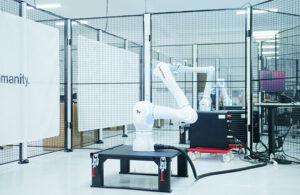
By the end of 2024, Neura Robotics will ramp up its production capacities in Metzingen while reducing them in China.
3 ways ABB sees AI driving robotics innovation
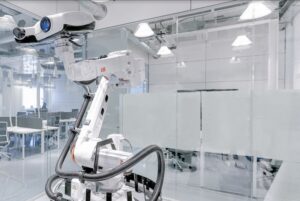
Marc Segura, president of ABB Robotics, shares three ways AI is driving robotics innovation.
RoboGuide robot dog uses AI to assist the visually impaired
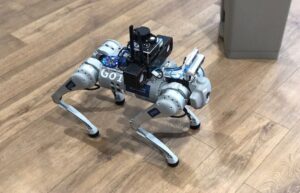
Technologies such as RoboGuide could enable people with visual impairments to more fully navigate and interact with the world.
MassRobotics returns as strategic partner for 2024 Robotics Summit & Expo
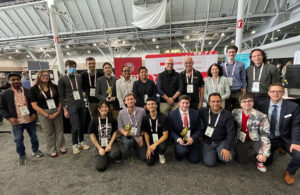
MassRobotics will announce Form & Function Challenge winners and host an engineering career fair at the 2024 Robotics Summit & Expo.
Top 5 robotics trends for 2024, according to the IFR
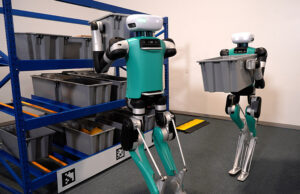
The IFR has cited technology trends including the rise of generative AI, mobile manipulation, and humanoid robots for 2024.
RoboXchange examines real-world operational challenges and new brains for robots
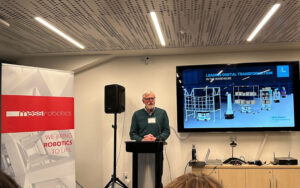
At the first MassRobotics RoboXchange, Locus Robotics shared tips on warehouse challenges, and Opteran showed a new navigational approach.
Nala Robotics incorporates generative AI into restaurant robot recipes
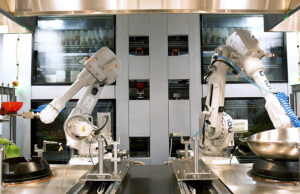
Nala Robotics said it is looking at how AI can help robots create recipes with the ingredients at hand, reducing food waste.
Intuition Robotics brings generative AI capabilities to ElliQ 3

ElliQ 3’s hardware improvements pave the way for its software upgrades, which center around integrating generative AI capabilities.
Multiple AI models help robots execute complex plans

A multimodal system uses models trained on language, vision, and action data to help robots develop and execute plans for household, construction, and manufacturing tasks.
1X Technologies raises $100M Series B to advance NEO humanoid robot

1X says its NEO android is being developed with embodied AI to handle household tasks and be safe to operate around consumers.
GRIT Vision System applies AI to Kane Robotics’ cobot weld grinding
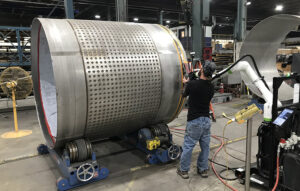
Kane Robotics has developed the GRIT Vision System to improve cobot material removal and finishing for customers such as Paul Mueller Co.
Generative AI and Isaac to power smarter robots, says NVIDIA before CES

Generative AI and large language models can improve robot training, perception, and human-machine interactions, says NVIDIA and its partners.
5 robotics trends to expect in 2024

With 2023 in the rearview mirror, it’s time to look ahead to what 2024 has in store for the robotics industry.
Is using AI for full self-driving a good idea? Musk says yes, but AI watchdog says no

Self-driving vehicle developers say different approaches to AI are safer than human drivers, but critics are skeptical after accidents.
The 5 biggest robotics industry trends of 2023
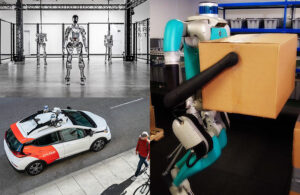
As 2023 comes to an end, we look back at some of the biggest trends in the robotics industry this year.
4 ways robotics, AI will transform industry in 2024

How will robotics and AI impact industry in 2024? Anders Billesø Beck, VP of Innovation and Strategy at Universal Robots, weighs in.
Outrider releases latest AI-driven perception technology to accelerate yard automation
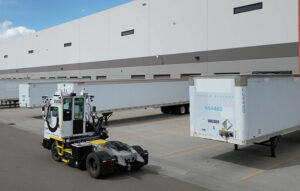
Outrider has updated its perception technology to enhance yard safety and efficiency as it looks to new capabilities and markets in 2024.
NVIDIA Isaac Sim on AWS to ease robotics development
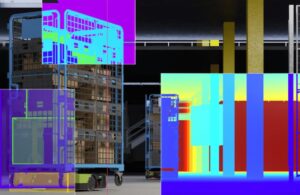
NVIDIA said roboticists will have improved access to preconfigured virtual machines to run Isaac Sim workloads.
Mujin finalizes Series C extension for logistics robot controllers
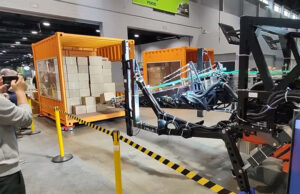
Mujin, which has raised a total of $178 million, plans to make its MujinController more accessible to developers.