Humanoid robot developers are trying to replicate the human hand. Source: Adobe Stock
Human hands are dexterous, versatile machines. Roboticists have tried to copy the biological structures of the hand for humanoid grippers. This, however, typically results in complex and difficult-to-control structures.
Researchers proposed an alternative end-effector solution in a new study published by Wiley in Advanced Science. They created the BioflexBot, a novel robot that mimics and even exceeds core motions of the hand with a simple design.
Instead of creating a robotic hand with the intricate anatomy of a human hand, the researchers aimed to capture fundamental hand motions with a coiled spring, constraining shell, and basic pneumatic system, using compressed air to control mechanical action. Optimized for precision and range of mobility, the BioflexBot can pinch, rotate, hook, and grasp with just two pneumatic inputs.
“By harnessing structural and physical intelligence, we pursued a simple design capable of both cross-scale grasping and complex human-like manipulation,” said senior author Yingtian Li, Ph.D., currently of the Chinese University of Hong Kong, Shenzhen.
“Unlike most robotic hands that replicate the human form, at high hardware and control costs, our approach focuses solely on mimicking the functions, not the shape,” said Yang Yang, senior author and a Ph.D. at the Nanjing University of Information Science and Technology.
How did researchers validate the BioflexBot hand?
The Chinese researchers validated that the BioflexBot could replicate these foundational hand motions.
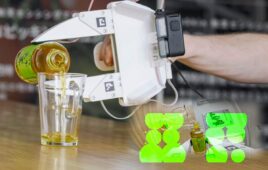
To simulate pinching, the BioflexBot successfully manipulated an acupuncture needle and reliably transported liquid using a pipette, completing delicate tasks common in healthcare or laboratory settings. The BioflexBot rotated a bottle cap, rotating almost four times more than a human hand’s capability.
The researchers showed that the BioflexBot could hook objects such as a toolbox and goggles. Finally, they found that the BioflexBot could securely grasp objects of varying sizes, up to almost 13 times bigger than similar systems.
Editor’s note: Humanoid robotics development is the topic of a session track at RoboBusiness 2026, which will be on Oct. 20 and 21 in Santa Clara, Calif. Registration is now open.
 Register now and help us celebrate 20 years of RoboBusiness!
What does it mean to go beyond human-level performance?
Beyond reliably mimicking traditional hand motions, the BioflexBot exceeds human hand performance, extending and contracting 3.5 times more than the human hand, the researchers claimed. Therefore, the BioflexBot can grasp complex objects, reach long distances, deliver objects in confined spaces, and transport multiple objects sequentially.
The researchers demonstrated three potential applications for the BioflexBot: inspecting aeroengine blades, completing daily tasks integrated with a humanoid robot, and conducting a chemistry experiment.
These findings suggest that the simple design of the BioflexBot can result in high dexterity at extremely low costs with applications across industries, said the scientists. They plan to translate the prototype to a fully automated platform in future work.
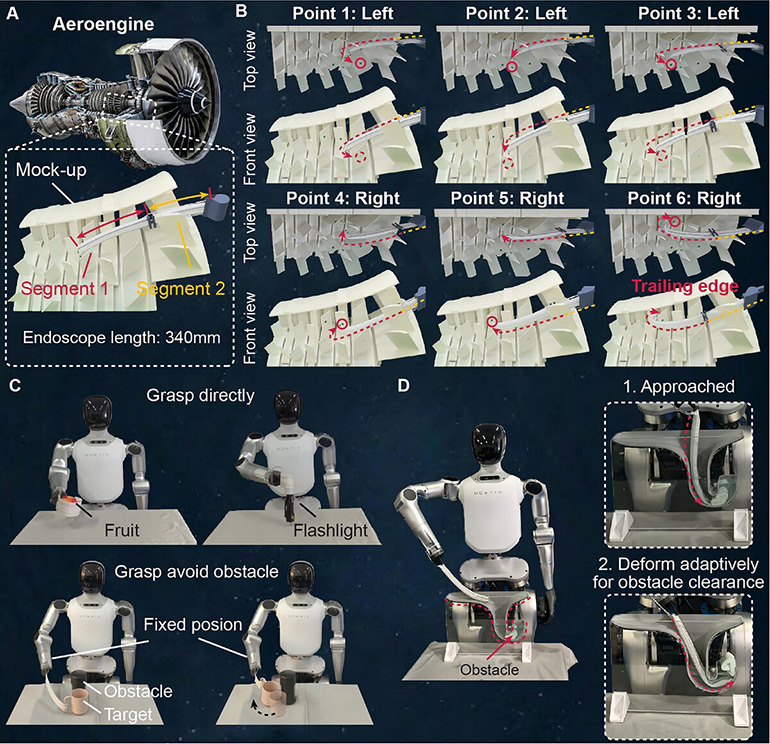
Demonstration of BioflexBot using its tool-hand integration capability. (A) Inspection of a 3D-printed mockup of aeroengine blade array. (B) The robot’s large-curvature distal bending enables successful inspection of the blade’s trailing edge (Point 6: right). (C) Experimental demonstration of BioflexBot for direct grasping and obstacle-avoiding grasping. (D) Clearing obstructions within a narrow channel using the BioflexBot. Source: Advanced Science
Tell Us What You Think!