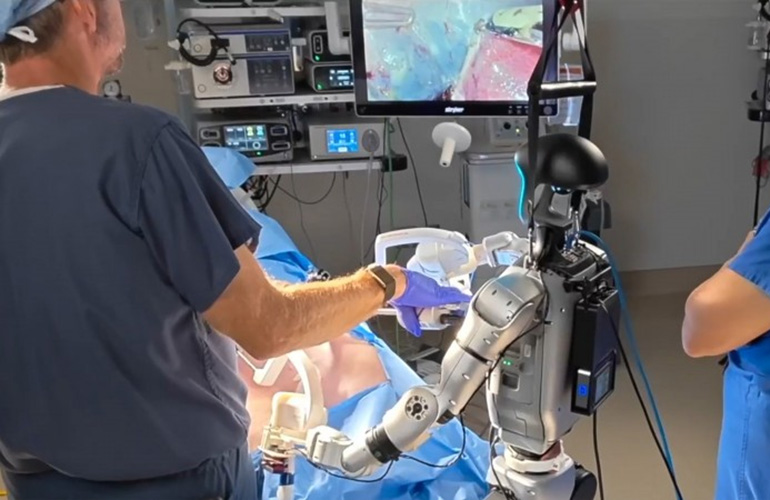
A team including a humanoid robot and a human surgeon successfully performed a gallbladder removal. | Credit: UC San Diego
In a medical first, University of California San Diego researchers have successfully used two teleoperated humanoid robots to complete surgeries during a preclinical trial, according to a study published this week in the journal Nature.
In one surgery, a team made up of a humanoid robot and a human surgeon acting as an assistant successfully performed a gallbladder removal. A second successful procedure was performed by two humanoids working side by side in a robot-robot team. Both procedures were performed on large non-primate mammals.
The proof-of-concept experiment is a first step toward introducing humanoids in the operating room, the researchers said. These robots could first assist during procedures, then later perform surgeries with teleoperation.
“Remotely operated and autonomous humanoid robots have real potential for amplifying access to critical surgeries to which patients would otherwise not have access. This can help address the healthcare crisis not only in the United States, but also worldwide,” said Michael Yip, a faculty member in the UC San Diego Department of Electrical and Computer Engineering and one of the paper’s senior authors.
Unlike dedicated platforms such as Intuitive Surgical‘s da Vinci Surgical System or Stryker‘s Mako Robotic Arm, the researchers focused on the thesis that humanoid robots are versatile and could perform a wide range of procedures and general tasks. The market leaders have proven that robotic systems have a place in the operating room; now the question is whether a humanoid robot can also support surgical procedures.
“The procedure that we actually carried out was called colocystectomies,” explained Yip. “This is one of the most common procedures done for general surgery, where you’re removing the gallbladder. It’s common, but it’s also challenging to do because you need dexterous instruments.”
“So things that have wrists at the end of their tools that you’re holding, and then you’re trying to do fine dissections and remove parts of the organ. And so it’s what everybody in general surgery gets trained on,” he told The Robot Report. “It’s a really good metric to evaluate how well somebody’s performing the surgery.”
“So when you put a humanoid robot as an avatar for the doctor to control their actions and then perform the surgery, you can really measure if somebody was doing this procedure through the humanoid, what are the advantages? What are the challenges?” Yip said.
Humanoid robots could improve access to surgical care
The dedicated surgical robots are large, heavy, and typically installed in a single operating room. This limits access and scheduling, said the researchers. A humanoid robot could be versatile enough to perform a wider range of tasks and support some of the functions that occur in the operating room behind the surgeon.
Building specialized operating rooms for robotic surgical systems or finding large teams to operate a specialized piece of equipment could be prohibitively expensive in these settings, Yip said.
“A procedure performed by a teleoperated humanoid robot is just as precise as one performed with a teleoperated surgical robotic system,” said Shanglei Liu, M.D., an assistant professor of surgery at the UC San Diego (UCSD) School of Medicine, one of the paper’s senior authors. He teleoperated the robot during the study.
“It’s a fraction of the cost, and it takes a fraction of the space in an operating room,” Liu added. “So it’s easy to deploy, anywhere from rural areas to the battlefield, and even to space. A procedure performed by a teleoperated humanoid robot is just as precise as one performed with a teleoperated surgical robotic system.”
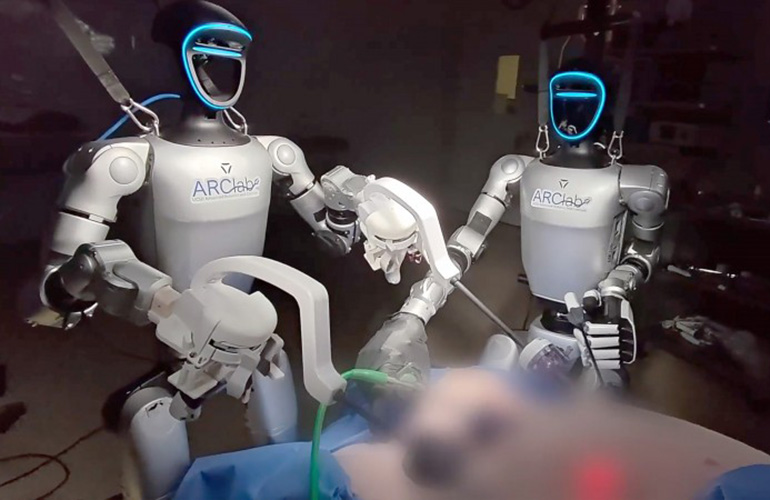
Two humanoid robots performed a second successful surgery working side by side. | Credit: UC San Diego
Teleoperation challenges still need solving
Several issues with teleoperation still need to be addressed. The humanoid robots had to be recalibrated several times during surgery. As a result, the procedures took much longer than when performed with existing specialized surgical systems. But this was also common with early-stage specialized robotic systems as well and will likely get better with time, Liu said. The first robotic laparoscopic surgery took six hours; it now takes 30 minutes.
When asked about how the humanoid robots performed, Yip stated, “What we learned very quickly was that the G1, because of its small stature, its arms don’t move around as much. And so when you’re doing surgery with manual tools, it turns out you need a lot of range. You have to reach over the patient’s body, especially if you’re working side by side with the person. You sometimes have to reach into their workspace and kind of maneuver around them.”
“So the paper outlines these limitations very transparently. That we will have to work through. But that would probably be the major one,” he said. “The other one is that, as expected, a humanoid robot is a potentially good platform for many things, but an expert at nothing. And so it will not be as accurate as a da Vinci robot that was specially designed for that procedure. But it was accurate enough to complete the whole procedure through the humanoid. So, I think that is a great sign for what the future holds for these platforms.”
Latency — a delay between when the surgeon moves the controller and when the robot moves — is being improved as the team explores longer-distance operations to remote communities.
Researchers also see a different role for the humanoid robots. Because these robots can walk and perform most physical tasks a human can do, it could fetch tools for the surgeons and clean up an operating room after a procedure.
“One of our goals is to develop the autonomous surgical assistant,” Yip said. “Many communities struggle with adequate staffing on the surgical team, which means patients are not being treated. Our goal is an operating theatre of the future, where humanoid robots and humans work side by side as an integrated team to deliver procedures to those in need, both in traditional hospital settings as well as in non-traditional, field medicine scenarios.”
Looking to the future, Yip continued, “Back in the ’90s, people were already doing autonomous suturing, visual servoing, and things like that. And so I think what’s really exciting is to see if we bring all of that knowledge into today’s world by looking at translations of the autonomy that abstract away what the platform actually is. If I could have the autonomous procedure that I designed to work on the da Vinci robot, basically copy and paste it, and now it works on a humanoid robot.”
Researchers emphasized that the work would not have been possible without a close collaboration between engineers and surgeons, and the role of the UC San Diego Center for the future of surgery.

Tell Us What You Think!