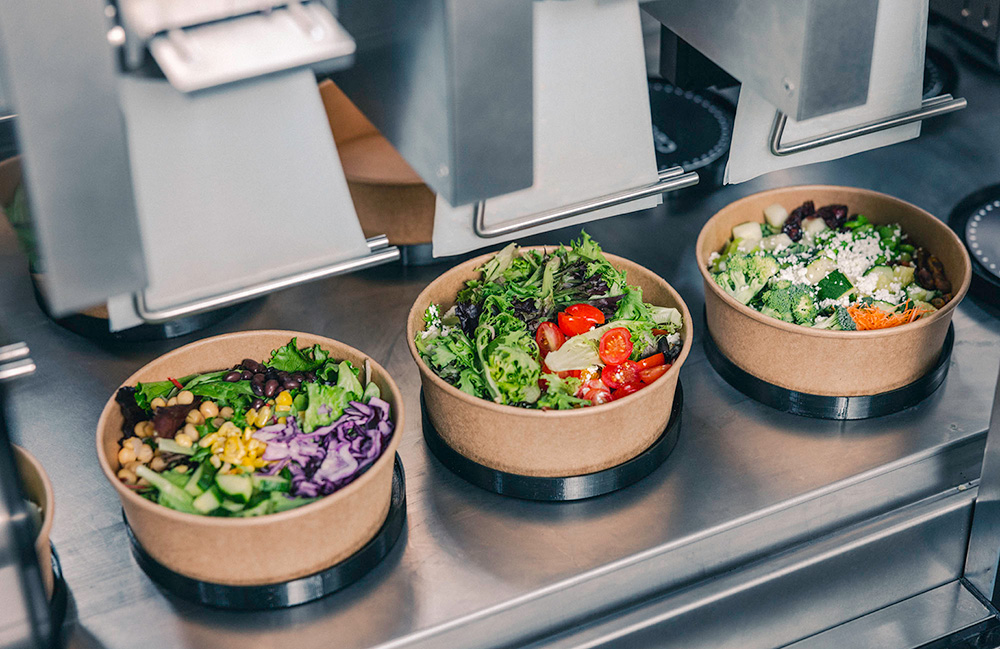
Cibotica, now part of Appetronix, offers Remy, an automated salad and bowl assembly line that can work with a range of ingredients. | Source: Appetronix
Appetronix today announced it acquired Cibotica, which develops ingredient dispensing and portioning technology. The acquisition opens new doors for Appetronix, which has focused on establishing standalone, autonomous restaurants.
The acquisition will bring Cibotica’s flagship product, an automated bowl and salad assembly system, to Appetronix’s restaurants. The companies did not disclose the financial details of the deal.
“With Cibotica, what they’ve done is created this amazing equipment that’s very modular,” Nipun Sharma, the CEO of Appetronix, told The Robot Report. “It goes into existing restaurants. It automates a big percentage of tasks that are done in current restaurants. They’ve already done the work. We already have an infrastructure that we can benefit from the technology, because our machines can use what they’ve developed. And now, we can offer the service to everybody.”
Appetronix currently operates robotic pizza kitchens through its partnership with Donatos, including a fully autonomous location at John Glenn Columbus International Airport in Columbus, Ohio, and another location opening this spring. With the addition of Cibotica’s dispensing technology, the company said it is better positioned to launch robotic concepts across multiple cuisines and other formats requiring precise ingredient portioning.
Robotics could relieve pressure on the restaurant industry
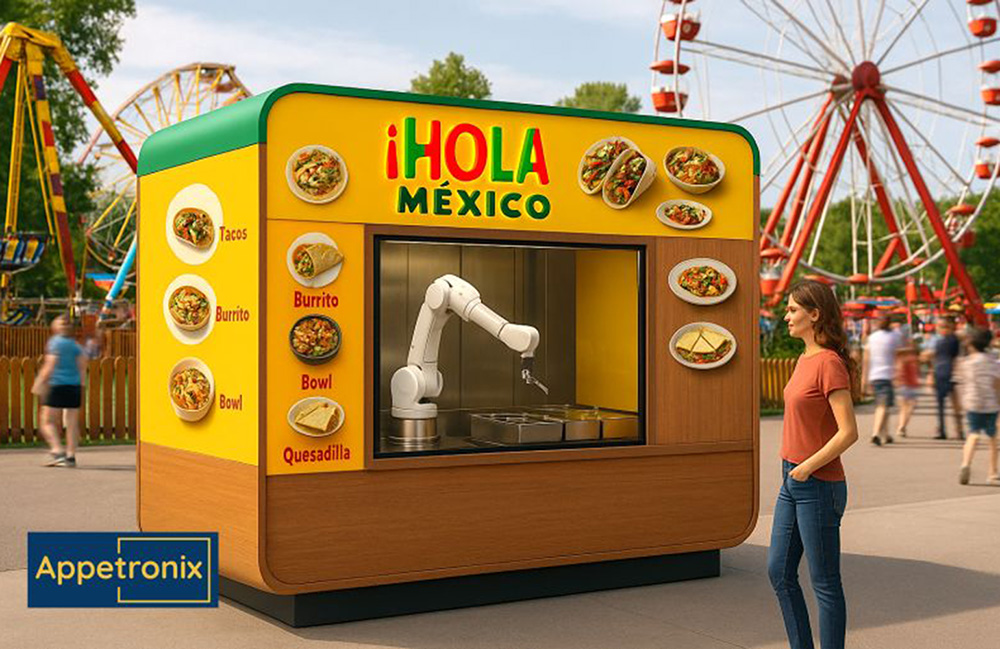
Appetronix hopes to operate micro restaurants in a range of cuisines and locations, including theme parks. | Source: Appetronix
“In the last 10 years, if you’ve been active in the restaurant industry, you will notice that the biggest challenge has been labor,” Sharma said. “There’s only so much I could do from a single oven. If there’s nobody to press the buttons, I have a problem.”
In addition, rising labor costs and the rising cost of goods from tariffs and inflation have put even more pressure on restaurants in recent years.
“The restaurant industry is really, really vulnerable, and we know that robotics and automation will play a big role in this. At the end of the day, people want their food made safely, quickly, and to taste great,” Sharma said.
To help relieve this pressure, Toronto-based Appetronix has focused on creating small, standalone, entirely autonomous kitchens. This, Sharma said, is more effective than automating existing kitchens.
“A lot of companies are automating existing kitchens, which is great. But they were not really speeding up the process, saving money, or eliminating labor,” said Sharma. “They were making things slightly convenient, which is great, but it doesn’t move the needle on economics.”
Using AI and robotics, Appetronix’s restaurants predict, based on how busy the restaurant usually is and what traffic it can expect, how long its ingredients will last and when it will need refills. “We estimate that when we provide this machine to our operator, they need to give us about three to four hours from one employee per day to run a machine,” Sharma said.

Cibotica creates modular automation for existing kitchens
Appetronix and Cibotica are both Canadian robotics companies serving the food industry. So, naturally, they’ve been running in the same circles for years. “I was always impressed by the things they’re doing with very limited resources, just like us. I think they’ve built a very, very powerful product,” Sharma said.
While Appetronix originally planned to avoid automating existing kitchens, its outlook began to change as it worked with its customers.
“We deliberately chose not to automate existing kitchens, because it is a smaller market, and it’s a painful process to integrate new equipment into existing kitchens,” Sharma said. “Our customers, both earned and future customers, have always asked us, ‘Hey, can you automate our existing kitchens?’ And our answer is always, ‘No, we’re just going to build a new one.’ But it was an opportunity that we were saying ‘no’ to.”
Sharma said Cibotica’s smart, modular technology was the right solution for automating existing kitchens.
“Having the knowledge base that Cibotica developed, the products, the patents – and it’s astonishing what they’ve developed in the last few years – now we can sort of put it on our platform and go to some existing customers and say, ‘Hey, while we’re doing the restaurant, we can probably automate your current base as well,’” Sharma said.
What’s next for Appetronix?
Moving forward, Sharma said Appetronix will offer a dual approach to its customers in automating existing kitchens and setting up new, fully autonomous kitchens. “It makes the customers happy in the short run, but survive and thrive in the long run,” Sharma noted.
The company is also interested in acquiring more companies in the future. According to Sharma, the Appetronix is spending a lot of time working on portion and temperature control. It is also exploring using laser technology to cut food, something not practical in a restaurant with people, but possible in a 100% autonomous kitchen.
“I’m a firm believer in not reinventing the wheel,” Sharma said. “We’re talking not just to hardware companies, but also some software companies that have an overlap in our needs for both maintenance and data infrastructure for AI. So, we’re going to be acquiring whenever we have an opportunity to accelerate our development.”
“Our whole ethos is we don’t sell robots; we sell food. And, we sell the best-tasting food out there,” Sharma continued. Appetronix plans to expand to new food styles and establish restaurants in new areas, including theme parks, airports, gas stations, supermarkets, and offices.

Tell Us What You Think!