The Robot Report

  • Home
  • News
  • Technologies
    • Batteries / Power Supplies
    • Cameras / Imaging / Vision
    • Controllers
    • End Effectors
    • Microprocessors / SoCs
    • Motion Control
    • Sensors
    • Soft Robotics
    • Software / Simulation
  • Development
    • Artificial Intelligence
    • Human Robot Interaction / Haptics
    • Mobility / Navigation
    • Research
  • Robots
    • AGVs
    • AMRs
    • Consumer
    • Collaborative Robots
    • Drones
    • Humanoids
    • Industrial
    • Self-Driving Vehicles
    • Unmanned Maritime Systems
  • Business
    • Financial
      • Investments
      • Mergers & Acquisitions
      • Earnings
    • Markets
      • Agriculture
      • Healthcare
      • Logistics
      • Manufacturing
      • Mining
      • Security
    • RBR50
      • RBR50 Winners 2025
      • RBR50 Winners 2024
      • RBR50 Winners 2023
      • RBR50 Winners 2022
      • RBR50 Winners 2021
  • Resources
    • Automated Warehouse Research Reports
    • Digital Issues
    • eBooks
    • Publications
      • Automated Warehouse
      • Collaborative Robotics Trends
    • Search Robotics Database
    • Videos
    • Webinars / Digital Events
  • Events
    • RoboBusiness
    • Robotics Summit & Expo
    • DeviceTalks
    • R&D 100
    • Robotics Weeks
  • Podcast
    • Episodes
  • Advertise
  • Subscribe

Alphabet testing robots to autonomously clean offices

By Steve Crowe | November 22, 2021

X Moonshot Factory Everyday Robots

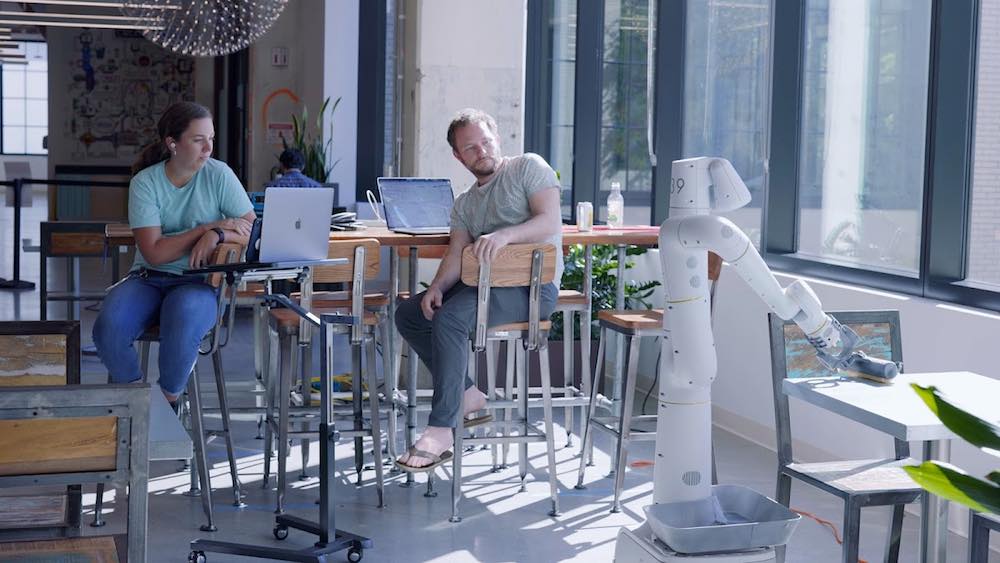
Alphabet is testing how well a fleet of robots can clean some of Google’s offices around the Bay Area. As an update to its Everyday Robots project that was first talked about in 2019, X, the moonshot division of Alphabet, released more details about how these robots are sorting trash, cleaning tables and tidying chairs.

The robots are mobile manipulators that use a multipurpose gripper on the end of a flexible arm attached. The robots also a variety of cameras and sensors, such as LiDAR, on top for machine vision and autonomous navigation. Fellow Alphabet company Waymo developed its own LiDAR sensor called the Laser Bear Honeycomb. It’s unclear if these robots use Waymo’s LiDAR, but Waymo recently said it’s “winding down” its commercial LiDAR business.

X said that using a combination of machine learning techniques like reinforcement learning, collaborative learning, and learning from demonstration, the robots are beginning to better understand the world around them and become more skilled at doing everyday tasks. Hans Peter Brøndmo, chief robot officer at X, said simulation is also playing a major role in the development of these robots.

“Back in 2016, when we weren’t using simulation and were using a small lab-configuration of industrial robots to learn how to grasp small objects like toys, keys and everyday household items, it took the equivalent of four months for one robot to learn how to perform a simple grasp with a 75% success rate,” he wrote. “Today, a single robot learns how to perform a complex task such as opening doors with a 90% success rate with less than a day of real-world learning. Even more excitingly, we’ve shown that we can build on the algorithms and learnings from door opening and apply them to a new task: straightening up chairs in our cafes. This progress gives us hope that our moonshot for building general purpose learning robots might just be possible.”

The goal Brøndmo said is to build robots that “can learn by themselves” rather than having to be precisely programmed “to solve just a single problem, in just one environment.”

“Today, most robots still operate in environments specifically designed, structured, and even illuminated for them,” he said. “The tasks they complete are very specific, and the robots are painstakingly coded to perform those tasks in exactly the right way, at exactly the right time. Yet this approach simply won’t work in the messy complex spaces of our everyday lives. Imagine trying to script all the possible ways to pick up a cup of coffee, anticipate the lighting or open a door. It simply wouldn’t scale.”

Will this approach by X scale? We’ll have to wait and see. But earlier in 2021, robotics software company Intrinsic spun out of X. Details about Intrinsic’s software are limited, but the company said it is developing software tools designed to make industrial robots easier to use and less costly.


About The Author

Steve Crowe

Steve Crowe is Executive Editor, Robotics, WTWH Media, and chair of the Robotics Summit & Expo and RoboBusiness. He is also co-host of The Robot Report Podcast, the top-rated podcast for the robotics industry. He joined WTWH Media in January 2018 after spending four-plus years as Managing Editor of Robotics Trends Media. He can be reached at [email protected]

Tell Us What You Think! Cancel reply

This site uses Akismet to reduce spam. Learn how your comment data is processed.

Related Articles Read More >

A humanoid robot such as this is one platform that the Microsoft Rho-alpha model is intended to make more autonomous.
Microsoft Research reveals Rho-alpha vision-language-action model for robots
Top 5 global robotics trends from IFR.
IFR names top 5 global robotics trends of 2026
The 2025 Form and Function Challenge Winners.
MassRobotics opens applications for fourth Form and Function Robotics Challenge
A Roomba, a Fetch robot, robot arms training, and Melonee Wise standing with a KUKA arm.
Top 10 robotics developments of December 2025

RBR50 Innovation Awards

“rr
EXPAND YOUR KNOWLEDGE AND STAY CONNECTED
Get the latest info on technologies, tools and strategies for Robotics Professionals.

Latest Episode of The Robot Report Podcast

Automated Warehouse Research Reports

Sponsored Content

  • Supporting the future of medical robotics with smarter motor solutions
  • YUAN Unveils Next-Gen AI Robotics Powered by NVIDIA for Land, Sea & Air
  • ASMPT chooses Renishaw for high-quality motion control
  • Revolutionizing Manufacturing with Smart Factories
  • How to Set Up a Planetary Gear Motion with SOLIDWORKS
The Robot Report
  • Automated Warehouse
  • RoboBusiness Event
  • Robotics Summit & Expo
  • About The Robot Report
  • Subscribe
  • Contact Us

Copyright © 2026 WTWH Media LLC. All Rights Reserved. The material on this site may not be reproduced, distributed, transmitted, cached or otherwise used, except with the prior written permission of WTWH Media
Privacy Policy | Advertising | About Us

Search The Robot Report

  • Home
  • News
  • Technologies
    • Batteries / Power Supplies
    • Cameras / Imaging / Vision
    • Controllers
    • End Effectors
    • Microprocessors / SoCs
    • Motion Control
    • Sensors
    • Soft Robotics
    • Software / Simulation
  • Development
    • Artificial Intelligence
    • Human Robot Interaction / Haptics
    • Mobility / Navigation
    • Research
  • Robots
    • AGVs
    • AMRs
    • Consumer
    • Collaborative Robots
    • Drones
    • Humanoids
    • Industrial
    • Self-Driving Vehicles
    • Unmanned Maritime Systems
  • Business
    • Financial
      • Investments
      • Mergers & Acquisitions
      • Earnings
    • Markets
      • Agriculture
      • Healthcare
      • Logistics
      • Manufacturing
      • Mining
      • Security
    • RBR50
      • RBR50 Winners 2025
      • RBR50 Winners 2024
      • RBR50 Winners 2023
      • RBR50 Winners 2022
      • RBR50 Winners 2021
  • Resources
    • Automated Warehouse Research Reports
    • Digital Issues
    • eBooks
    • Publications
      • Automated Warehouse
      • Collaborative Robotics Trends
    • Search Robotics Database
    • Videos
    • Webinars / Digital Events
  • Events
    • RoboBusiness
    • Robotics Summit & Expo
    • DeviceTalks
    • R&D 100
    • Robotics Weeks
  • Podcast
    • Episodes
  • Advertise
  • Subscribe