|
Listen to this article
 |
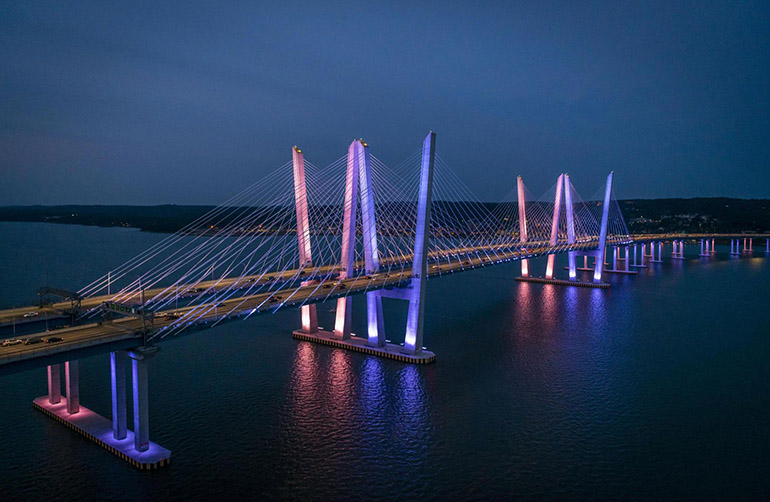
Welding robots helped build the new Tappan Zee Bridge (later renamed the Gov. Mario Cuomo Bridge). Source: New York State
According to a new report from analysts at Frost & Sullivan, using robots for industrial welding is no longer an option — it’s “inevitable.”
The report, “Transition to Welding Robotics Inevitable Across Industries Globally,” is part of Frost & Sullivan’s Global Welding Robotics Fact Book. Manufacturers beyond the automotive industry have become interested in robotics applications, according to the report.
Traditional resistance, or spot, welding remains popular for car-making robots, but other industries such as construction, electronics, and heavy machinery are more interested in arc welding robots.
The market for automated welding will grow from $2.44 billion in 2014 to $3.38 billion in 2020, said the report.
Both improved technology and better marketing by robotics vendors have helped increase awareness of automation’s potential, said Guru Mahesh, co-author of the Frost & Sullivan report.
“End users are looking for advanced technology that will cater to their needs for energy efficiency, improved productivity, and reliability,” he told Robotics Business Review.
Robot welders get smarter, but humans still needed
Technological developments are also encouraging adoption, as robots continue to move out of factories and become nimbler. “Advanced robotics with sensing technology … capable of adapting to the changing environment of a warehouse, which has numerous variables, are likely to witness growth,” Mahesh said.
One example of developments in automated welding can be found at the Lappeenraanta University of Technology (LUT) in Finland. Researchers there are working on a “self-adjusting” system involving sensors that watch the bevel angle, heat levels, and the weld form. These sensors are then tied to a neural network that is able to react to simultaneous changes in multiple variables, according to LUT’s website.
“When a mistake is detected, the system is able both to correct it during the welding process and also calculate what other faults may arise,” explained Markku Pirinen, project manager at LUT. The system works well for high-steel welding used in construction in the Arctic, he said.
“The system will bring significant savings for the welding industry, as resources will no longer be required for post-welding checks and repairs,” Pirinen said. “However, the system can only be used for mass-welding operations, so hand-operated welding will continue to be used for the kinds of work which the robotic welders cannot do.”
The LUT project has received about $865,000 (800,000 euros) in funding, most of it from Tekes, the Finnish Funding Agency for Innovation.
In another example, at Automate 2015 in Chicago, ABB Robotics demonstrated the IRB 6700. It uses a scanner laser welding system that “enables welding-on-the-fly coordination of head mirrors and robot motion without the use of a PC,” according to the company.
Global growth, but more gradual in the U.S.
Mahesh predicted that adoption of industrial welding robots will grow most across Asia and Europe, particularly in China, India, and Russia. He also expects rising robot demand from Latin America, which is rapidly industrializing.
The report stated that the global market for welding robotics grew from 46,359 units in 2010 to 58,903 units in 2015. At about 5% to 6% annual growth, the market could reach 77,485 units in 2020.
China and Japan remain the largest markets for welding robots, which are used in the automotive, electronics metals, and machinery industries. As the Asia-Pacific region’s economy stabilizes, the report forecasts increasing demand in heavy machinery and process industries such as chemicals, food, paper, and water.
Frost & Sullivan also predicted high growth in welding robotics adoption in Africa and the Middle East.
In North America, the situation is more complicated. “The U.S. is witnessing a shortage of skilled labor besides being under pressure from an aging workforce,” Mahesh said. “In terms of the number of welding robot units installed, North America is a relatively large market. However, [we expect] that the market will experience a relatively slow and gradual growth.”
Proponents of increased usage of robotic welding often point to labor shortages, but some say the welder shortage is overblown. They are concerned that employers may look to robots to save on costs but lose human expertise in the process.
On the other hand, adopters claim that robots are more precise for repetitive motions, can save workers from hazardous conditions, and can learn from and work well with humans. The debate continues.
For instance, Wilkinson Technologies has brought in two-dozen robot welders to work on the $3.9 billion project to replace New York’s Tappan Zee Bridge. Local welders with the skills needed were hard to find, so six staffers from Youngsville, La.-based Wilkinson work with the robots, which are reportedly faster and less error-prone than human welders.
“If you don’t provide the support to your customer to reduce their manufacturing costs, then it will be provided by another source,” said Christopher A. Bailey, general manager of Lincoln Electric’s automation division, in Welding & Gases Today Online.
In addition to reduced costs, improvements in machine vision and software development could make welding more attractive to locate in the U.S., he said.
Logistics drives welding robotics
The report noted that in a competitive global market, companies need to modernize their welding methods. Robots can also address shortening product life cycles and improve product quality, it said.
“The convergence of information technology (IT) and operational technology (OT) has transformed the manufacturing landscape,” said Mahesh via e-mail.
Robots can be more responsive to just-in-time manufacturing and shortened supply chains. “With the digitization of the supply chain by IT, robotics is finding increased demand in material handling,” he said.
New materials beyond metals, such as composites and carbon fiber, also present an opportunity for automation, as does 3-D printing, said Frost & Sullivan.