
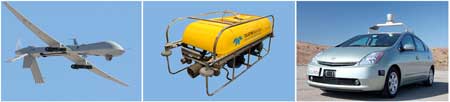
The business of unmanned aerial, underwater and ground vehicles — originally funded by DARPA, NSF and other government-sponsored research programs — and the many ancillary businesses involved — has grown quickly and dramatically. Lobbying for its interests has been well-funded by defense contractors and very successful in advancing the defense side of the industry. Movies show the technologies in use: e.g., the latest Bourne movie has a Predator strike and also a drone making a pickup of materials at a specified location.
But when the focus broadens beyond military budgets, Congress often leads the way to other opportunities. The mandated integration of unmanned systems into the U.S. national airspace by 2015 has many unmanned vehicle manufacturers re-marketing their technology for civilian purposes.
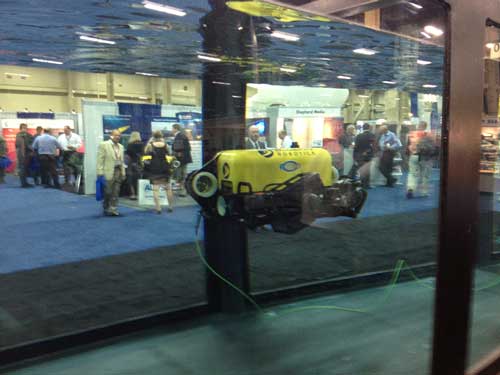 |
| Large tank showing tethered ROV with exhibition hall in background. |
Underwater and ground vehicles are farther along in that process than the aerial segment. This fact is evidenced by the flurry of underwater projects, joint ventures, and acquisitions being undertaken by the oil and gas exploration and mining industries. The recent Schlumberger joint venture with Liquid Robotics is a good example. The initial purpose of the venture will be for surveillance; seep/spill detection; and communications gateway services.
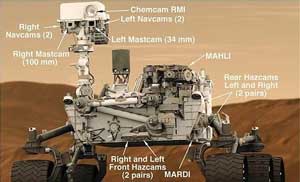
It can also be seen by the steady movement toward driverless trucks and cars by Google and the auto industry and driverless tractors for agri-business. These large-scale projects involve enormous consumer revenues and are overshadowing military UGVs like bomb disposal and military truck convoys and space projects like the Mars rover Curiosity.
Mobile remote presence devices such as iRobot and InTouch Health’s new RP-VITA robot are also taking root and finding multiple uses in the health care sector. iRobot is an example of a robot company diversifying into non-defense endeavors even though their basic research dollars have come from DARPA and the DoD.
 As much as aerial “drones” have been in the news for their surveillance and bombing prowess, unmanned aerial systems (UAS) have not made too much headway toward commercialization because they cannot, at present, fly in civilian airspace and, even if the rules were changed, they still couldn’t fly without serious modifications. A recent $2,000 Research & Markets report on the prospects for the global unmanned aerial vehicle market for the next four years shows only limited growth; 4.28% CAGR through 2015.
Thus interest was high and the questions pointed and serious at the AUVSI (Association for Unmanned Vehicle Systems International) North America’s Conference & Show in Las Vegas this week. Five hundred fifty exhibitor companies manned the show floor and 9,000 industry attendees listened to presentations and strolled the exhibition halls.
 |
| FAA Acting Administrator Michael Huerta |
At the keynote presentation, Michael Huerta, FAA’s Acting Administrator and Leslie Cary, International Civil Aviation Organization (ICOA) Unmanned Aircraft Systems Study Group Secretary, discussed the timing, process and complexities of the Congressional mandate to provide rules, regulations and facilities which would allow unmanned aircraft into the civil airspace by September, 2015.
The consensus of the people I talked with afterwards was that both the FAA and ICAO, although they “talk the talk” of enabling the transition, are far from where they need to be to truly make it happen.
- The FAA, which is currently understaffed and underfunded, has its hands full because they are in the process of changing their technology from 2D to 3D – an immense and complex transition – and are also searching for a new director. They have yet to mention how they plan to regulate and enforce the new rules or how they plan to underwrite and test collision avoidance and communication systems.
- The FAA isn’t the only player in the Congressional mandate and inter-agency issues are complex, political and far-reaching. Also involved are the DoD and the FCC and the international ICAO.
- There were many comments about ICAO’s timetables which extended 10 and 20 years from now, and which certainly trails the American deadline of September, 2015. Their insistence that UASs be remotely piloted with a licensed pilot and individually certified aircraft and ground systems was thought to be too stringent. They coined the term RPAS: Remotely Piloted Aerial Systems. The one decision ICAO has made is that model aircraft will not be covered in their new rules even though these aircraft could hinder the airspace.
Because UAS technology is here to stay and will only grow in size, there are steps being taken to comply with what the industry expects the rules to be. These include setting up multiple-state UAS testing centers and establishing two new schools for unmanned flight training, one in the US and the other in Europe. These new entities will be able to customize their curricula and procedures to prepare their clients for various licensing and certification requirements once they are established by the FAA and ICAO.
Along the line of making changes that are inevitable, the International Association of Chiefs of Police (IACP) adopted guidelines for the use of unmanned aircraft systems by law enforcement agencies. The guidelines provide an outline of how to use UAS safely and responsibly and with respect to individuals’ privacy. The adoption of the IACP guidelines follows the recent adoption of AUVSI’s “Code of Conduct” for those who design, test and operate UAS.
Industry executives know they will have to change from the loose and unusually permissive regulatory situation they have had up until now. As the war in Afghanistan scales down, a portion of the industry’s forward-thinking companies are focusing on commercializing their product lines and are attempting to wean themselves away from defense contracts even though there will still be a large business in the civilian first-responder marketplace.
Also, since most of the current UASs do not have the systems or maneuverability to safely fly in civilian airspace, the industry needs to enhance its products to be more robust, incorporate redundant systems, situational awareness and other collision avoidance sensors and communication systems. These are not insignificant modifications and there have been a few notable recent incidents of lost-link and mid-air collisions, including the recent clamor when a UAV lost its link and was on a direct course for Washington, DC. Present-day payload systems used in manned aircraft, although very capable, are also big and heavy. They will need to be miniaturized in order to be able to fit into the limited payload capacities of UASs.
A Few Companies Transitioning to the Civilian Marketplace
Here are a few of the companies transitioning to the civilian marketplace:
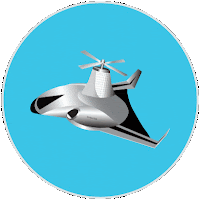 |
| Canadian start-up Eqquera UAVs for forest fire fighting and tanker operations. |
- AeroVironment’s has repurposed it’s Qube portable UAV for use in public safety applications such as law enforcement and first response. The system provides a portable aerial vantage point to help public safety workers perform their duties more safely and effectively.
- Canadian start-up Eqquera demonstrated their novel and creatively designed UASs for forest fire fighting and nuclear and arctic surveillance.
- HDT and The Johns Hopkins University presented their MK2 robotic arm for rehab purposes and a two-armed version with significant torque and lift capabilities for general purpose shop and factory work.
- i2Tech, one of many electronic and vision systems providers at the show, has a line of light weight, low-power, stabilized camera and thermal imaging systems for health care, industrial testing and surveillance.
- Both Kairos Autonomy and Brock Technologies have low-cost kits which are able to convert any existing ground vehicle into an unmanned system and Autonomous Solutions just received a patent for a kit-based autonomous clip-on tethered unmanned convoy system.
- Israel’s RoboTeam‘s multi-purpose line of mobile tactical ground robots were described as solutions for homeland security and public safety.
- MDL‘s displayed their tiny 43-gram USB-powered micro laser module for distance metering.
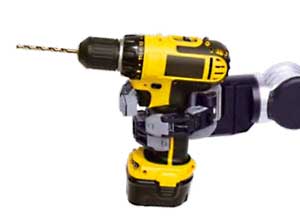
- HDT, a predominately military provider, is partnering with Johns Hopkins University Applied Physics Lab to build advanced prosthetic and robotic health care prototype systems. At the show they displayed their two-armed MK-2 robot, a portable, lightweight and reasonably-priced device with high torque and lift capabilities capable of holding and using portable hand tools.
- Many additive 3D printing systems had booths and showed how their machines were able to work with exotic metal substances and to provide specialized capabilities well beyond the MakerBot 3D printers we all know and love:
- ExOne Digital Part Materialization
- Harvest Technologies Stereo Lithography
- Morris Technologies additive metal manufacturing
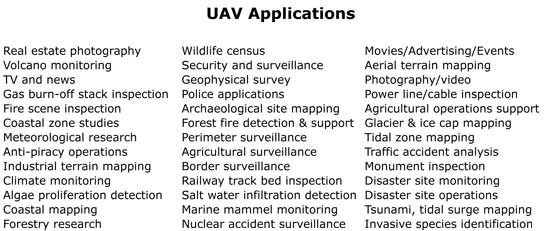
- Finally, TOR Robotics provided a long list of civilian uses for their quad-copter that are also valid for the whole UAS industry:
This year’s AUVSI show was transitional in the sense that the majority of the exhibitor’s businesses has come from governments around the world, and those governments —like the U.S. — are facing significant cuts in spending. Hence the need to step up the lobbying to keep spending high (as appears to be the case of the large aerospace conglomerates), or seek ways to modify products and transition to the commercial marketplace (as can be seen by the short list of companies described above).


Tell Us What You Think!