The Robot Report

  • Home
  • News
  • Technologies
    • Batteries / Power Supplies
    • Cameras / Imaging / Vision
    • Controllers
    • End Effectors
    • Microprocessors / SoCs
    • Motion Control
    • Sensors
    • Soft Robotics
    • Software / Simulation
  • Development
    • Artificial Intelligence
    • Human Robot Interaction / Haptics
    • Mobility / Navigation
    • Research
  • Robots
    • AGVs
    • AMRs
    • Consumer
    • Collaborative Robots
    • Drones
    • Humanoids
    • Industrial
    • Self-Driving Vehicles
    • Unmanned Maritime Systems
  • Business
    • Financial
      • Investments
      • Mergers & Acquisitions
      • Earnings
    • Markets
      • Agriculture
      • Healthcare
      • Logistics
      • Manufacturing
      • Mining
      • Security
    • RBR50
      • RBR50 Winners 2025
      • RBR50 Winners 2024
      • RBR50 Winners 2023
      • RBR50 Winners 2022
      • RBR50 Winners 2021
  • Resources
    • Automated Warehouse Research Reports
    • Digital Issues
    • eBooks
    • Publications
      • Automated Warehouse
      • Collaborative Robotics Trends
    • Search Robotics Database
    • Videos
    • Webinars / Digital Events
  • Events
    • RoboBusiness
    • Robotics Summit & Expo
    • DeviceTalks
    • R&D 100
    • Robotics Weeks
  • Podcast
    • Episodes
  • Advertise
  • Subscribe

Sortera uses physical AI to double capacity in a Tennessee sorting facility

By The Robot Report Staff | May 24, 2026

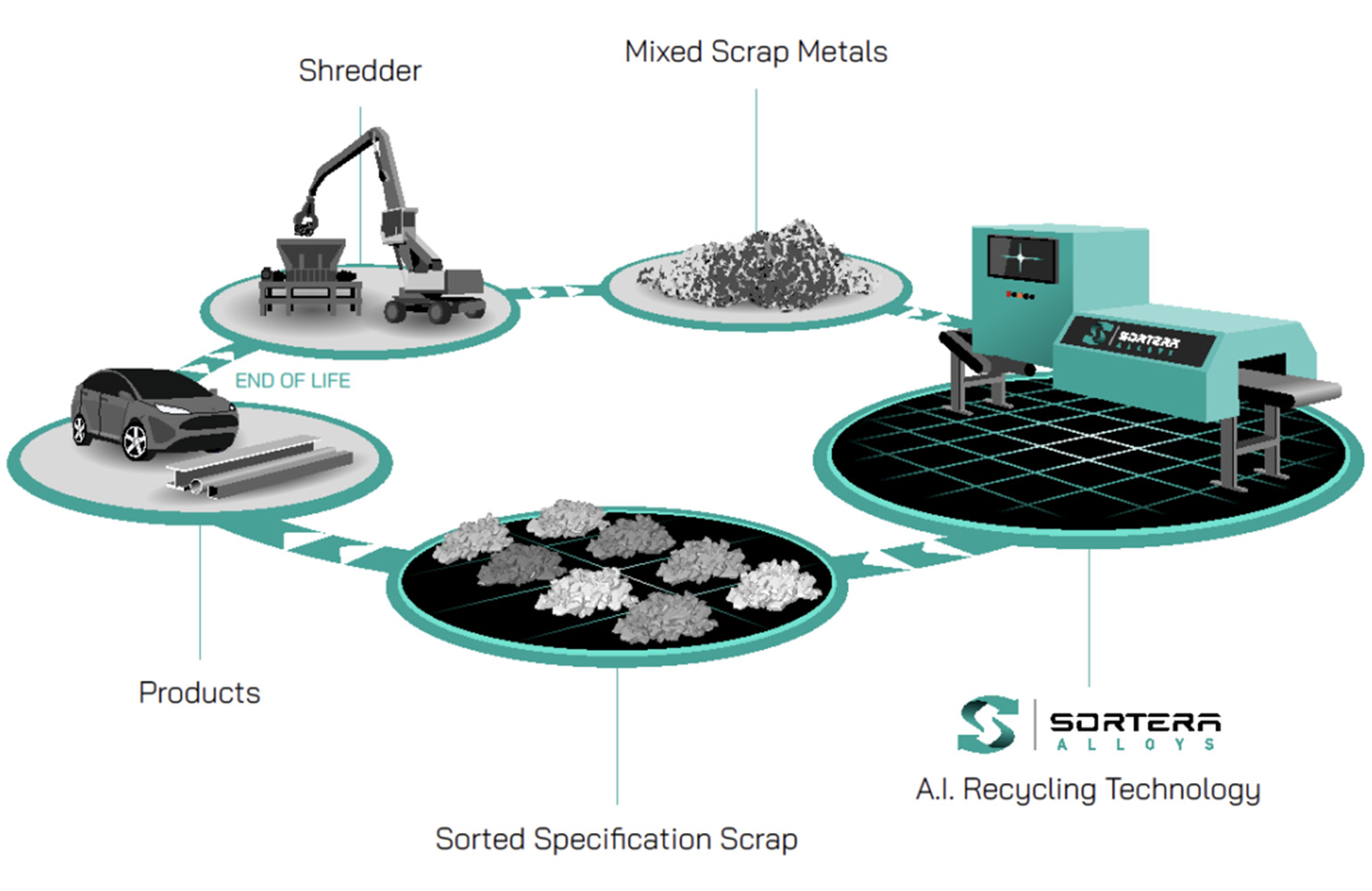
Sortera creates recycled metal fractions from existing scrap recycling streams, enabling the domestic production of metals for manufacturing.

Sortera creates recycled fractions from existing scrap streams, enabling the domestic production of metals for manufacturing. | Source: Sortera Technologies

Sortera Technologies Inc. announced that its second state-of-the-art processing facility in Lebanon, Tenn., is moving into full operational status this month. The company developed an upcycling platform powered by artificial intelligence, data analytics, and advanced sensors.

With the new facility, Sortera has increased its annual processing capacity to an estimated 240 million lb. (108.8 million kg). This includes the company‘s success with its flagship facility in Markle, Ind.

“The performance of our Markle facility proved there is strong appetite for sustainable, high-quality recycled aluminum,” said Michael Siemer, CEO of Sortera Technologies. “By bringing our Lebanon operation online, we are meeting that demand head-on—effectively doubling our capacity and providing a streamlined, localized supply chain for our regional customers. Optimizing our high-speed sorting lines here in Tennessee ensures our partners receive the highest purity feedstock with maximum efficiency and minimal environmental impact.”

The facility utilizes Sortera’s proprietary AI-driven sorting technology to transform mixed alloy scrap into high-value materials for the automotive, construction, and aerospace industries. This keeps critical materials within the U.S. economy, reducing reliance on international imports and volatile global markets, Sortera said.

Sortera replicates success with Markle facility

https://www.therobotreport.com/wp-content/uploads/2026/05/us_manufacturing_sortera-cut.mp4

The Lebanon operation mirrors the advanced capabilities of Sortera’s Markle facility, which has demonstrated how mixed scrap can be reclaimed for critical domestic applications. Historically, mixed scrap is downgraded or shipped overseas.

The company said that benefits of its upcycled metals include:

  • Energy efficiency: Using approximately 95% less energy than virgin aluminum production
  • Carbon reduction: Providing a massive reduction in the CO₂ footprint for Sortera’s partners, supporting their 2030 and 2040 sustainability goals
  • Strategic logistics: Reducing transport emissions and costs by providing high-quality recycled content directly to regional manufacturers

“Bringing the Lebanon facility to full operational status is a testament to our team’s ability to scale this complex technology rapidly,” said Ben Pope, chief operating officer of Sortera Technologies. “This facility represents the next evolution of our operational footprint, building a more robust, domestic infrastructure that can support the rapid growth of sustainable manufacturing in North America.”

The Lebanon site achieved full operational status both on schedule and within budget. Sortera said the materials recovery facility demonstrated the maturity of its AI-powered platform, successfully producing sellable, high-purity material within its first week of operation.

This transition from installation to production proved that the company can rapidly deploy its technology to meet urgent market requirements without the typical delays associated with complex industrial commissions, Sortera said.



SITE AD for the 2026 Robotics Summit save the date.

Tell Us What You Think! Cancel reply

This site uses Akismet to reduce spam. Learn how your comment data is processed.

Related Articles Read More >

HAilo provides processors for edge AI devices such as robots.
The future of physical AI isn’t humanoid; it’s task-specific and cost-efficient
headshot of chris elston and the podcast logo.
Exploring PLC and robot integration with YRG Robotics’ Chris Elston
Brain Corp and UC San Diego are creating a contextual grounding layer for robot autonomy.
Brain Corp partners with UC San Diego to help robots operate in complex environments
By working with Google, FANUC hopes to blend proven automation with cutting-edge AI to deliver smarter, more adaptive robots for modern manufacturing environments.
FANUC partners with Google to advance physical AI in its robots

RBR50 Innovation Awards

“2026”
“rr
EXPAND YOUR KNOWLEDGE AND STAY CONNECTED
Get the latest info on technologies, tools and strategies for Robotics Professionals.

Latest Episode of The Robot Report Podcast

Automated Warehouse Research Reports

Sponsored Content

  • The Convergence in Perception Systems from Cars to Robots
  • How humanoids learn to read the room
  • GMSL and the growing ecosystem around robotic vision systems
  • The Evolution of Vision Connectivity in Robotics: From USB and Ethernet to GMSL
  • Architecting Reliability: How GMSL Diagnostics Enable Robust Vision
The Robot Report
  • Automated Warehouse
  • RoboBusiness Event
  • Robotics Summit & Expo
  • About The Robot Report
  • Subscribe
  • Contact Us

Copyright © 2026 WTWH Media LLC. All Rights Reserved. The material on this site may not be reproduced, distributed, transmitted, cached or otherwise used, except with the prior written permission of WTWH Media
Privacy Policy | Advertising | About Us

Search The Robot Report

  • Home
  • News
  • Technologies
    • Batteries / Power Supplies
    • Cameras / Imaging / Vision
    • Controllers
    • End Effectors
    • Microprocessors / SoCs
    • Motion Control
    • Sensors
    • Soft Robotics
    • Software / Simulation
  • Development
    • Artificial Intelligence
    • Human Robot Interaction / Haptics
    • Mobility / Navigation
    • Research
  • Robots
    • AGVs
    • AMRs
    • Consumer
    • Collaborative Robots
    • Drones
    • Humanoids
    • Industrial
    • Self-Driving Vehicles
    • Unmanned Maritime Systems
  • Business
    • Financial
      • Investments
      • Mergers & Acquisitions
      • Earnings
    • Markets
      • Agriculture
      • Healthcare
      • Logistics
      • Manufacturing
      • Mining
      • Security
    • RBR50
      • RBR50 Winners 2025
      • RBR50 Winners 2024
      • RBR50 Winners 2023
      • RBR50 Winners 2022
      • RBR50 Winners 2021
  • Resources
    • Automated Warehouse Research Reports
    • Digital Issues
    • eBooks
    • Publications
      • Automated Warehouse
      • Collaborative Robotics Trends
    • Search Robotics Database
    • Videos
    • Webinars / Digital Events
  • Events
    • RoboBusiness
    • Robotics Summit & Expo
    • DeviceTalks
    • R&D 100
    • Robotics Weeks
  • Podcast
    • Episodes
  • Advertise
  • Subscribe