The Robot Report

  • Home
  • News
  • Technologies
    • Batteries / Power Supplies
    • Cameras / Imaging / Vision
    • Controllers
    • End Effectors
    • Microprocessors / SoCs
    • Motion Control
    • Sensors
    • Soft Robotics
    • Software / Simulation
  • Development
    • Artificial Intelligence
    • Human Robot Interaction / Haptics
    • Mobility / Navigation
    • Research
  • Robots
    • AGVs
    • AMRs
    • Consumer
    • Collaborative Robots
    • Drones
    • Humanoids
    • Industrial
    • Self-Driving Vehicles
    • Unmanned Maritime Systems
  • Business
    • Financial
      • Investments
      • Mergers & Acquisitions
      • Earnings
    • Markets
      • Agriculture
      • Healthcare
      • Logistics
      • Manufacturing
      • Mining
      • Security
    • RBR50
      • RBR50 Winners 2025
      • RBR50 Winners 2024
      • RBR50 Winners 2023
      • RBR50 Winners 2022
      • RBR50 Winners 2021
  • Resources
    • Automated Warehouse Research Reports
    • Digital Issues
    • eBooks
    • Publications
      • Automated Warehouse
      • Collaborative Robotics Trends
    • Search Robotics Database
    • Videos
    • Webinars / Digital Events
  • Events
    • RoboBusiness
    • Robotics Summit & Expo
    • DeviceTalks
    • R&D 100
    • Robotics Weeks
  • Podcast
    • Episodes
  • Advertise
  • Subscribe

Roach-inspired robot shares insect’s speed, toughness

By Kara Manke | August 4, 2019

If the sight of a skittering bug makes you squirm, you may want to look away — a new insect-sized robot created by researchers at the University of California, Berkeley, can scurry across the floor at nearly the speed of a darting cockroach. And it’s nearly as hardy as a roach is. Try to squash this robot under your foot, and more than likely, it will just keep going.

“Most of the robots at this particular small scale are very fragile. If you step on them, you pretty much destroy the robot,” said Liwei Lin, a professor of mechanical engineering at UC Berkeley and senior author of a new study that describes the robot. “We found that if we put weight on our robot, it still more or less functions.”

Small-scale robots like these could be advantageous in search-and-rescue missions, squeezing and squishing into places where dogs or humans can’t fit, or where it may be too dangerous for them to go, said Yichuan Wu, first author of the paper, who completed the work as a graduate student in mechanical engineering at UC Berkeley through the Tsinghua-Berkeley Shenzhen Institute partnership.

“For example, if an earthquake happens, it’s very hard for the big machines, or the big dogs, to find life underneath debris, so that’s why we need a small-sized robot that is agile and robust,” said Wu, who is now an assistant professor at the University of Electronic Science and Technology of China.

The study appears this week in the journal Science Robotics.

PVDF provides roach-like characteristics

The robot, which is about the size of a large postage stamp, is made of a thin sheet of a piezoelectric material called polyvinylidene fluoride, or PVDF. Piezoelectric materials are unique, in that applying electric voltage to them causes the materials to expand or contract.
UC Berkeley roach robot

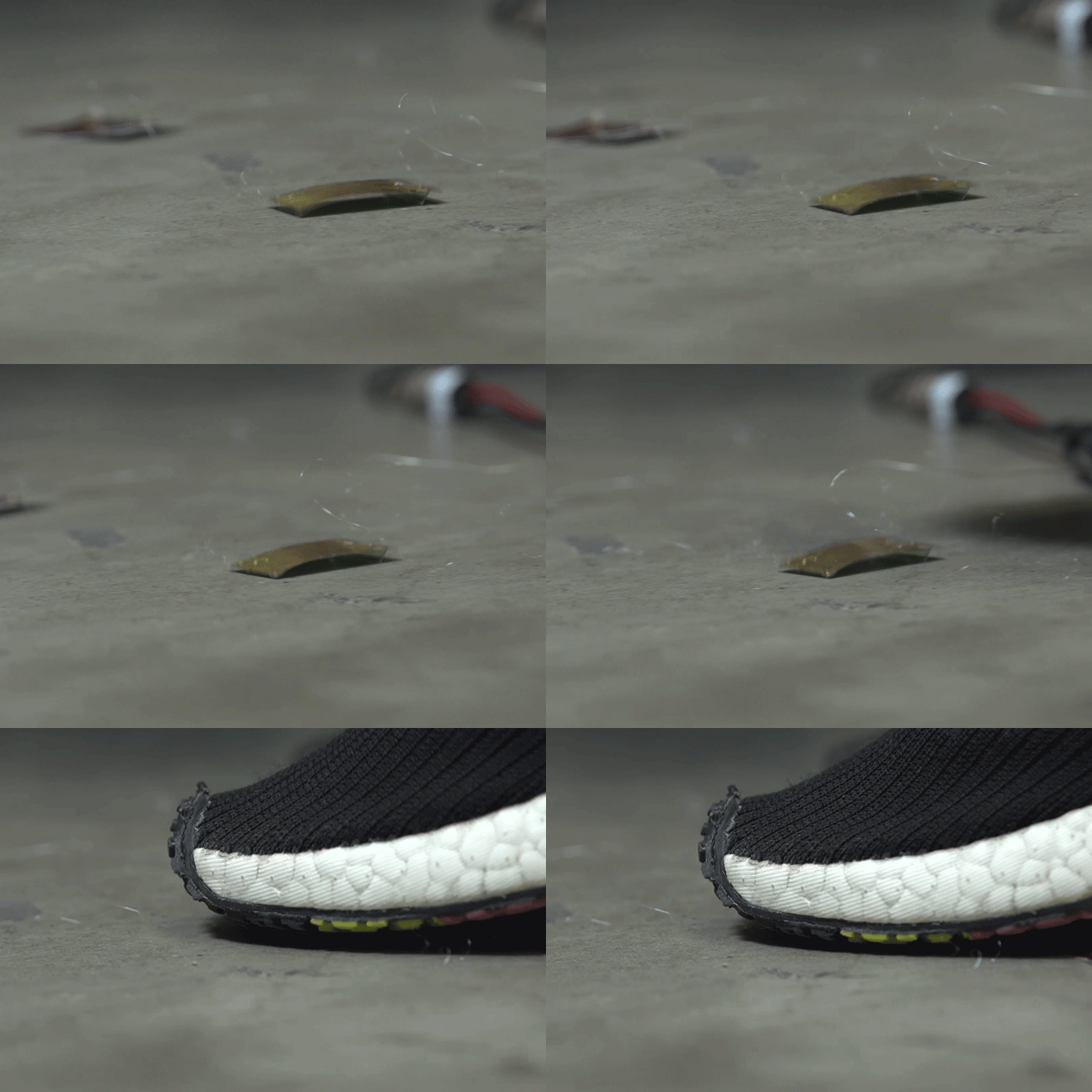
The robot is built of a layered material that bends and straightens when AC voltage is applied, causing it to spring forward in a “leapfrogging” motion. Credit: UC Berkeley video and photo by Stephen McNally

The researchers coated the PVDF in a layer of an elastic polymer, which causes the entire sheet to bend, instead of to expand or contract. They then added a front leg so that, as the material bends and straightens under an electric field, the oscillations propel the device forward in a “leapfrogging” motion.

The resulting robot may be simple to look at, but it has some remarkable abilities. It can sail along the ground at a speed of 20 body lengths per second, a rate comparable to that of a roach and reported to be the fastest pace among insect-scale robots. It can zip through tubes, climb small slopes, and carry small loads, such as a peanut.

Perhaps most impressively, the robot, which weighs less than one tenth of a gram, can withstand a weight of around 60kg [132 lb.] — about the weight of an average human — which is approximately 1 million times the weight of the robot.

“People may have experienced that, if you step on the cockroach, you may have to grind it up a little bit, otherwise the cockroach may still survive and run away,” Lin said. “Somebody stepping on our robot is applying an extraordinarily large weight, but [the robot] still works, it still functions. So, in that particular sense, it’s very similar to a cockroach.”

The robot is currently “tethered” to a thin wire that carries an electric voltage that drives the oscillations. The team is experimenting with adding a battery so the roach robot can roam independently. They are also working to add gas sensors and are improving the design of the robot so it can be steered around obstacles.

Co-authors of the paper include Justin K. Yim, Zhichun Shao, Mingjing Qi, Junwen Zhong, Zihao Luo, Ronald S. Fearing and Robert J. Full of UC Berkeley, Xiaojun Yan of Beihang University and Jiaming Liang, Min Zhang and Xiaohao Wang of Tsinghua University.

This work is supported in part by the Berkeley Sensor and Actuator Center, an Industry-University Cooperation Research Center.

Editor’s note: This article republished from the University of California, Berkeley.

Tell Us What You Think! Cancel reply

This site uses Akismet to reduce spam. Learn how your comment data is processed.

Related Articles Read More >

The MobED platform from Hyundai Motor Group can operate inside and outside.
Hyundai Motor Group unveils its first mass-produced mobility robot platform
Logos of sponsors MassRobotics, AWS, and NVIDIA. Applications are open for the second Physical AI Fellowship cohort.
MassRobotics expands physical AI fellowship with AWS and NVIDIA
A humanoid robot carrying a box in an automated facility.
Popular AI models aren’t ready to safely run robots, say CMU researchers
The FANUC LR Mate 200iD industrial robot arm, shown here, includes miniaturized components for agility.
How miniaturization is making robots smarter and more autonomous

RBR50 Innovation Awards

“rr
EXPAND YOUR KNOWLEDGE AND STAY CONNECTED
Get the latest info on technologies, tools and strategies for Robotics Professionals.

Latest Episode of The Robot Report Podcast

Automated Warehouse Research Reports

Sponsored Content

  • Supporting the future of medical robotics with smarter motor solutions
  • YUAN Unveils Next-Gen AI Robotics Powered by NVIDIA for Land, Sea & Air
  • ASMPT chooses Renishaw for high-quality motion control
  • Revolutionizing Manufacturing with Smart Factories
  • How to Set Up a Planetary Gear Motion with SOLIDWORKS
The Robot Report
  • Automated Warehouse
  • RoboBusiness Event
  • Robotics Summit & Expo
  • About The Robot Report
  • Subscribe
  • Contact Us

Copyright © 2025 WTWH Media LLC. All Rights Reserved. The material on this site may not be reproduced, distributed, transmitted, cached or otherwise used, except with the prior written permission of WTWH Media
Privacy Policy | Advertising | About Us

Search The Robot Report

  • Home
  • News
  • Technologies
    • Batteries / Power Supplies
    • Cameras / Imaging / Vision
    • Controllers
    • End Effectors
    • Microprocessors / SoCs
    • Motion Control
    • Sensors
    • Soft Robotics
    • Software / Simulation
  • Development
    • Artificial Intelligence
    • Human Robot Interaction / Haptics
    • Mobility / Navigation
    • Research
  • Robots
    • AGVs
    • AMRs
    • Consumer
    • Collaborative Robots
    • Drones
    • Humanoids
    • Industrial
    • Self-Driving Vehicles
    • Unmanned Maritime Systems
  • Business
    • Financial
      • Investments
      • Mergers & Acquisitions
      • Earnings
    • Markets
      • Agriculture
      • Healthcare
      • Logistics
      • Manufacturing
      • Mining
      • Security
    • RBR50
      • RBR50 Winners 2025
      • RBR50 Winners 2024
      • RBR50 Winners 2023
      • RBR50 Winners 2022
      • RBR50 Winners 2021
  • Resources
    • Automated Warehouse Research Reports
    • Digital Issues
    • eBooks
    • Publications
      • Automated Warehouse
      • Collaborative Robotics Trends
    • Search Robotics Database
    • Videos
    • Webinars / Digital Events
  • Events
    • RoboBusiness
    • Robotics Summit & Expo
    • DeviceTalks
    • R&D 100
    • Robotics Weeks
  • Podcast
    • Episodes
  • Advertise
  • Subscribe