The Robot Report

  • Home
  • News
  • Technologies
    • Batteries / Power Supplies
    • Cameras / Imaging / Vision
    • Controllers
    • End Effectors
    • Microprocessors / SoCs
    • Motion Control
    • Sensors
    • Soft Robotics
    • Software / Simulation
  • Development
    • Artificial Intelligence
    • Human Robot Interaction / Haptics
    • Mobility / Navigation
    • Research
  • Robots
    • AGVs
    • AMRs
    • Consumer
    • Collaborative Robots
    • Drones
    • Humanoids
    • Industrial
    • Self-Driving Vehicles
    • Unmanned Maritime Systems
  • Business
    • Financial
      • Investments
      • Mergers & Acquisitions
      • Earnings
    • Markets
      • Agriculture
      • Healthcare
      • Logistics
      • Manufacturing
      • Mining
      • Security
    • RBR50
      • RBR50 Winners 2025
      • RBR50 Winners 2024
      • RBR50 Winners 2023
      • RBR50 Winners 2022
      • RBR50 Winners 2021
  • Resources
    • Automated Warehouse Research Reports
    • Digital Issues
    • eBooks
    • Publications
      • Automated Warehouse
      • Collaborative Robotics Trends
    • Search Robotics Database
    • Videos
    • Webinars / Digital Events
  • Events
    • RoboBusiness
    • Robotics Summit & Expo
    • DeviceTalks
    • R&D 100
    • Robotics Weeks
  • Podcast
    • Episodes
  • Advertise
  • Subscribe

Perseverance collects its first dirt sample on Mars

By Brianna Wessling | December 14, 2022

perseverance rover

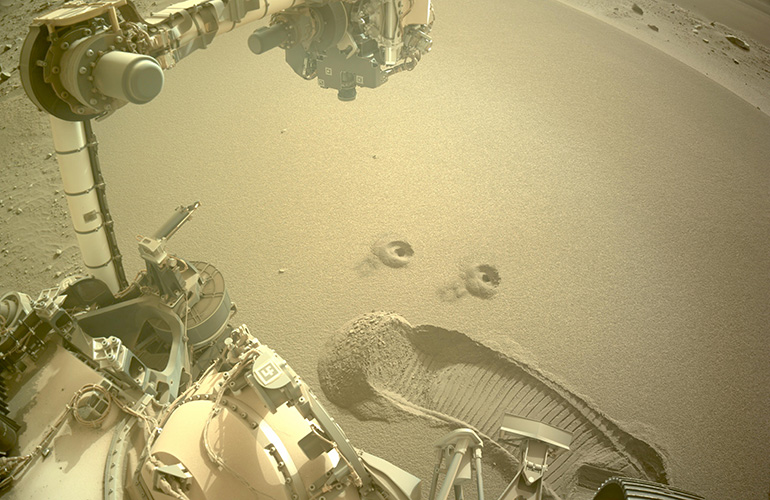
Two holes on the Martian surface where Perseverance took its regolith samples. | Source: NASA/JPL-Caltech

NASA’s Perseverance Rover recently collected its first two samples of regolith, broken-up rock and dust, on Mars. The samples were collected on December 2 and 6 from a pile of windblown sand, setting it apart from the 15 rock samples Perseverance has already gathered. 

Regolith presents NASA’s scientists with unique information about the red planet. Generally, Perseverance’s job on Mars is to collect samples from the red planet that could eventually be sent back to Earth for scientists to study. In particular, NASA is looking for signs of ancient microbial life on the planet. 

Regolith will provide unique insights into geological processes on the planet and how the environment on Mars has developed. Martian regolith could also be invaluable for NASA’s engineers. Regolith can have an effect on any equipment sent to another planet, whether it be spacesuits or solar panels. For example, during the Apollo missions, scientists found that Lunar regolith was sharp enough to tear microscopic holes in space suits. 

Knowing more about the makeup of Martian regolith will help NASA’s engineers better understand how to prepare for it and how to plan longer-term missions on Mars. While regolith could be useful packed against a habitat to protect astronauts from radiation, areas of the Martian surface contain perchlorate, a toxic chemical that isn’t safe for the astronauts to inhale in large amounts. 

“If we have a more permanent presence on Mars, we need to know how the dust and regolith will interact with our spacecraft and habitats,” Perseverance team member Erin Gibbons, a McGill University doctoral candidate who uses Mars regolith simulants as part of her work with the rover’s rock-vaporizing laser, said.

Perseverance collected the samples using a drill on the end of its robotic arm. To collect the regolith, the rover used a drill bit that looks like a spike with smaller holes on one end instead of its typical drill bits for extracting rock samples. This drill bit was specially designed and tested with simulated regolith, made with volcanic rock crushed to a variety of particle sizes. 

The rover is keeping the regolith samples in special metal collection tubes, one of which will be considered for deposit on the Martian surface sometime this month as part of the Mars Sample Return (MSR) campaign. 

The rover has already started scouting for good spots for the MSR campaign to land. NASA plans to launch its Earth Return Orbiter in the fall of 2027 and its Sample Retrieval Lander in the summer of 2028. The lander is expected to make it to the surface of Mars in 2030. If all goes well, the samples should return to Earth in 2033. 

Below you can interact with a map of the rover’s journey on Mars so far, and the locations it has collected samples. 

About The Author

Brianna Wessling

Brianna Wessling is an Associate Editor, Robotics, WTWH Media. She joined WTWH Media in November 2021, after graduating from the University of Kansas with degrees in Journalism and English. She covers a wide range of robotics topics, but specializes in women in robotics, robotics in healthcare, and space robotics.

She can be reached at [email protected]

Tell Us What You Think! Cancel reply

This site uses Akismet to reduce spam. Learn how your comment data is processed.

Related Articles Read More >

CivNav works with existing solar equipment such as this loader, says Civ Robotics.
Civ Robotics provides CivNav AI navigation for solar construction systems
Melonee Wise headshot.
Melonee Wise to lead KUKA’s new software and AI organization
Festo has developed its soft gripper to be sold as components, shown here, or as an entire system.
Festo designs HPSX compliant gripper to meet industry requirements
A collaborative robot working in a lab.
IEEE survey sheds light on how AI and humanoids will affect robotics in 2026

RBR50 Innovation Awards

“rr
EXPAND YOUR KNOWLEDGE AND STAY CONNECTED
Get the latest info on technologies, tools and strategies for Robotics Professionals.

Latest Episode of The Robot Report Podcast

Automated Warehouse Research Reports

Sponsored Content

  • Supporting the future of medical robotics with smarter motor solutions
  • YUAN Unveils Next-Gen AI Robotics Powered by NVIDIA for Land, Sea & Air
  • ASMPT chooses Renishaw for high-quality motion control
  • Revolutionizing Manufacturing with Smart Factories
  • How to Set Up a Planetary Gear Motion with SOLIDWORKS
The Robot Report
  • Automated Warehouse
  • RoboBusiness Event
  • Robotics Summit & Expo
  • About The Robot Report
  • Subscribe
  • Contact Us

Copyright © 2025 WTWH Media LLC. All Rights Reserved. The material on this site may not be reproduced, distributed, transmitted, cached or otherwise used, except with the prior written permission of WTWH Media
Privacy Policy | Advertising | About Us

Search The Robot Report

  • Home
  • News
  • Technologies
    • Batteries / Power Supplies
    • Cameras / Imaging / Vision
    • Controllers
    • End Effectors
    • Microprocessors / SoCs
    • Motion Control
    • Sensors
    • Soft Robotics
    • Software / Simulation
  • Development
    • Artificial Intelligence
    • Human Robot Interaction / Haptics
    • Mobility / Navigation
    • Research
  • Robots
    • AGVs
    • AMRs
    • Consumer
    • Collaborative Robots
    • Drones
    • Humanoids
    • Industrial
    • Self-Driving Vehicles
    • Unmanned Maritime Systems
  • Business
    • Financial
      • Investments
      • Mergers & Acquisitions
      • Earnings
    • Markets
      • Agriculture
      • Healthcare
      • Logistics
      • Manufacturing
      • Mining
      • Security
    • RBR50
      • RBR50 Winners 2025
      • RBR50 Winners 2024
      • RBR50 Winners 2023
      • RBR50 Winners 2022
      • RBR50 Winners 2021
  • Resources
    • Automated Warehouse Research Reports
    • Digital Issues
    • eBooks
    • Publications
      • Automated Warehouse
      • Collaborative Robotics Trends
    • Search Robotics Database
    • Videos
    • Webinars / Digital Events
  • Events
    • RoboBusiness
    • Robotics Summit & Expo
    • DeviceTalks
    • R&D 100
    • Robotics Weeks
  • Podcast
    • Episodes
  • Advertise
  • Subscribe